The limits of the Asian NATO analogy: European and Indo-Pacific security architectures
The Limits of the Asian NATO Analogy: European and Indo-Pacific Security Architectures
WRITTEN BY TAKUMA MATSU AND DR. PAWEŁ BEHRENDT
11 November 2026
The idea of an “Asian NATO” has re-emerged in recent years as policymakers and analysts search for ways to strengthen security cooperation in the Indo-Pacific. In Japan, the issue gained renewed attention following former Prime Minister Shigeru Ishiba’s 2024 collective-defense proposal, which raised substantial questions about its political and institutional feasibility. Developments such as closer cooperation between NATO and its four Indo-Pacific partners — Australia, Japan, New Zealand, and South Korea, also known as the IP4 — have further fuelled discussion about whether Europe’s security model could be applied to Asia.
But the NATO analogy can obscure what is actually happening in the region. Europe and the Indo-Pacific are responding to similar pressures, but from very different starting points. Europe is reforming an established, institutionalised alliance centred on NATO. The Indo-Pacific, by contrast, is gradually layering increasingly flexible forms of cooperation onto a hub-and-spoke system of bilateral US alliances. While the US is central to both systems, its role in each takes different forms. The region’s security architecture has therefore followed a different path, shaped by geography, strategic conditions, political diversity, and the legacy of the US alliance system.
Europe’s institutionalised security order under pressure
NATO’s role in Europe has long been summarised by the familiar phrase, “keep the Americans in, the Germans down, and the Soviets out”. Following World War II, Western Europe lacked the capacity to protect itself from the Soviet Union. Washington therefore decided to maintain its military presence temporarily to avoid having to intervene in another global conflict starting in Europe. Once European allies had rebuilt their capabilities, American forces were expected to be significantly reduced.
The situation changed in the early 1990s. The collapse of the Soviet Union and dissolution of the Warsaw Pact created a security void in Central and Eastern Europe. The region’s future was uncertain, raising fears that Russia might suffer the same fate as Yugoslavia. It was also unclear how far Russia would go to maintain its dominance. Meanwhile, German reunification also revived fears about a resurgence of German expansionism and renewed ambitions to dominate the continent. Against this backdrop, NATO expanded eastward and, alongside EU integration, become central to Europe’s institutionalised security order. By 2010, much of Europe was embedded in a dual system in which the EU provided economic opportunities, NATO provided security, and the US underwrote the whole arrangement.
This dual system also created vulnerabilities. The post-Cold War “peace dividend” and reliance on US security guarantees encouraged European states to reduce defence spending. Furthermore, since the Cold War, militaries had increasingly developed as auxiliaries to US forces with joint planning, logistics, and interoperability. During the War on Terror, Washington further encouraged European allies to reorganise their forces for expeditionary operations. As a result, their abilities to participate in a full-scale conflict and defend their own territory significantly declined.
The Indo-Pacific is unlikely to follow Europe’s institutional trajectory. Rather than shifting toward a NATO analogue, it is developing a layered security architecture built on bilateral alliances and functional minilateral arrangements.
Pressure to reform the European security system gradually intensified. The Obama administration identified China as the main challenger to US primacy and urged European allies to take greater responsibility for their defence. In Washington, a growing perception emerged that weak allies were a burden rather than an asset. This view has grown stronger under the Trump administration, which plans to reduce US military presence in Europe.
A resurgent Russia seeking to shape the European security order in its favour increased the urgency for reform. This process began with the annexation of Crimea in 2014 and culminated with the ultimatum to NATO in December 2021 and the subsequent invasion of Ukraine. The invasion, combined with Trump’s return to office, finally spurred Europe to seriously rethink its security.
Although the expansion of EU security obligations could address European concerns, most member states prefer the US-led NATO framework. France’ concept of strategic autonomy remains too vague to offer a viable alternative, while the lack of consensus over the EU’s future constrains Brussels' ambitions. NATO provides a clear, well-defined, and time-tested framework for collective defence, and the US nuclear arsenal is much larger and more diverse than the nuclear assets of France and the UK. Furthermore, EU security ambitions are often seen as parallel to NATO, creating the risk of overlap, competition, and waste. Previous attempts at European security arrangements outside of NATO, such as rapid reaction battle groups and the European Intervention Initiative, have failed to overcome these challenges.
From hub-and-spoke to functional networks in the Indo-Pacific
Unlike Europe, the Indo-Pacific did not develop a durable collective defence organisation comparable to NATO after World War II. Attempts such as the Southeast Asia Treaty Organisation (SEATO) had limited participation and institutional capacity, failing to evolve into a lasting regional security framework. At the same time, many Asian states pursued strategic autonomy, non-alignment, or ASEAN-centric approaches to regional security. This reflected a region marked by political diversity, differing threat perceptions, and varying approaches to alignment.
These enduring differences, alongside limited willingness to accept binding security commitments, continue to make an Asian NATO unlikely. The Indo-Pacific is vast, largely maritime, and operationally dispersed. While some states such as Japan and the Philippines increasingly regard China as the region’s principal security challenge, others, including Vietnam and Malaysia, seek to balance security concerns with deep economic ties with Beijing. India continues to emphasise strategic autonomy, while ASEAN members generally remain sceptical of exclusive military blocs. Japan, despite its expanding security role, faces constitutional and political constraints on the use of force that limit the scope and political feasibility of its security commitments.
These differences help explain the appeal of functional minilateralism. Rather than requiring agreement on a single threat or binding collective-defence commitments, it allows states to cooperate selectively where their interests and capabilities overlap. Functional minilateralism takes the form of small-group security arrangements in which participation, institutional arrangements, and operational cooperation are determined primarily by the security function to be performed rather than by permanent membership or comprehensive political alignment.
This pattern is visible across several regional initiatives. The Quad emphasises maritime domain awareness, technology, resilience, and capacity-building. AUKUS focuses more narrowly on advanced defence capabilities and sensitive technology sharing. Japan–US–Australia and Japan–US–Philippines cooperation have strengthened interoperability, maritime security, and deterrence. Other arrangements address practical issues such as sanctions enforcement, logistics, cybersecurity, critical infrastructure protection, and supply-chain resilience. The Enforcement Coordination Cell (ECC), established to coordinate multinational sanctions enforcement activities against North Korea, illustrates how states can cooperate around a narrowly defined operational objective without creating a permanent regional security organisation or requiring broad political alignment among all participants.
Washington remains the connective tissue of this architecture, but rather than replacing bilateral alliances with a regional institution, it has linked allies and partners through practical, function-specific initiatives. What is emerging is a networked security architecture in which bilateral alliances provide the foundation and minilateral arrangements add flexibility, rather than an Asian version of NATO. This approach allows regional states to cooperate without forcing them into a single, comprehensive alliance framework. Although less institutionally coherent than NATO, it is better suited to a region where geography, threat perceptions, and political constraints differ widely.
The United States as the key enabler
NATO remains the backbone of European security, and the US is indispensable for defence of the continent. Despite growing transatlantic friction, no European state can replace Washington's role. French or German leadership is still politically sensitive, especially with the rise of right-wing populist parties in both countries, and a common European Army under the EU remains an illusion. Despite calls for more burden-sharing, only the US can provide crucial C5ISR (Command, Control, Communications, Computers, Cyber, Intelligence, Surveillance, and Reconnaissance) capabilities and corps- and army-level command at scale. Building these capabilities in Europe will take considerable time and resources.
European states consequently remain dependent on US security guarantees, and many continue to seek a sustained American military presence. Germany provides a telling example. Berlin aims to field the strongest conventional military in Europe by 2039, but German military strategy clearly states that expanded capabilities are intended to strengthen NATO and show Washington its European allies are responsible and useful.
The Indo-Pacific is no less dependent on the United States, but its dependence takes a different form. In Europe, American leadership sustains an institutionalised alliance. In the Indo-Pacific, it connects a looser set of allies and partners through function-specific networks. In both theatres, advanced US C5ISR capabilities remain difficult to replace. This shared dependence is also a source of vulnerability: uncertainty over the durability of US commitments increases pressure on states in both regions to strengthen their own capabilities while preserving the networks that US power currently enables.
Different paths, shared US centrality
The contrast between European and Indo-Pacific security arrangements should not be overstated. Europe, too, has adopted smaller, more flexible formats. Uncertainty about the US posture, a lack of consensus among allies, and slow-moving institutional procedures have encouraged the search for additional solutions. The UK-led Joint Expeditionary Force (JEF) is the most developed example, but it is designed to complement NATO rather than replacing it. European minilateral arrangements bring together states with particularly acute concerns about Russia, allowing them to coordinate more flexibility within the broader alliance framework.
Nevertheless, NATO remains the backbone of European security. Finland’s and Sweden’s accession to the alliance in 2023 and 2024, respectively, underscores its continued centrality. NATO’s underlying strategic logic has thus proved remarkably persistent since the alliance was founded in 1949. Its role in Europe is still the same: keep the Americans in, the Germans down, and the Russians out.
The Indo-Pacific is unlikely to follow Europe’s institutional trajectory. Rather than shifting toward a NATO analogue, it is developing a layered security architecture built on bilateral alliances and functional minilateral arrangements. These mechanisms are not part of a single institutional design, but they are becoming more connected through shared functions, overlapping participation, and practical cooperation. For policymakers, the task is therefore not to design an “Asian NATO”. It is to make these networks work under pressure. That means improving coordination, interoperability, information sharing, and clarity over the roles of participating states before a crisis exposes the gaps in the emerging architecture.
DISCLAIMER: All views expressed are those of the writer and do not necessarily represent those of the 9DASHLINE.com platform.
Authors biographies
Takuma Matsu is a Research Fellow at the Sasakawa Peace Foundation, Tokyo, Japan. His research focuses on Indo-Pacific security, maritime security, alliance politics, and functional minilateral security cooperation.
Dr. Paweł Behrendt is Chair of the Board at the Boym Institute, Warsaw, Poland. His research focuses on the foreign and defense policies of Japan and China, international relations and security in East Asia, Europe-Indo-Pacific relations, and the impact of new technologies on security.
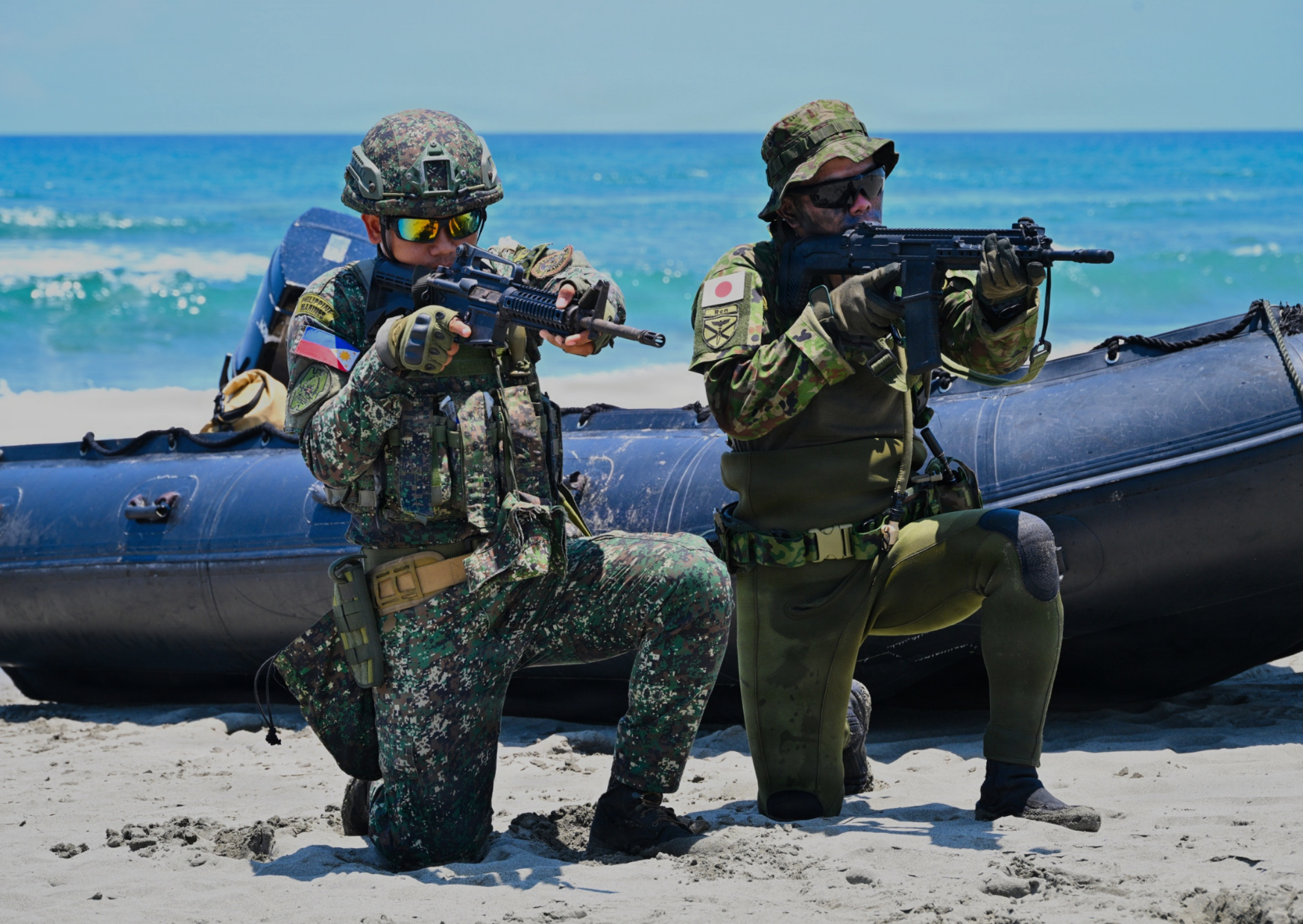
Image credit: DVIDS/Balikatan 2026: Japan Ground Self-Defense Force, Philippine Army conduct amphibious assault by SGT Brendon Donahue.