In Conversation: Pavin Chachavalpongpun, Founder of 112Watch
20 August 2026
This week, 9DASHLINE had the opportunity to speak with Pavin Chachavalpongpun, Founder of 112Watch and Professor at the Center for Southeast Asian Studies, Kyoto University. 112Watch is an international coalition that campaigns against Thailand’s use of Article 112, the country’s lèse-majesté law, which criminalises criticism of the monarchy and has been used to prosecute hundreds of activists in recent years. We discussed 112Watch’s work, political repression in Thailand and across Southeast Asia, the role of international actors in defending civic space, and what lies ahead for the movement.
9DL: You founded 112Watch in 2021, after being forced into exile following the 2014 coup and having yourself faced legal charges under Thailand’s lèse-majesté law. What prompted you to move from individual advocacy to building a formal international coalition? How has your own experience shaped the establishment and development of 112Watch?
PC: When the 2014 military coup forced me into exile and resulted in the revocation of my passport and an arrest warrant, I experienced firsthand the isolating nature of state persecution. However, following the youth-led pro-democracy demonstrations in 2020 — where young Thais courageously broke a long-standing taboo by publicly demanding reform of the monarchy — the state’s retaliation intensified dramatically. Article 112 was no longer just targeting high-profile dissidents like myself; it was being deployed systematically against hundreds of students, activists, and ordinary citizens. It became clear that individual voices, while impactful, could easily be fragmented or ignored by international bodies. I established 112Watch in 2021 to bridge this gap by transforming isolated personal struggles into a structured, global advocacy platform.
As a scholar studying authoritarianism, I understood the necessity of rigorous documentation, systematic tracking of judicial abuse, and evidence-based reporting to engage foreign governments, international institutions, and global human rights networks. As a victim of royalist-military persecution and an exiled activist, I knew the importance of solidarity and giving a platform to those silenced inside Thailand. 112Watch was therefore built on a dual foundation: an authoritative observatory to monitor and archive lèse-majesté cases, and a pressure group that keeps the erosion of Thai civic space firmly on the global human rights agenda. Authoritarian regimes thrive when their abuses occur in the dark; 112Watch ensures that Thailand’s judicial harassment of dissidents remains under a constant international spotlight.
9DL: Beyond Article 112 itself, you have documented a wider system of repression: Section 116 (Sedition) charges, the Computer Crimes Act, and informal harassment, alongside a sharp rise in prosecutions since 2020-2021 protests, extending to people with no clear political role. How should we understand these different forms of political repression? And what, if anything, fundamentally changed after the 2020–21 protests in the way political repression was deployed?
PC: To understand the landscape of Thai political repression, one must view Article 112 not as an isolated statute, but as the centrepiece of a multi-layered, ecosystemic regime of state control. The Thai royalist-military establishment employs a flexible repertoire of charges: when the high legal and political threshold of lèse-majesté is deemed strategically unsuitable in a given case, the state shifts to secondary legal mechanisms like Section 116 (Sedition), the Computer Crimes Act, and emergency decrees to achieve identical outcomes — silencing dissent and imposing prohibitive bail conditions. Running parallel to this judicial harassment is a pervasive architecture of informal coercion, ranging from physical surveillance, home visits by security officers, and blacklisting, to state-sponsored online harassment and dox campaigns. This hybrid strategy allows the state to maintain a facade of the rule of law for international observers while exploiting judicial procedure as a form of pre-trial punishment to drain the financial, physical, and psychological resources of activists.
Prior to 2020, lèse-majesté prosecutions were selectively deployed against prominent political figures or vocal critics. However, when hundreds of thousands of young Thais openly questioned the political power, financial opacity, and constitutional role of the monarchy — triggering the complete collapse of the unspoken “royal taboo” — the establishment suffered an existential shock. In response, the state democratised its repression: the legal hammer began falling indiscriminately on high school students, street vendors selling satirical calendars, ordinary citizens sharing social media posts, and bystanders with no formal organisational ties. In the post-2020 era, the goal has shifted from neutralising key leaders to instilling a climate of fear across the public sphere.
9DL: Across Southeast Asia, governments have been using different legal mechanisms to restrict dissent. Where does Thailand’s use of Article 112 fit within this broader regional pattern? Is there something distinctive about the Thai case, or is it another expression of a broader regional trend in which legal mechanisms are used to constrain political dissent?
PC: Thailand’s deployment of Article 112 fits directly into the broader regional phenomenon of ‘autocratic legalism’ or ‘lawfare’, where Southeast Asian regimes increasingly rely on judicial machinery rather than military force to sanitise political suppression. From Vietnam’s criminalisation of online dissent under Article 331 and Cambodia’s judicial dissolution of major opposition parties, to Malaysia’s historical reliance on the Sedition Act to protect royal prerogatives, governments across the region have learned that weaponising the statute book provides a veneer of legality while effectively neutralising opposition.
The events of 2020 shattered the ideological hegemony of the royalist establishment. You can dissolve political parties, incarcerate youth leaders, and censor social media, but you cannot un-teach an entire generation what they now know about power, accountability, and their own rights.
However, Article 112 is significantly more potent and intractable than other repressive legal instruments in the region. Unlike laws that protect elected politicians or state ideologies, Article 112 shields an unelected, semi-divine institution that the Thai establishment has successfully conflated with national identity and state existence itself; criticising the crown is thus framed not as political dissent, but as existential treason. Furthermore, the law is uniquely draconian: it carries severe mandatory minimum sentences of 3 to 15 years per count — leading to record-breaking cumulative prison terms reaching up to 50 years — and is enforced alongside systemic bail denials that turn pre-trial detention into immediate punishment. Crucially, its open complaint mechanism allows any individual to file charges against anyone else, outsourcing state surveillance to royalist vigilantes. As evidenced by the Constitutional Court’s dissolution of the Move Forward Party in 2024 simply for advocating its legislative amendment, Article 112 operates as a constitutional pillar designed for permanent political erasure.
9DL: Thailand has played a contradictory role in the region: while restricting dissent domestically, it has also served as a place of refuge for exiled activists from neighbouring countries, even as it has, in documented cases, cooperated in their forced return. How do you make sense of Thailand playing both roles at once: as a host to some of the region’s exiles, while also participating in transnational repression against others?
PC: Thailand’s dual identity as both a sanctuary for regional dissidents and an accomplice in their forced return is best understood not as a contradiction, but as a calculated policy of flexible, transactional realpolitik. Historically, Thailand’s geographical location, civil society networks, and relatively open infrastructure made it a natural transit hub and temporary refuge for political exiles fleeing repression in Myanmar, Cambodia, Laos, and Vietnam. However, this status as a sanctuary has never been rooted in a principled commitment to international human rights or asylum protocols — Thailand, notably, is not a state party to the 1951 Refugee Convention. Instead, refuge in Thailand exists in a grey zone of state tolerance that lasts only as long as it serves Bangkok’s strategic interests or until foreign regimes offer sufficient political, economic, or security currency to revoke it.
This operates as a form of authoritarian solidarity through reciprocal transnational repression: Southeast Asian autocracies use dissidents as bargaining chips to preserve bilateral ties and secure cross-border stability. When Thai security forces push back Myanmar refugees or facilitate the forced return of anti-junta activists and Cambodian or Lao dissidents, Bangkok engages in a quid-pro-quo mechanism in which neighbouring regimes reciprocate by monitoring or extraditing Thai dissidents on their territory. By selectively permitting an underground refugee ecosystem while periodically executing high-profile renditions and forced pushbacks, Thailand retains leverage over foreign dissidents while demonstrating its reliability to fellow autocratic neighbours. Ultimately, human rights and the principle of non-refoulement are subordinated to regime security, elite alignment, and transactional diplomacy.
9DL: The US has long maintained close security ties with Thailand as a treaty ally, while China has become an increasingly important economic and diplomatic partner for many Southeast Asian states, including Thailand. How, if at all, do Thailand’s relationships with these major powers shape the international space for raising concerns about restrictions on political expression?
PC: Thailand’s delicate foreign policy balancing act — maintaining its security alliance with the US while deepening economic, diplomatic, and military ties with China — significantly constrains international leverage on Article 112 and human rights. Bangkok’s long-standing strategy of “bamboo diplomacy” allows the ruling establishment to play major powers against one another, insulating itself from meaningful external pressure on domestic political repression.
From the American perspective, countering Chinese influence in the Indo-Pacific consistently overshadows democratic values and human rights concerns. Washington regularly issues diplomatic statements expressing concern over Article 112 prosecutions, party dissolutions, and the shrinking of civic space, but these criticisms rarely translate into tangible political or economic consequences. The US relies on Thailand as a key treaty ally, a logistics hub, and a co-host of major regional military exercises like Cobra Gold, and fears that heavy-handed sanctions or public condemnation could push Bangkok further towards Beijing. As a result, US human rights advocacy remains largely symbolic.
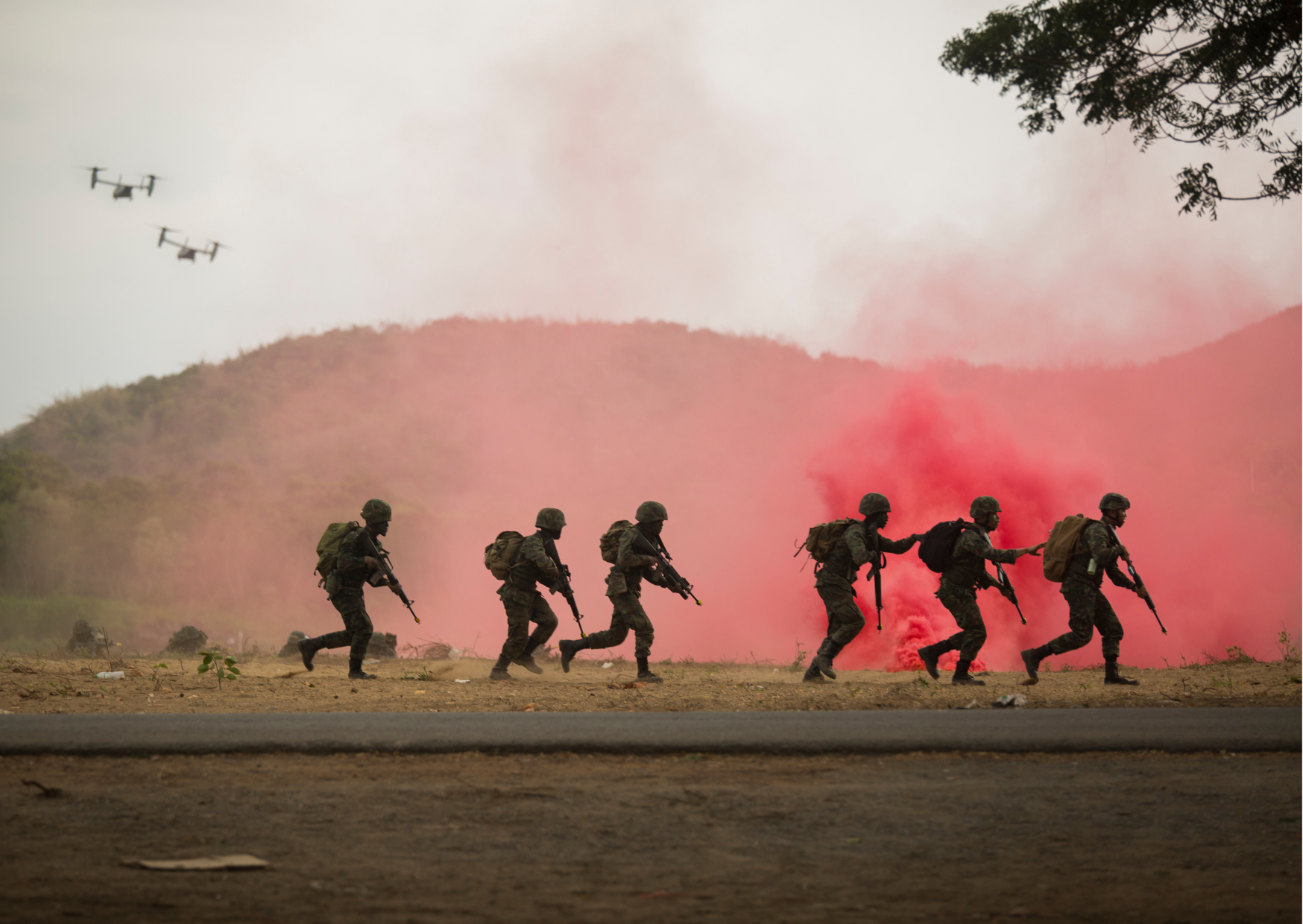
US Marines assault the beach as part of the amphibious beach landing at Hat Yao Beach, Thailand, during Cobra Gold 2020. Image credit: US Marine Corps photo by Staff Sgt. Jordan E. Gilbert.
Conversely, China provides Thailand’s royalist establishment with a diplomatic shield. Beijing operates on a strict policy of ‘non-interference’ in internal affairs, viewing domestic political repression as a matter of sovereign stability rather than a human rights violation. Its willingness to provide trade, infrastructure investment (such as the high-speed rail project), and military hardware without human rights conditions gives Bangkok strategic leverage. Whenever Western governments heighten their criticism of Thailand’s democratic backsliding or lèse-majesté enforcement, the Thai government can simply pivot closer to China.
For civil society and organisations like 112Watch, major-power competition narrows the space for effective international advocacy. It allows the Thai state to frame human rights campaigns against Article 112 as Western-sponsored interference or ideological imposition, while utilising its strategic value to both Washington and Beijing to evade accountability. Advocates must therefore move beyond Western state pressure by building coalitions of businesses , UN mechanisms, and civil society networks less easily dismissed as foreign interference.
9DL: 112Watch has identified international advocacy as an important part of its strategy, with the goal of building networks with UN human-rights mechanisms, the EU, and international civil society. What do you think has been missing from the international response so far, and what would you like these actors to do differently?
PC: What has been fundamentally missing from the international response is actionable enforcement and economic leverage. Diplomatic bodies frequently express ‘concern’ over pre-trial detention and lèse-majesté convictions, but such statements are easily absorbed by Bangkok’s political and judicial establishment. Thailand continues to enjoy the benefits of international integration — including Free Trade Agreements (FTAs) and a seat on the UN Human Rights Council — without facing tangible costs for its erosion of civic space. To move beyond performative concern, international actors should shift their strategy in three ways.
First, the EU must tie human rights benchmarks to trade. The EU is pursuing an ambitious FTA with Thailand, yet has not made the release of political prisoners or reform of Article 112 a prerequisite for trade concessions. The EU Commission and Parliament should establish measurable conditions — such as an immediate end to arbitrary pre-trial detention under Article 112 and anti-strategic lawsuit against public participation (anti-SLAPP) guarantees for lawyers and activists — before signing any trade agreement.
Second, UN mechanisms and democratic states should challenge Thailand’s hypocrisy on international platforms. Thailand seeks international prestige while disregarding findings from UN bodies such as the UN Working Group on Arbitrary Detention (WGAD), which found that Article 112 detentions violate international human rights law. Member states should use mechanisms like the Universal Periodic Review (UPR) and other multilateral forums to demand compliance, rather than issue mild recommendations. Thailand should not be able to present itself as a human rights partner abroad while operating a system of judicial repression at home.
Third, international actors should address transnational repression and private-sector accountability. Thailand’s repression extends beyond its borders through digital surveillance, passport revocations, and cross-border harassment of exiles. Foreign governments hosting Thai dissidents should police and penalise these acts of transnational intimidation on their own soil. Multinational corporations and technology platforms operating in Thailand should be pressed to ensure they are not complicit in state surveillance, censorship, or judicial harassment of activists.
9DL: Looking ahead, what gives you hope — and what concerns you most — about the future of civic space in Thailand and the wider region? What would meaningful progress look like for you and 112Watch over the next five years?
PC: What concerns me most is the institutionalisation of autocratic legalism and its generational toll. The Thai ruling establishment has learned that it does not need tanks on the streets to crush political opposition when courts, constitutional dissolutions, and indefinite pre-trial detentions can achieve the same result. The dissolution of the Move Forward Party — a party that won 14 million votes — proved that the state is willing to disenfranchise an entire electorate to protect the status quo. Across Thailand and Southeast Asia, civic space is shrinking as repression becomes increasingly legalised, quiet, and entrenched. Activists are being drained financially and psychologically by relentless legal battles, creating a dangerous risk of burnout and public cynicism.
What gives me hope is the irreversible shift in public consciousness, driven by the younger generation. The events of 2020 shattered the ideological hegemony of the royalist establishment. You can dissolve political parties, incarcerate youth leaders, and censor social media, but you cannot un-teach an entire generation what they now know about power, accountability, and their own rights. Despite severe repression and the recent electoral success of conservative forces, young Thais, regional activists, and diaspora networks continue to innovate, utilising digital spaces, art, and cross-border solidarity to keep the demand for reform alive. The taboo surrounding the monarchy has been broken, and the genie cannot simply be put back into the bottle.
For myself and 112Watch, meaningful progress in the next five years is defined by concrete structural change. First, an immediate end to arbitrary pre-trial detention for political prisoners, the dropping of all pending Article 112 charges against peaceful protesters, and a comprehensive amnesty for political dissidents and exiles. Second, formal parliamentary proceedings to radically amend or entirely repeal Article 112 by removing its mandatory minimum sentences, stripping private citizens of the right to file charges, and aligning the law with international free expression standards. Third, binding human rights clauses in foreign trade agreements alongside permanent international monitoring mechanisms in Thailand to prevent transnational repression and safeguard what remains of civic space.
DISCLAIMER: All views expressed are those of Dr Pavin Chachavalpongpun and do not necessarily represent those of the 9DASHLINE.com platform.
Biography
Dr Pavin Chachavalpongpun is the Founder of 112Watch, Professor at Kyoto University’s Center for Southeast Asian Studies, and Editor-in-Chief of Kyoto Review of Southeast Asia.