The Cockroach in the Room: India’s Youth Movement and the Politics of Restraint
The Cockroach in the Room: India’s Youth Movement and the Politics of Restraint
WRITTEN BY VIGNESH RAJAHMANI
21 August 2026
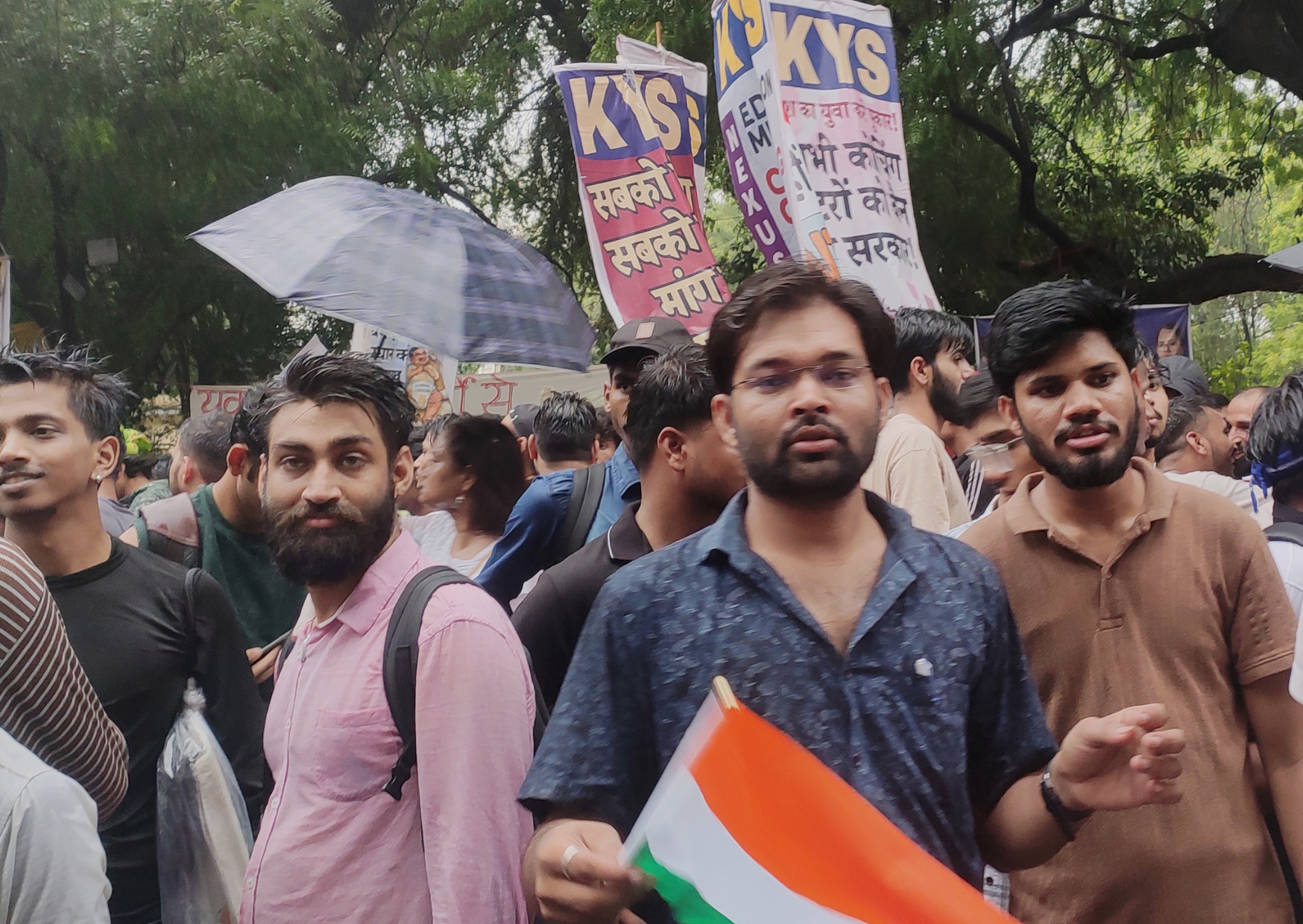
On 15 May 2026, the press reported that the chief justice of India, Surya Kant, had called unemployed young people who become media commentators, social media activists, or right-to-information petitioners “cockroaches” and “parasites”. Kant said the following day that his remarks had been misquoted, and were only directed at those entering professions on fake qualifications. Within 24 hours, Abhijeet Dipke, a Boston University graduate and former Aam Aadmi Party (AAP) communications strategist, turned the insult back. He launched an Instagram account, a website, and a name: the Cockroach Janta Party (CJP), a play on the ruling Bharatiya Janata Party (BJP). Within a week, its followers had overtaken the BJP’s on Instagram. On 6 June, just under 2,000 protesters gathered at Jantar Mantar demanding the resignation of Union Education Minister Dharmendra Pradhan. On 25 July, he resigned. Between those dates, the movement spread to more than a dozen cities, drew tens of thousands into the streets, provoked a sustained police crackdown, and became the first mass movement to force a cabinet exit over governance since Narendra Modi took office in 2014.
On 12 May, a paper leak forced the cancellation of the examination required for admission to India’s undergraduate medical colleges, the National Eligibility cum Entrance Test (NEET). Roughly 2 million students had already sat the exam on 3 May. Rahul Gandhi, the leader of the opposition in the Lok Sabha (House of the People) and head of the Chhatron Ki Goonj (Echo of Students) initiative later said it was one of more than 150 paper leaks in the previous decade.
The movement’s success is no longer measured by Pradhan’s resignation. What counts now is the institutional response the movement can compel: an independent NEET investigation, a reform timetable, procedural safeguards, and legal defence for those beaten and detained in July.
The CJP is not a registered political party. It has no state units, no manifesto beyond a mock one, and no territorial base, yet its grievance cut across state boundaries. What matters is what CJP refused to become: another Gen Z mass occupation forcing out a government through direct confrontation, as in Sri Lanka, Bangladesh, and Nepal. Its demand stayed narrow — one minister’s resignation and reform of one examination system. Both sides practised restraint for two months. Each was tested in mid-July; the state’s restraint broke into a violent crackdown, then gave way to a resignation. The movement’s held.
A meme with a manifesto
The rise is easy to describe and harder to explain. Dipke’s slogan, Main Bhi Cockroach (I am also a cockroach), landed because the material conditions behind it were shared. NEET candidates lose a year after a leak; civil-service aspirants pay for coaching from savings their families cannot replace; graduates with technical degrees end up overqualified for the work available. The chief justice’s throwaway line condensed a familiar suspicion, that elites see youth frustration as inconvenient rather than instructive.
Earlier waves of mobilisation, such as India Against Corruption in 2011, bore the imprint of civil society organisations with legible ideological anchors. The CJP’s register is more intimate: reels, memes, vlogs, and humour in the face of riot police. A protester in Delhi told an officer she had skipped her protein shake; another in Bihar asked a policeman whether there was tear gas that day. What critics call the generation’s under-politicisation worked as an asset: participants had no memory of previous encounters with the state and were hard to script against. That Dipke had worked in AAP communications helped; the playbook of narrow demand, wide reach, and refusal of party form is one he had used before. Some protesters said they had voted for the BJP. Their demand read less as opposition than as a call for accountability from within the party’s own base.
The journalist Ajaz Ashraf’s field reporting at Jantar Mantar found that, of a sample of ten volunteers he surveyed, only two came from the general category; the rest were Scheduled Caste, Scheduled Tribe, or Other Backward Class. When asked about caste, protesters said they were students first; pressed further, they named it. They were unanimous that a broken examination system compromised the life chances of all. That Dipke is a Dalit gave the students-first framing credibility. The refusal to be sorted, in a political register effectively sorted by caste for a decade, was the movement’s second act of restraint. Its political value lay in its distance from the parties that would instrumentalise it. While left-wing student organisations and the youth wing of the Bharatiya Kisan Union provided the infrastructure the CJP lacked, none publicly claimed control.
Some in the CJP argued for a broader register. The mock manifesto covered press freedom, disenfranchisement, and appointing retired judges to Parliament. The public voice stayed narrower, confined to Pradhan’s resignation and examination integrity, and made little of the concentration of recent leak scams in BJP-ruled states. The self-limitation was deliberate. A wider register would invite the ‘anti-national’ label the state was ready to apply.
The 6 June rally drew fewer than 2,000 against an online reach of over 20 million, but that gap narrowed over the following six weeks. The veteran activist Sonam Wangchuk called himself an “honorary cockroach” and began a hunger strike on 28 June. It drew television coverage that platform restrictions could not offset, and solidarity spread to Mumbai, Bengaluru, Goa, and beyond. By mid-July, videos of lathi (baton) charges in Bihar, West Bengal, and Tamil Nadu were circulating widely.
Containment, not restraint
It is tempting to read the government’s response as restraint. Until mid-July, it was more accurately described as calibrated containment. On 21 May, hours after the CJP overtook the BJP on Instagram, the Ministry of Electronics and Information Technology invoked Section 69A of the Information Technology Act, and asked X to withhold the CJP’s account, citing Intelligence Bureau inputs on national-security concerns. Within minutes, the party returned under a new handle. On 26 May, Dipke challenged the block in the Delhi High Court. A teacher in Haryana was suspended for supporting the movement, then reinstated three days later after public criticism.
The government also worked to delegitimise the movement, which Pradhan called a “B team of terrorists”. Sukanta Majumdar, the union minister of state for education, claimed 49 per cent of the CJP’s followers were from Pakistan. Dipke disputed the claim using the account’s location data, and fact-checkers could not verify the viral graphic underpinning the allegation. The CJP’s spokesperson, Saurav Das, denied online allegations of political and foreign-funding links. Much of the mainstream media amplified the state’s framing rather than testing it, and the old playbook — raise doubts without triggering a wider cause — failed. Flooding the discourse with counter-narratives assumes an opposition the state can outrun. On the same channels, the movement outran it.
By mid-July there had been no mass arrests, no invocation of the Unlawful Activities (Prevention) Act, no set-piece national crackdown. The state treated police action and tear gas at solidarity protests as local incidents rather than a national campaign. A coordinated crackdown risked drawing in students, parents, and opposition parties in ways the CJP had not managed alone. Sheikh Hasina’s July 2024 crackdown on Bangladesh’s student protesters was the negative reference point.
The calculation broke between 18 and 25 July. On 18 July, Wangchuk was forcibly hospitalised on the 21st day of his hunger strike; Dipke began fasting in his place. On 20 July, more than 10,000 marched on Parliament. Delhi Police fired tear gas, used lathis, and imposed mobile-phone jammers and internet restrictions around the protest areas. More than 170 protesters and security personnel were injured, and about 70 people detained. Similar scenes played out across the country. That evening, Union Health Minister JP Nadda met a CJP delegation. The next day, police detained Rahul Gandhi and other opposition MPs at a solidarity protest. On 24 July, Wangchuk broke his fast on written government assurances of examination reform. Twenty-four hours later, Pradhan resigned. The government had moved from its first direct contact with the CJP to a cabinet resignation in five days.
The state’s crackdown has since decentralised. Police have targeted people who protested and posted content critical of the government online. In response, the All India Students' Association, whose president Neha Bora had joined the fast, began documenting arrests. The CJP also announced Saakshi (witness), an evidence repository intended to preserve protest photographs and videos for legal-aid teams.
Between accountability and rupture
The CJP resisted comparison with Gen Z mobilisations in the neighbourhood. Dipke said repeatedly that dissent would stay within the Constitution of India. The ‘anti-national’ framing invited by comparisons with Nepal or Bangladesh is a live weapon, one Pradhan echoed in his resignation letter. India’s neighbours reached their breaking points through deeper crises: Sri Lanka’s 2022 economic collapse, 15 years of Awami League rule in Bangladesh, and prolonged corruption and misgovernance in Nepal. In each, an existing party channelled the anger. India had no equivalent vehicle. It had a satirical movement that, in 50 days, forced a resignation without ousting a government. Whether the CJP takes an organisational form of its own is the open question of the next 12 months.
Success is no longer measured by Pradhan’s resignation. What counts now is the institutional response the movement can compel: an independent NEET investigation, a reform timetable, procedural safeguards, and legal defence for those beaten and detained in July. Some of that work has already passed to the parties the movement kept at a distance. The Indian National Congress, Samajwadi Party (SP), Nationalist Congress Party (NCP), Trinamool Congress (TMC), and the Dravida Munnetra Kazhagam (DMK) are taking questions of examination integrity, detainees, and statutory reform into Parliament. These pre-existing vehicles have inherited the moment. Whether the CJP retains authorship of it is the near-term test. Generational grievance without organisational form dissipates, but ignored long enough it finds forms the state does not anticipate.
DISCLAIMER: All views expressed are those of the writer and do not necessarily represent those of the 9DASHLINE.com platform.
Author Biography
Dr Vignesh Rajahmani is a postdoctoral research fellow in Indian and Indonesian politics at the Royal Netherlands Institute of Southeast Asian and Caribbean Studies, Leiden, and a research affiliate at King’s India Institute, King’s College London. Image Credit: Sumita Roy Dutta.