Islands, not capitals: the front lines of Philippines-Japan relations
Islands, not capitals: the front lines of Philippines-Japan relations
WRITTEN BY CARMINA YU UNTALAN
18 August 2026
In a span of three years under Philippine President Ferdinand Marcos Jr., Philippines-Japan relations have moved from a “golden age” to what he and Japanese Prime Minister Sanae Takaichi called “a platinum era”. During the May 2026 summit in Tokyo, which coincided with the 70th anniversary of Philippines-Japan relations, both parties renewed their commitment to uphold the Free and Open Indo-Pacific (FOIP). This rapid deepening of ties is often attributed to concerns over China and the Trump administration’s erratic regional approach. Yet, this focus on great-power rivalry overlooks a consequential development: the reconfiguration of bilateral relations around island peripheries, where communities and places are recast as strategic outposts.
From Okinawa to Batanes, islands are playing crucial roles as nodes linking the Philippines and Japan. Seen from these peripheries, however, this bilateral development does more than strengthen ties. It also puts island communities at the forefront of strategic competition, where security priorities come at the expense of the local communities and the environment.
Islands taking centre stage
The geographical reconfiguration of Philippines-Japan relations around islands constitutes an important pillar of bilateral security cooperation. The Reciprocal Access Agreement (RAA), Acquisition and Cross-Servicing Agreement (ACSA), ongoing negotiations over the General Security of Military Information Agreement (GSOMIA), and the delimitation of maritime borders aim to reduce bureaucratic and operational barriers to military deployment, logistics, intelligence-sharing, and surveillance. Together, these arrangements transform seemingly disconnected island locations into an integrated security network.
Indeed, if stronger Philippines-Japan relations rest on upholding a rules-based international order, then both parties must extend the same normative and legal commitments to protect and empower the communities in their own island peripheries.
Although these arrangements are negotiated bilaterally between national governments, they are organised across an archipelagic configuration. Okinawa and Japan’s southwestern islands, Taiwan, Batanes, and northern Luzon are increasingly understood not as separate locations but as connected entities within a broader deterrence framework, particularly in discouraging Chinese military coercion and preserving stability across the Taiwan Strait. This builds on deepening bilateral ties, including Japan’s provision of air and coastal radar systems to the Philippines. It also complements the expansion of the US-Philippines Enhanced Defense Cooperation Agreement (EDCA) that extends access from five to nine locations, including areas in Northern Luzon and Palawan.
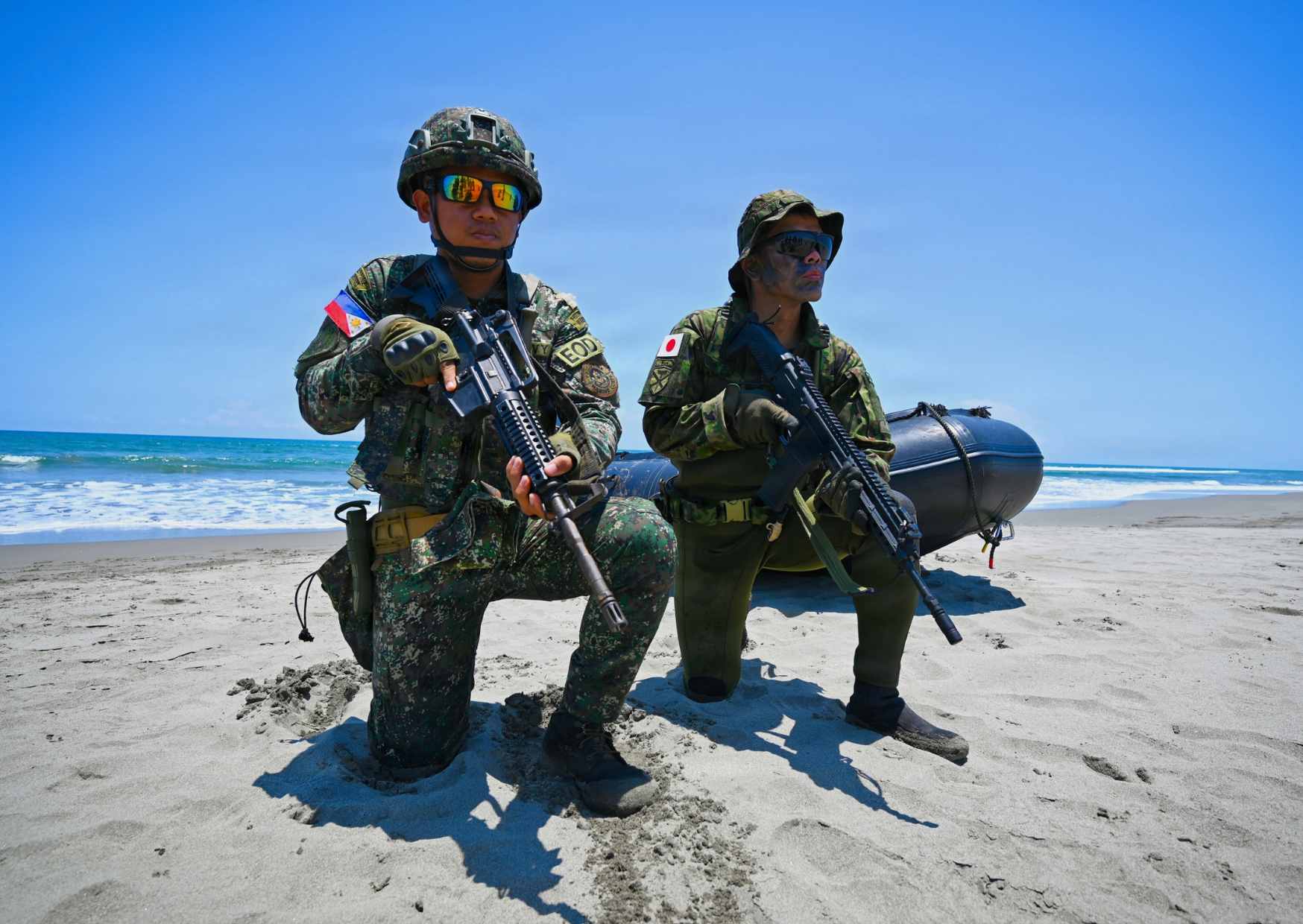
The growing attention to Batanes further illustrates how island networks emerge through deterrence and disputes. Its proximity to Taiwan makes it pertinent to military drills and maritime monitoring. Batanes was a key site for the deployment of NMESIS anti-ship missiles during the April-May 2026 Balikatan exercises, a move that reaffirms the alliance’s commitment to deter China. Although Japan was not part of this, it joined the parachute drill in Kamandag 10 exercises between Philippine and US Marines on 16 June, barely three weeks after Marcos Jr. and Takaichi agreed to begin discussions about delimiting their EEZs and continental shelves. Together, these developments show that Philippines-Japan relations are becoming folded into a wider security strategy connecting Taiwan and the South China Sea, rather than just running parallel to it.
An uncontested American Cold War architecture
Yet this decision-making process between capitals leaves little room for the communities whose land and livelihood bear the consequences. This unequal relationship between capitals and island communities is not incidental. Nor is the selection of islands implicated in this reconfiguration. They are part of the “first chain” of an older imperial security architecture which John Foster Dulles called the “Island Chain Strategy”, where islands have been organised as strategic frontiers for great power objectives during the Cold War. Here, “imperial” refers to a structural hierarchy where strategic decisions are concentrated in powerful capitals, while peripheral islands bear disproportionate military, social, and environmental costs.
The Pentagon has recently resurfaced the strategy to honour its “deep historical roots” of maintaining peace and order in the Pacific. However, islands have always taken the brunt of alliance management decisions made in Washington D.C., Tokyo, and other capitals. Island residents barely have a seat at the table. Okinawa, which Japan annexed in 1879 and used as an imperial frontier during WWII from 1944-45, has since been shouldering the unfair burden of hosting roughly 70 per cent of the US bases in Japan, on about 0.6 per cent of the island’s land area, to which Tokyo remains compliant. This is likely to continue, despite Okinawans’ consistent anti-war and anti-military base protests, since stronger Philippines-Japan cooperation may give it a bigger role within a wider network of military access and surveillance connecting East and Southeast Asia.
Batanes may be facing a similar trajectory. The province is increasingly discussed as a contentious strategic gateway. Yet, the language of strategic importance can obscure the people who live there. While some local officials have welcomed the Balikatan exercises, residents have also expressed their concerns about possible military build-up, including fears that increased military activity could disrupt local life, making the province vulnerable to military escalation and possible disruption of food and fuel supply. Both reactions in Okinawa and Batanes suggest that island communities refuse to be passive subjects of the ‘platinum era’.
Furthermore, their experience raises an important question that goes beyond the US or its allies. Because strategic competition risks reducing islands to objects of great-power rivalry, the question of whether affected communities have meaningful influence in these developments must also be addressed to China. China’s presence in the South China Sea/West Philippine Sea has severely affected people’s livelihoods by depleting fish stocks. Its reclamation activities and construction of artificial islands in the area have also caused irreversible damage to the marine ecosystem. For this reason, some Filipinos have viewed China’s aggressive behaviour as coercive, with civil society groups touting it as “imperialist”.
China positions itself against “imperialism”, which the government associates with foreign intervention and historical humiliation. It recurrently invokes its historical rights over contested territories, as well as the history of Japanese imperialism to drive a wedge between the Philippines and Japan, and Okinawa and Japan, as part of their narrative of Japanese imperialism and military resurgence. Whatever the intended purpose of these narratives may be, their effect is to reinforce a view that islands are primarily objects of great power competition rather than inhabited spaces. In this sense, by merely questioning “who” controls the islands, rather than how much control capitals should have over them, China’s anti-imperialist rhetoric inadvertently reinforces the hierarchical logic embedded in the US-led regional security order.
The real test
The key test of Philippines-Japan relations ultimately lies in how both countries uphold the principles of the 2016 South China Sea Arbitral Tribunal award, a key reference for their shared emphasis on FOIP. On 12 July, the Philippines marked the anniversary of the award, with Japan immediately expressing its backing by reaffirming the UNCLOS. China dismissed the ruling outright, condemning Japan’s interference as a “challenge to postwar international order”. The diplomatic row appears to revolve around sovereignty and regional peace and stability, while the obligation to protect the island communities and their environments has received comparatively less attention.
The arbitration ruling that found China to have breached the UNCLOS Article 192 is an important basis for the Philippines and Japan to question the legality of Chinese activities in the disputed territories. Whether they can withstand Chinese attempts to invalidate the ruling by asserting sovereignty rights may not be the most important challenge. If the Philippines and Japan invoke UNCLOS as their basis for demanding other states to protect maritime environments and communities, the same principle should also inform the way they manage militarisation involving foreign presence, in their own island peripheries. This includes Okinawa, where locals have been protesting the environmental harms caused by the construction of US Marine facilities in Henoko, and Batanes, whose communities are beginning to confront the impact of military exercises. It also includes other islands that will be affected by this emerging geographical reconfiguration.
Indeed, if stronger Philippines-Japan relations rest on upholding a rules-based international order, then both parties must extend the same normative and legal commitments to protect and empower the communities in their own island peripheries. This means moving away from a security order inherited from the Cold War and shaped by Japan’s historical relationship with Okinawa, in which capitals decide while islands absorb the costs. Doing so would not derail the Philippines and Japan from promoting peace and stability in the region. Instead, it would lead them to the full realisation of the principles that they seek to defend.
DISCLAIMER: All views expressed are those of the writer and do not necessarily represent those of the 9DASHLINE.com platform.
Author biography
Carmina Yu Untalan is an FCT researcher at the Institute of Contemporary History, New University of Lisbon. Image credit: DVIDS/Balikatan 2026: Japan Ground Self-Defense Force, Philippine Army conduct amphibious assault by SGT Brendon Donahue.