Two navies, no war: the untested balance in the East China Sea
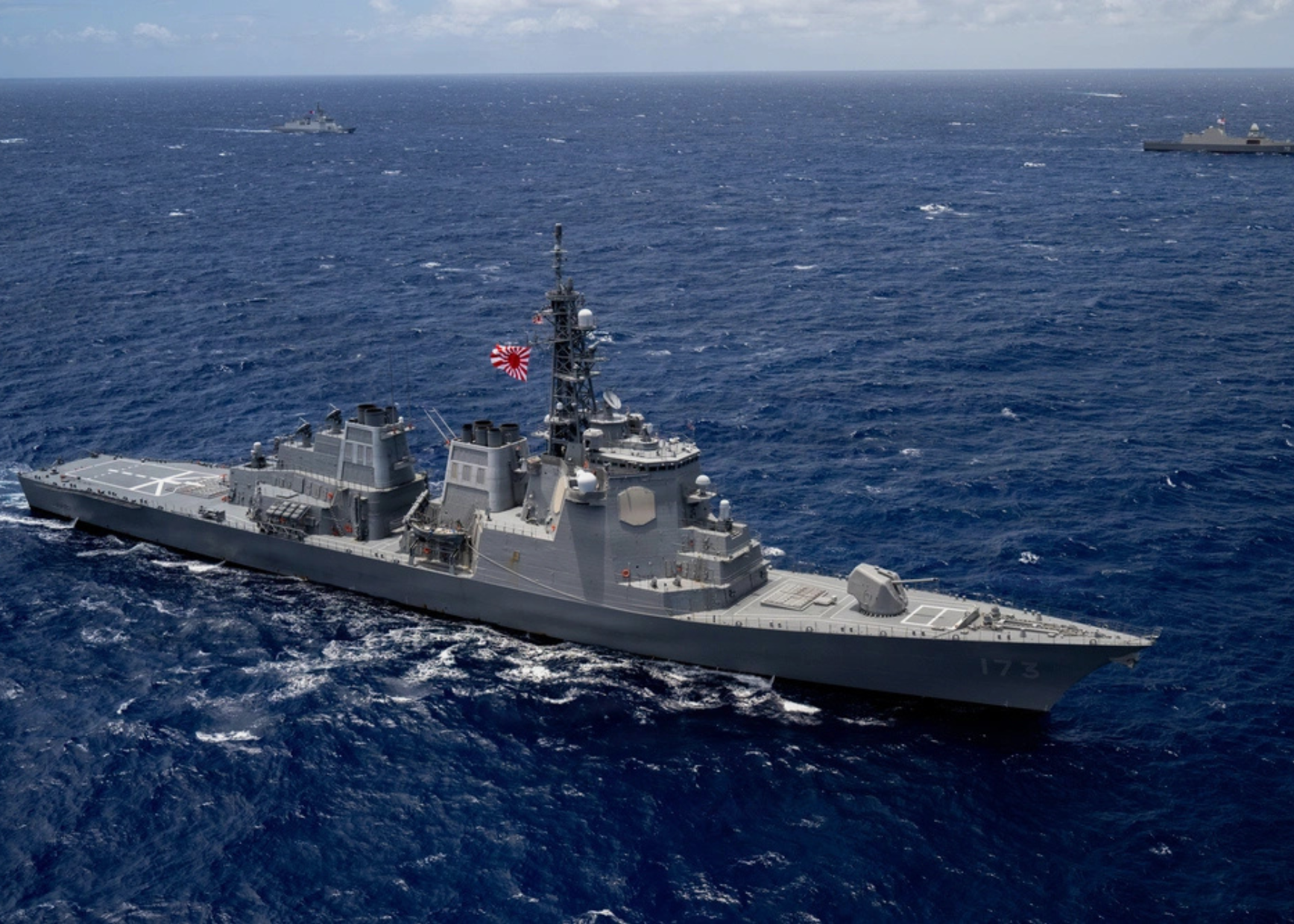
Two navies, no war: the untested balance in the East China Sea
WRITTEN BY LEONARDO MORREALE
28 July 2026
The naval balance between China and Japan is usually read through a single number: fleet size. By that measure, the contest looks settled, with China commanding the largest navy in the world. But hull counts describe capacity, not competence — and competence in a modern war at sea is precisely what neither navy has ever been forced to prove. The East China Sea is shaping up as a confrontation between two of the most capable fleets in Asia, and two of the least tested.
A full contingency would involve more than fleets. China’s land-based missile forces and air power would shape any engagement from the outset, and Japan’s defence rests as much on its air and missile capabilities as on its ships. The naval comparison is worth isolating because the sea is where the two states would meet first and most directly in the East China Sea, and because it is there that the gap between measurable capacity and untested competence is widest.
Where the two fleets diverge
According to the Pentagon, China’s navy fields a battle force of over 370 ships and is the largest in the world by count, sustained by a shipbuilding capacity that dwarfs any competitor. Roughly 70 per cent of its warships have entered service after 2010, thus constituting a modern fleet. Japan’s Maritime Self-Defense Force (JMSDF) operates around 155 vessels, well under half China’s number.
However, Japan’s fleet carries a lead in average tonnage per combatant and leans on high-end platforms: Aegis-equipped destroyers, SM-3 interceptors, and a new class of dedicated ships built to counter ballistic and hypersonic threats. China has bet on quantity and offensive missile mass, with hundreds of intermediate-range ballistic missiles able to reach Japanese territory; Japan has bet on the defensive layer and on a qualitative edge, and is now closing the strike gap with long-range anti-ship missiles and US-supplied Tomahawks.
The widest divergence is in anti-submarine warfare, and it favours Tokyo. The JMSDF was built, from the Cold War onward, primarily for the anti-submarine role: its destroyers, its fleet of exceptionally quiet diesel-electric submarines, and its large force of maritime-patrol aircraft are all oriented toward hunting submarines. China has long lagged in this domain, a recognised weakness that leaves it without a robust deep-water capability even as it races to close the gap. The one arena where a Taiwan or East China Sea contingency could turn is the one where Japan is strong, and China is not yet.
In a first clash, both China and Japan would be learning the most expensive lessons in real time, and the side that adapts faster, not the side with more hulls, would likely prevail.
Each fleet also carries a distinct vulnerability that no procurement can quickly fix. China has never conducted a real amphibious operation. Its landing rehearsals opposite Taiwan have grown more elaborate: a large exercise in August 2025 simulated a multi-axis assault across roughly 360 kilometres of coastline, mirroring the geography of Taiwan’s western shore. Yet the same exercise exposes China’s limits. Much of the lift depends on requisitioned civilian roll-on, roll-off ferries crewed by untrained personnel — a fragile arrangement for the contested first hours of a landing, and the operation was staged in calm seas against an undefended shore. An amphibious assault against a defender who shoots back, in the weather of the strait, is a different undertaking, and one the force has never attempted. China’s navy also carries the residue of a corruption purge that has reached flag rank, and a command culture whose ability to improvise under fire is itself unproven.
Japan’s constraints are different. Its magazines and munitions stocks are limited, a serious liability in a war of attrition where missiles are expended faster than they can be replaced. Its freedom of action is bound to coordination with the United States, a source of capability but also a potential brake on speed and independent decision-making. And its demographic decline is now a military problem too: a shrinking cohort of young people is squeezing recruitment into the Japan Self-Defense Forces, which struggles to fill its ranks even as it fields more sophisticated ships. A fleet can be built faster than the crews to run it.
The ghost of Tsushima
Japan has faced a similar situation before and emerged on the winning side. At Tsushima, in 1905, it destroyed a Russian fleet that was larger on paper but older, slower, exhausted by an 18,000-mile voyage, and poorly led. Three factors decided that battle: technological and operational superiority, proximity to home waters, and an alliance with Britain, the dominant naval power of the age, which had built and trained the Imperial fleet. It remains the founding myth of Japanese sea power, preserved in the battleship Mikasa, moored today as a museum a short walk from the JMSDF’s fleet headquarters at Yokosuka.
Measured against China, those conditions have largely reversed. The modern, home-water, numerically superior fleet is now the Chinese one; Japan holds the qualitative and alliance advantages that once let it win from a position of strength. The lesson of 1905 — that quality and preparation beat numbers — held only because those numbers were obsolete. Against a modern fleet in its own waters, the formula that made Japan great no longer suffices on its own. The myth is a poor guide to the present, and a founding victory this large risks blurring the line between inherited prestige and untested capability.
The experience neither side has
Neither the Chinese nor the Japanese navy has fought a modern war at sea. China’s modern platforms, however numerous, have never been tested in combat; Japan’s postwar navy has never fought a fleet action at all. Both have trained intensively and exercised constantly, but training is not war, and the gap between the two is where plans meet friction: the performance of untried weapons, the endurance of crews under fire, the resilience of command chains when communications fail and losses mount.
The operational implications cut across both fleets. A navy that has never absorbed real losses does not know how its damage control, its logistics, or its morale will hold. A missile system that has never been fired in anger is a projection, not a proven capability. In a first clash, both China and Japan would be learning the most expensive lessons in real time, and the side that adapts faster, not the side with more hulls, would likely prevail.
Only one navy in the region carries current, hard combat experience, and it belongs to neither contestant. The United States Navy is fighting at sea now. It led Operation Epic Fury against Iran, sinking or disabling a large part of the Iranian fleet in the opening days; its destroyers have come under live fire from missiles, drones, and small craft in the Strait of Hormuz; and it has run a months-long blockade of Iranian ports. In January 2026, it also took part in the operation that seized Venezuela’s leader, Maduro.
What that experience reveals is as instructive as the capability itself. Even a force as overwhelming as the American one has not been able to reopen the Strait of Hormuz: Pentagon officials reportedly told lawmakers that clearing the waterway of mines could take six months, and only once the fighting stops. The most powerful navy in the world, fighting a far weaker opponent, has found that closing a chokepoint is easy and reopening it is not. That is the kind of lesson no exercise teaches, and neither the Chinese nor the Japanese navy has had the chance to learn it.
This is the experience that Japan, like Imperial Japan drawing on Britain, accesses only through its alliance: in the bases on Okinawa, the Seventh Fleet at Yokosuka, and the constant joint exercises rehearsing the defence of the islands towards Taiwan. It is borrowed experience, not its own, and the distinction matters. An ally can share doctrine, tempo, and lessons learned, but in the first hours of a war the JMSDF would still be fighting its first battle, alongside a partner fighting its latest.
The balance beyond the numbers
Read through hulls, the East China Sea looks like a Chinese advantage. Read through capability and experience, it looks more contingent: a modern Japanese fleet with a real edge in the undersea domain and a critical edge in its alliance, facing a larger Chinese fleet with its own unproven amphibious and anti-submarine weaknesses, and neither side certain how it would actually fight. The balance does not rest on numbers alone, nor on the memory of past victories, but on a question that remains untested: which navy could turn paper capability into real proficiency. For Japan, much of the answer still depends on how much it can draw from its American ally.
DISCLAIMER: All views expressed are those of the writer and do not necessarily represent those of the 9DASHLINE.com platform.
Author biography
Leonardo Morreale is an independent analyst specialising in Indo-Pacific security and Japanese strategic affairs. Image credit: DVIDS/Aaron Haro Gonzalez.