The grey-zone of interest: How China tests Indonesia’s South China Sea strategy
THE GREY-ZONE
OF INTEREST:
HOW CHINA TESTS INDONESIA’S SOUTH CHINA SEA STRATEGY
WRITTEN BY OMAR RASYA JOENOES
2 March 2026
China has been subjecting Indonesia to grey-zone tactics in the North Natuna Sea, combining civilian activities, maritime law enforcement, and diplomacy to slowly expand its influence without triggering open conflict. In mid-2017, to reflect Indonesia's geographic position and sovereignty over its Exclusive Economic Zone (EEZ), the Indonesian government officially renamed the waters north of the Natuna Islands as the North Natuna Sea, replacing the previous reference to the South China Sea on national maps. Although Jakarta insisted the renaming was not intended to create new conflicts, Beijing nonetheless described the move as "unconducive" to the standardisation of geographic naming and maintaining regional stability.
Since late 2024, China’s maritime activities, including incursions beginning barely a day after President Prabowo Subianto’s inauguration, have tested Indonesia’s ambiguity strategy and prompted the coast guard to expel Chinese vessels on several occasions. This gradual pressure concerns not only Indonesia’s sovereignty — a concern reflected in a March 2024 survey revealing that 73 per cent of Indonesians perceive Chinese actions in the South China Sea as a threat — but also the stability of vital maritime trade routes for ASEAN and Singapore. To safeguard its sovereignty, Jakarta must recognise this threat seriously, abandon ambiguity as strategy, and adopt coherent responses, including firmer legal and diplomatic consistency, strengthened maritime enforcement, and the strategic use of Indonesia’s geographic leverage.
Indonesia under the threat of China’s grey-zone
Indonesia’s position in the South China Sea has long rested on legal clarity and diplomatic restraint. As a non-claimant state that places Natuna within its EEZ under the United Nations Convention on the Law of the Sea (UNCLOS), Indonesia faces a dilemma: safeguarding sovereignty while maintaining economic ties with China. After all, China remains Indonesia’s foremost trading partner, with bilateral trade amounting to over USD 135 billion and Chinese FDI exceeding USD 8 billion in 2024. Chinese capital plays a pivotal role in Indonesia’s downstreaming strategy, particularly in the nickel sector underpinning its industrial transformation. This economic interdependence raises the costs of confrontation and complicates Jakarta’s efforts to assert maritime sovereignty in the South China Sea. However, economic centrality does not translate into strategic alignment. Sovereignty sensitivities in the North Natuna Sea and domestic controversies over Chinese-linked industrial projects constrain how far Jakarta can recalibrate its China policy.
Hence, while Indonesia’s deliberately ambiguous approach — maintaining strategic manoeuvring space while avoiding escalation — allows diplomatic flexibility, the risk of a gradual buildup of pressure remains. Yet, since November 2024, a series of joint statements and so-called “cooperative initiatives” with Beijing signal a subtle but consequential shift: one that risks blurring Indonesia’s principled stance and, if left unmanaged, quietly advancing China’s grey-zone strategy without a single shot fired. For example, during a bilateral meeting in November 2024, Subianto referred to “overlapping claims” in the North Natuna Sea and expressed openness to joint development, diverging from Indonesia’s long-standing position that no such overlapping claims exist under UNCLOS. This was followed in April 2025 by the institutionalisation of a 2+2 dialogue mechanism between the two countries, signalling an expansion of defence and strategic coordination. While framed as pragmatic cooperation, such initiatives risk generating ambiguity that Beijing can leverage within its broader grey-zone strategy.
The challenge, therefore, is to transform ambiguity from a reactive posture into a deliberate and integrated strategy — one that manages asymmetry without allowing incremental pressure to redefine the strategic status quo.
China’s grey-zone tactics operate precisely in the space between war and peace, employing calibrated coercion that avoids overt escalation while gradually asserting control over contested maritime spaces. Following the standoff in the North Natuna Sea between December 2019 and January 2020 — when dozens of Chinese fishing vessels escorted by China Coast Guard (CCG) ships entered Indonesia’s EEZ and Beijing asserted “traditional fishing rights” — tensions escalated, prompting Jakarta to deploy naval assets and issue diplomatic protests. Although the confrontation subsided, Chinese fishing incursions backed by maritime militia and coast guard vessels became less visible but never ceased. Subsequent developments, including China’s prolonged seabed mapping activities in 2021 and its demands that Indonesia halt drilling and military exercises in Natuna waters, demonstrate how grey-zone pressure has continued below the threshold of public confrontation.
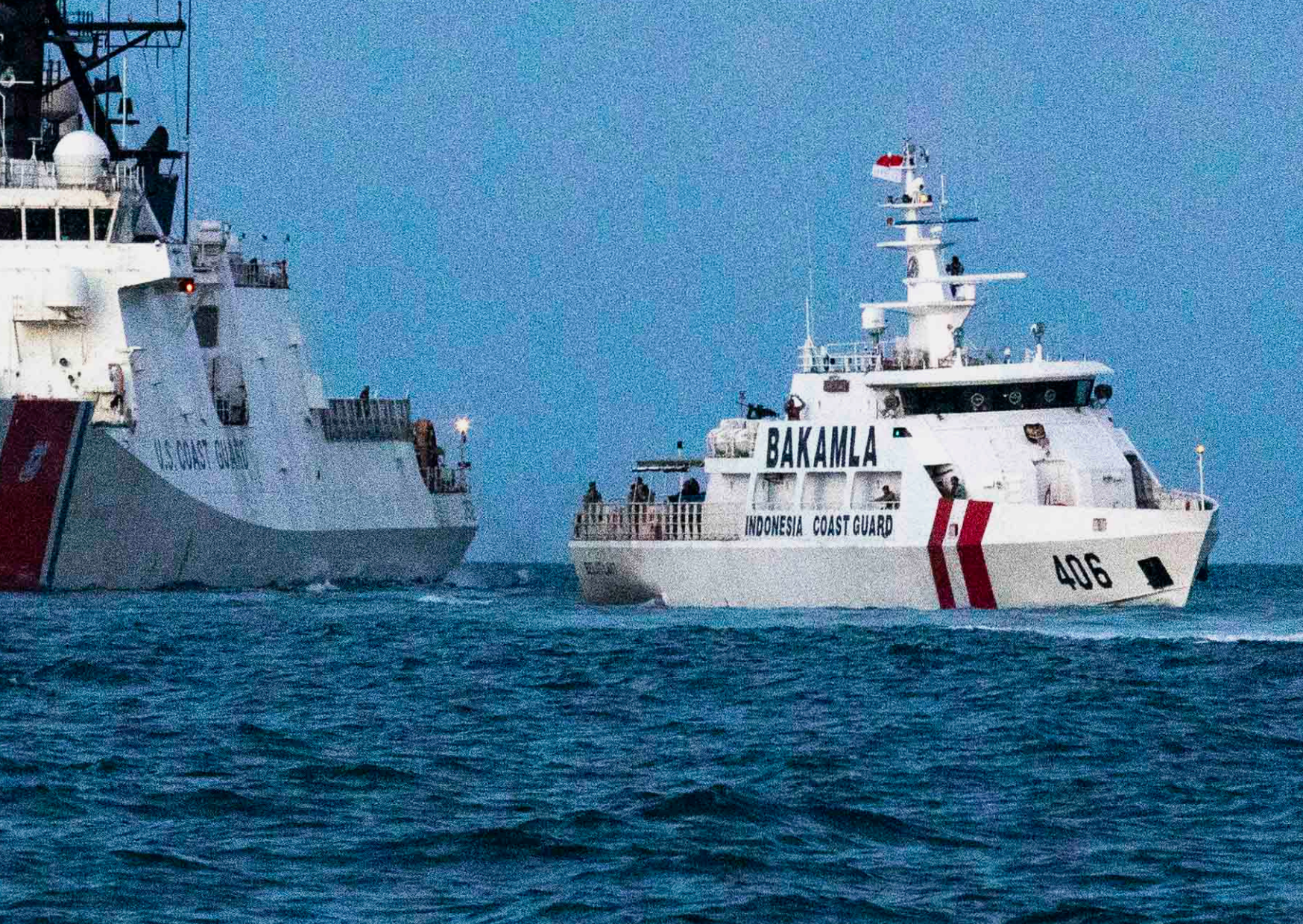
These actions did not overturn Indonesia’s legal position, but they steadily tested its willingness to enforce it, reflecting a measured strategy aimed at encouraging tacit acceptance of what Beijing defines as its maritime rights. Indonesia’s response remained largely symbolic, relying on periodic naval deployments, coordinated patrols involving the Indonesian Navy, Indonesian Maritime Security Agency (Bakamla), and other authorities to intercept intrusions within its EEZ, as well as formal diplomatic protests. These measures signalled concern but were insufficient to impose strategic costs.
While restraint is often intended to prevent escalation, in the context of grey-zone competition it can inadvertently reinforce the very dynamics such tactics are designed to exploit. In 2020, then-Coordinating Minister for Maritime and Investment Affairs Luhut Pandjaitan downplayed tensions with China in the South China Sea as a simple problem that needed no quarrelling. Former President Joko Widodo likewise displayed limited strategic assertiveness, as Jakarta responded to recurrent incursions around the Natuna Islands primarily with naval presence and de-escalatory diplomacy.
Today, the challenge is further complicated by Indonesia’s continued reliance on diplomatic ambiguity to preserve economic stability and strategic flexibility. Indonesia has increasingly adopted a posture of deliberate ambiguity under Subianto: a middle way between safeguarding sovereignty and sustaining economic cooperation with China. While this approach reflects a pragmatic reading of regional power asymmetries, it risks normalising incremental intrusions into Indonesia’s EEZ. By treating each maritime incident as an isolated episode to be diplomatically managed, Jakarta may inadvertently allow persistent coast guard patrols, seabed surveys, and interference with energy exploration to become routine. Over time, such repetition could recalibrate expectations of what constitutes acceptable presence in the North Natuna Sea.
Without a coherent framework, ambiguity risks shifting from a policy tool into an illusion of control: the belief that Indonesia remains firmly in charge in Natuna even as Chinese activities persist with limited pushback. This dynamic was evident between May and September 2025, during which the Indonesia Ocean Justice Initiative documented repeated operations by the Chinese research vessel Nan Feng and CCG ships in the North Natuna Sea. These persistent activities underscore how grey-zone pressure endures even in the absence of headline-grabbing incidents.
Indonesia’s potential responses
Indonesia’s options can be conceptualised as a spectrum of strategic choices rather than a binary decision between firmness and flexibility. One approach is to reinforce Indonesia’s legal standing by anchoring Natuna policy firmly in UNCLOS and delivering unified messaging both domestically and internationally. Preventive diplomacy, including timely protest notes combined with sustained dialogue, could help preserve legal clarity while limiting escalation risks. While this approach consolidates Indonesia’s normative legitimacy, it may prove insufficient without credible enforcement, potentially allowing grey-zone pressure to persist behind a veneer of diplomatic stability.
A second path lies in building adaptive maritime capabilities. Regular EEZ surveillance by the Indonesian Navy and Bakamla is essential to counter grey-zone activities. At the same time, cooperation with friendly nations could enhance readiness without binding Indonesia to rigid military blocs. Jakarta can explore how its growing defence partnerships with countries such as Australia, Japan, India, and France could be leveraged to deter grey-zone pressure while preserving Indonesia’s long-standing non-aligned posture. Indonesia’s operational readiness can be enhanced by expanding maritime capacity-building with like-minded partners while avoiding formal alliance commitments. Arrangements such as the 2025 Japan–EU maritime coordination framework — which emphasised interoperability, information-sharing, and joint exercises without collective defence guarantees — demonstrate how security collaboration can deter grey-zone pressure without formal bloc alignment. However, this approach carries risks: Beijing may interpret deeper defence coordination as strategic alignment, inviting economic or diplomatic retaliation. Expanded external partnerships could also raise questions about ASEAN centrality and Jakarta’s traditional non-aligned posture.
A third strategic choice concerns Indonesia’s strategic geography. Although China is widely perceived as the dominant power both in the bilateral relationship and in Asia, Beijing remains heavily dependent on Indonesian sea lanes for the transit of its exports and imports between the Indian Ocean and the South China Sea. Nearly two-thirds of China’s maritime trade transits the Malacca Strait — including 53 per cent of its energy imports in 2023 — underscoring the strategic importance of Southeast Asian maritime routes and reinforcing longstanding concerns over chokepoint vulnerability in Beijing’s strategic calculus.
This dependence does not translate into coercive leverage, as Indonesia cannot realistically threaten closure of sea lanes within its territorial waters without incurring severe economic and diplomatic costs. However, it does confer more subtle forms of influence. As an archipelagic state, Indonesia exercises regulatory authority over archipelagic sea lanes and retains discretion over enforcement intensity, inspection regimes, maritime domain awareness, and environmental or navigational standards. Incremental adjustments in these areas, particularly when coordinated with other littoral states, could alter China’s risk calculations without overt confrontation.
Ultimately, responding to China’s grey-zone tactics is about building sustainable mechanisms that allow Indonesia to anticipate, absorb, and shape pressure before it hardens into strategic loss. By doing so, Indonesia can safeguard its sovereignty in Natuna while retaining diplomatic and economic flexibility in a complex regional environment. In grey-zone competition, sovereignty is rarely taken; it is slowly surrendered through inattention. The challenge, therefore, is to transform ambiguity from a reactive posture into a deliberate and integrated strategy — one that manages asymmetry without allowing incremental pressure to redefine the strategic status quo.
DISCLAIMER: All views expressed are those of the writer and do not necessarily represent those of the 9DASHLINE.com platform.
Author biography
Omar Rasya Joenoes is a Research Fellow at the Central European Institute of Asian Studies, focusing on Indo-Pacific strategic dynamics and Indonesian foreign policy. He received his doctorate in Political Science from the University of Vienna. His research examines maritime security, grey-zone competition, and middle-power strategy in Southeast Asia. He has published policy analysis on regional security issues and is involved in international research collaborations between Indonesia and Europe. Image credit: United States Coast Guard (cropped).