Prabowo’s presidency: Meals, power, and China
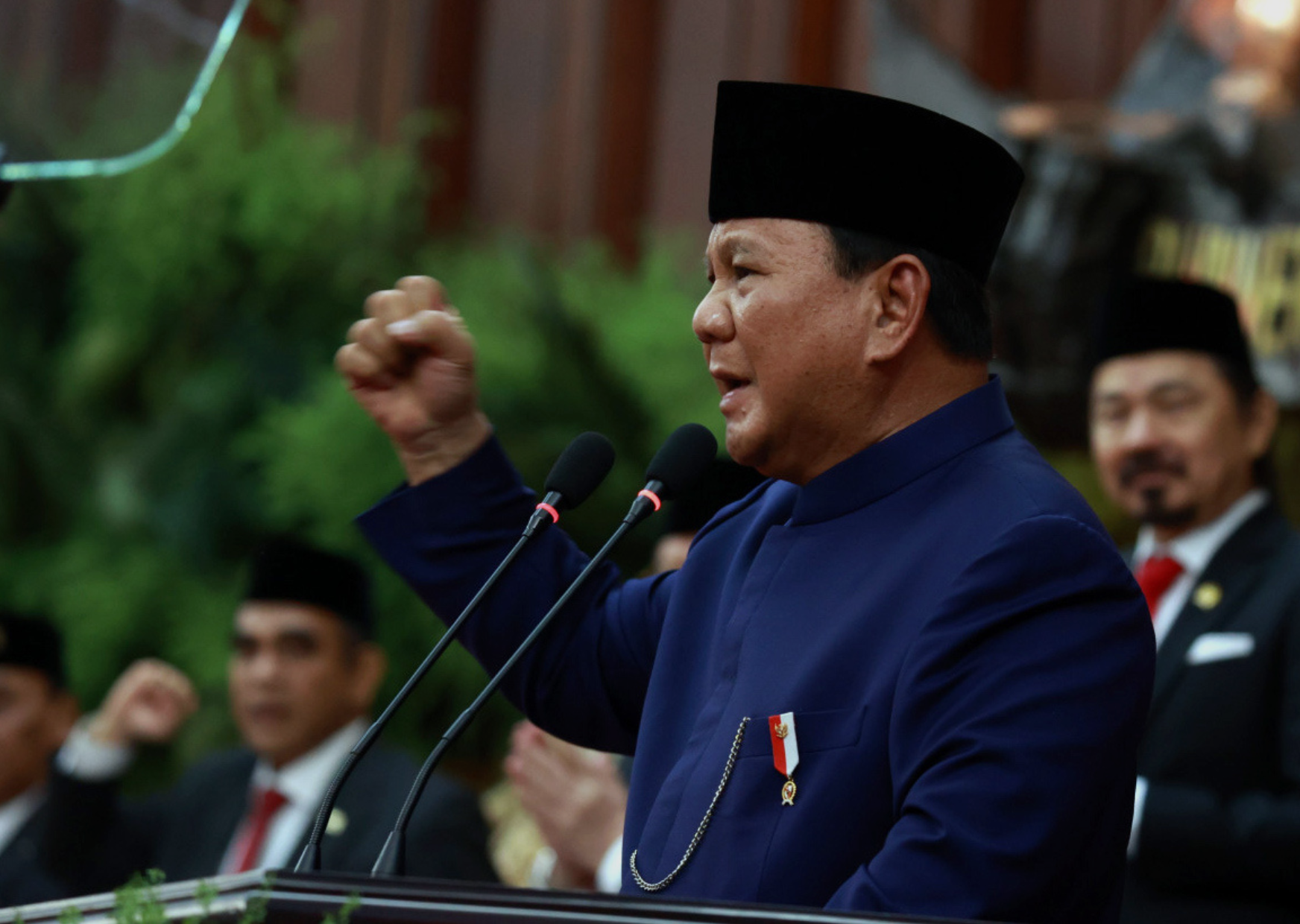
Prabowo’s presidency: Meals, power, and China
WRITTEN BY NATHANIEL SCHOCHET AND PEYSON HUNT
17 February 2026
When Indonesia’s President Subianto Prabowo came to power in 2024, he brought with him an ambitious populist agenda. Chief among them was the national meal programme Makan Bergizi Gratis (MBG). Nearing the one-year anniversary of its announcement, it has rapidly become the Prabowo administration’s most important policy initiative at the centre of its social welfare agenda. The programme, championed by the Indonesian National Armed Forces (TNI), has become increasingly reliant on the military’s capacity to compensate for institutional shortcomings. Prabowo’s national meal programme illustrates how domestic civil-military fusion has become a foundation of governance in Indonesia, reinforcing executive control, while subtly orienting the country’s foreign policy towards China.
Civil-military fusion
Although the MBG programme was designed to combat Indonesia's long-running challenge of childhood malnutrition and stunted growth by providing daily meals to school-age children and expectant mothers, its implementation has outpaced both the nation’s budgetary projections and its capacity. The budget has continued to balloon since the initiative's announcement from just over USD 10 billion to nearly USD 20 billion — with a portion of the original funds coming from Prabowo’s personal wealth — underscoring not only the fiscal challenges, but also the extent to which the administration has tied its legitimacy to the programme.
The administration has tasked TNI with implementing the meal programme nationally. However, untrained kitchen staff, inadequate storage facilities, disjointed logistics, and a lack of oversight have led to an underwhelming rollout and raised serious health risks. Over 6,000 students have been hospitalised with food poisoning as a result of these problems, highlighting institutional capacity constraints and insufficient preparation ahead of the programme’s hasty rollout.
The MBG programme stands as both a policy initiative and a political symbol of the Prabowo administration: ambitious in scope, reinforced by the military, and directed by an executive willing to subordinate bureaucracy and norms in pursuit of their goals.
The TNI plays a distinct and peculiar role in Indonesian society. Through decades of involvement in rural development, disaster response, and community outreach, the TNI has built a reputation for national stewardship and a legitimacy that many civilian ministries lack. Surveys routinely rank the TNI among the most trusted institutions in Indonesia, surpassing political parties and the bureaucracy at large. This differs from most national militaries due to the scale and ambiguous delineation of civil and military affairs. In the context of the meal programme, the military is responsible for distribution, transportation, coordination, and the direct handling of meal preparation in remote communities. Although this plays to the TNI’s logistical strengths and increases public confidence, the military could now be forced to spearhead a programme with the potential to erode the goodwill it has accumulated in the post-Suharto era.
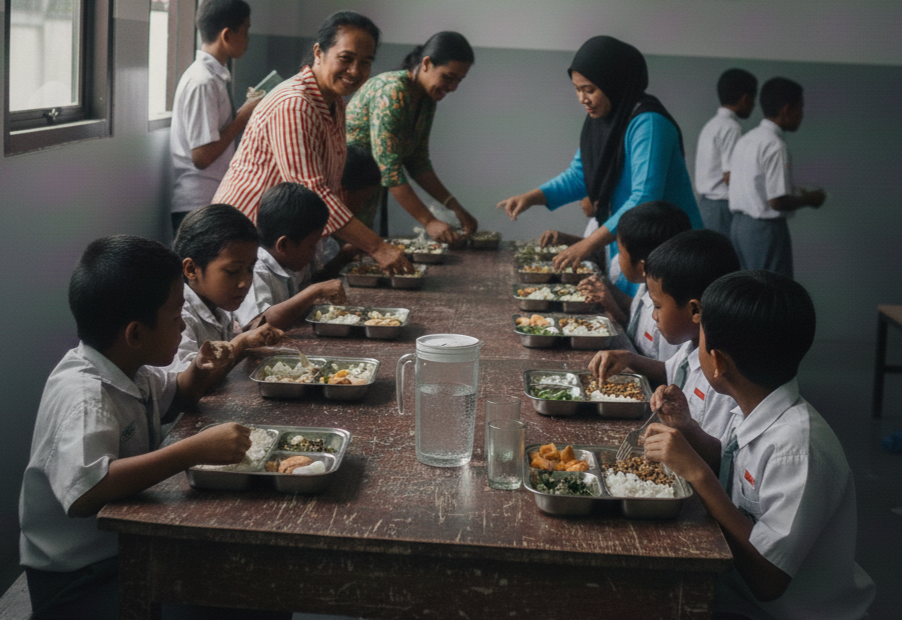
Image credit: Google Gemini
Beyond its immediate welfare objective, the MBG programme is emblematic of a broader pattern of executive authority consolidation increasingly characteristic of the Prabowo administration. The TNI’s swift and efficient mobilisation to manage the programme reflects both its institutional capacity and the societal acceptance of the TNI’s role in civilian affairs and institutions. This acceptance is rooted in Indonesia's strategic culture, in which the armed forces have traditionally been viewed as a binding force in a diverse, decentralised state. The TNI’s leadership of the meal programme reinforces a model of military-civil fusion that privileges the armed forces and consolidates Prabowo’s executive authority. This illustrates a broader governing approach under Prabowo, where military capacity is called upon to compensate for civilian institutional shortcomings and lack of trust from the public. The Indonesian civilian government has gained a reputation for corruption and poorly implemented policies, resulting in the public’s preference for the TNI and President Prabowo. The increasing centralisation of decision-making and circumvention of bureaucratic constraints has also expanded the executive’s ability to shape foreign policy. As the domestic political landscape within Indonesia has become more top down, so has its international relations, regional goals, and preference for likeminded partners that are able to direct their nations unilaterally.
The foreign policy president
Prabowo's presidency has already diverged significantly from that of his predecessor, Joko Widodo — who focused on domestic issues and improving the country’s economy — with some dubbing Prabowo the “foreign policy president”. He has strived to mould Indonesia into a more active player on the global stage, with reforms in civil-military fusion further advancing his agenda. Prabowo has consolidated power through reducing civilian constraints, such as marginalising civil society groups, and surrounding himself with military loyalists in an increasingly militarised bureaucracy, allowing him to expand the presidency's role in directly shaping foreign policy. Consequently, Prabowo has leveraged the executive’s expanded authority to pursue foreign direct investment (FDI) from China and other partners, signalling a shift away from Indonesia’s traditional equilibrium between the US and China.
Indonesia’s foreign policy is traditionally characterised as “independent and active” — which entails not siding with any major power and proactively engaging in regional and global issues — and Prabowo is particularly embracing the active component. He initiated his term with a high-stakes diplomatic balancing act, first anchoring relations in Beijing and Washington. This global outreach expanded through a strategic five-nation Middle East tour and key alliance-building in Japan, Canada, and the Netherlands, ultimately closing 2025 by engaging the distinct geopolitical poles of Australia and Russia.
Beyond diplomatic engagements, Prabowo has demonstrated a growing eagerness to take part in mini-lateral institutions. To the discomfort of the US, these ventures are predominantly viewed as aligning more closely with China. Just weeks after Prabowo’s inauguration, Indonesia joined BRICS, which President Trump had previously threatened with additional tariffs. Indonesia also increased its engagement with China’s other major mini-lateral, the Shanghai Cooperation Organisation (SCO), under the newly introduced SCO Plus format.
The Indonesia-China relationship
Indonesia and China have also sought to increase high-level engagements under Prabowo’s tenure, as exemplified by his attendance at the commemoration of China’s victory over Japan during WWII. Beyond this symbolic diplomacy, Indonesia became the first country to be a 2+2 dialogue partner of China during a meeting in April in which the two countries vowed to expand military-to-military cooperation.
Prabowo has repeatedly stated his admiration for former Chinese leader Deng Xiaoping’s transformation of China into an economic powerhouse. Prabowo hopes to bring about Indonesia’s own economic miracle so that the country can “stand on its own feet”, with China’s economic heft being integral to these efforts. It is Indonesia's largest trading partner, with bilateral trade reaching USD 135 billion and Chinese FDI totalling USD 8.1 billion in 2024. This deepening economic partnership further ties China to Indonesia’s development and makes it harder to oppose Beijing’s interests.
The development of these new relationships, alongside China’s key role as an economic partner, underscores the strategic reasoning of Prabowo’s pivot towards China. Accordingly, Prabowo could seek to emulate certain Chinese policies that have enhanced Chinese leader Xi Jinping’s authority, including the implementation of smart cities, which aim to augment state power. He could also expand trade and commerce between the two countries, helping Prabowo establish “enduring credibility” and thereby legitimising his decision to grant the military greater institutional power.
This is not to say the shift towards China is absolute. As Prabowo likes to say, “a thousand friends are too few, one enemy is too many”. Indonesia applied to join the Organisation for Economic Cooperation and Development (OECD) in June 2025 and signed the Australia-Indonesia Treaty of Common Security in February 2026 after upgrading its Defence Cooperation agreement with Australia. It also agreed to join Trump’s Board of Peace, a move that has caused some domestic strife. These measures signify Prabowo still seeks to engage with a diverse set of actors.
There are clear limits to Prabowo’s ability to move closer to China. His comments on the North Natuna Sea exemplify this. In November 2024, Prabowo controversially stated that "the two sides reached an important common understanding on joint development in areas of overlapping claims”. Officially, Indonesia asserts that there are no overlapping claims and that it has sole legal authority over the area. Prabowo’s comments undermine these claims and alarmed many in Indonesia, forcing officials to quickly walk back his statement. The South China Sea is not the only example of Chinese infringement on Indonesian sovereignty. A runway at Morowali Industrial Park — a major hub for Indonesia’s nickel industry — recently became a domestic scandal, as the Chinese have acted with semi-autonomy in the area through this clandestine airstrip. These issues highlight how persistent sovereignty issues, in conjunction with the complicated history between Indonesians and ethnic Chinese Indonesians, are likely to limit the rapid expansion of the relationship.
The window remains open
The MBG programme stands as both a policy initiative and a political symbol of the Prabowo administration: ambitious in scope, reinforced by the military, and directed by an executive willing to subordinate bureaucracy and norms in pursuit of their goals. Consequently, under Prabowo, the civil-military balance is eroding, potentially undermining the country’s democracy and leading to inefficient resource allocation. This centralisation of power in Prabowo's hands has enabled him to pursue a more active foreign policy and has yielded a policy stance that exhibits a limited tilt toward Beijing.
Prabowo views China as an indispensable economic partner and has seen how the country has developed through state-led growth, while maintaining social cohesion through rigorous top-down governance. Yet, its recent moves to join the OECD and upgrade its security relationship with Australia point to its desire to remain connected to both China and the West. This reflects a continuation of Indonesia's independent and active foreign policy, albeit with a slight tilt that could lead to a further erosion of Indonesian democratic norms and increased economic dependence on China. Indonesia’s deepening civil-military fusion warrants close observation by the US and its allies, as these developments could significantly shape the country’s external orientation.
DISCLAIMER: All views expressed are those of the writers and do not necessarily represent that of the 9DASHLINE.com platform.
Author biographies
Peyson Hunt is a researcher and Senior Visiting Fellow at the Cambodian Center for Regional Studies and a Regional Researcher at the Indo-Pacific Studies Center. His work focuses on ASEAN geopolitics, US foreign policy, and the shifting balance of power in Southeast Asia. His analysis appears in policy briefs, diplomatic reports, and international media, with a particular emphasis on regional diplomacy and U.S.–ASEAN engagement.
Nathaniel Schochet is a Senior Associate at CJPA Global Advisors and a Non-Resident Researcher at the Indo-Pacific Studies Center, focusing on Indo-Pacific security with an emphasis on Southeast Asia and China. He previously worked at the Center for a New American Security (CNAS).
Image credit: Wikimedia/Rahmat, Public Relations of the Cabinet Secretariat of the Republic of Indonesia.