Southeast Asian states are looking for options, but the United States isn’t giving them much to work with
Southeast Asian States Are Looking for Options, but the United States Isn’t Giving Them Much to Work With
WRITTEN BY HUNTER MARSTON
20 July 2026
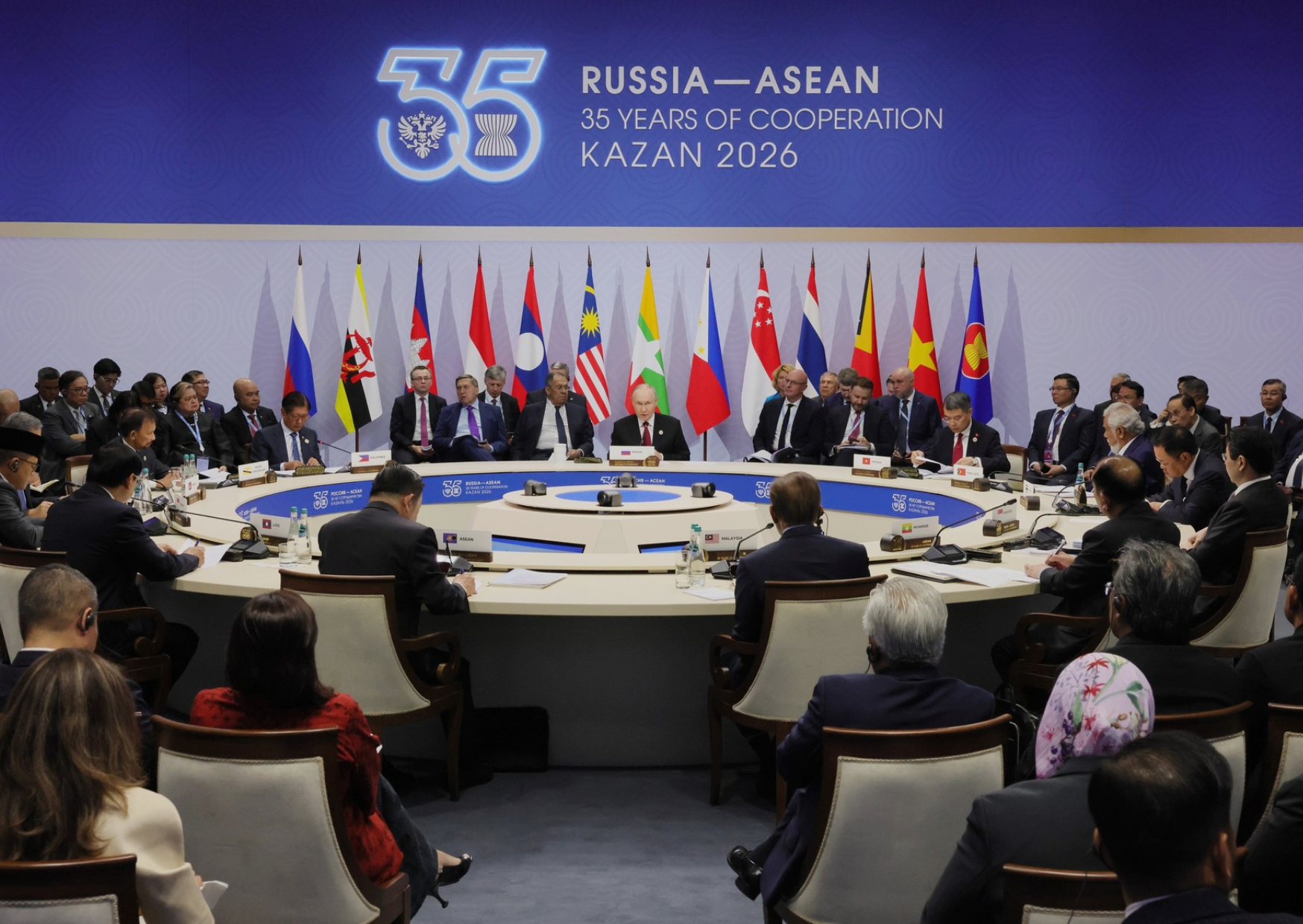
When leaders of the Association of Southeast Asian Nations (ASEAN) met with Russian leader Vladmir Putin in Kazan, 500 miles east of Moscow, for a commemorative summit on 17 and 18 June, they affirmed their “common aspiration…towards a just, multipolar world as guided by international law and the principles of the UN Charter to promote mutual benefit and respect for all states.” The emphasis on multipolarity, a frequent theme in Russian and Chinese talking points, marked a distinct shift for ASEAN, which more commonly refers to the importance of a “rules-based order” and “strategic autonomy.”
As the Trump administration pivots away from great power rivalry and urges Southeast Asian countries to look after their own security, the region is struggling to adjust to the return of a multipolar balance of power. While Russia and China have heralded the stabilising effects of multipolarity, Southeast Asian states are finding it far more unsettling than the previous era of great power rivalry, which was largely more predictable.
US partners are looking for alternatives
For the past two decades, Southeast Asian countries had grown comfortable hedging between the United States and China. The region largely looked to China as an economic partner and viewed the United States as a security guarantor — as well as an important source of investment. That status quo no longer holds. Instead, Southeast Asian countries find themselves in the uncomfortable position of hedging against both the United States and China for different reasons.
The Trump administration’s unilateral tariffs, policy incoherence, and distractions with Middle East adventurism have eroded US credibility and made it clear that Washington, just like Beijing, is a revisionist power and major source of instability. As a result, regional countries are diversifying and deepening their ties amongst one another and with a range of other middle powers, including Australia, Japan, South Korea, and Russia.
Heightened uncertainty has also prompted defections from the United States as the principal patron of a network of “like-minded” allies and partners. In response to the rapidly shifting balance of power, Southeast Asian countries are diversifying their economic ties to hedge against supply chain vulnerabilities and forging alternate security partnerships given an increasingly unreliable United States.
The recent Russia-ASEAN Summit is only the latest example of a more diffuse and loosely organised world order, in which Washington plays a less central role, and its rivals are calling the shots. While this emerging multipolar order is currently fuelling regional anxieties of instability and conflict in Southeast Asia, it is likely to be the new normal.
For instance, the Philippines, one of two US treaty allies in Southeast Asia, has concluded new defence cooperation agreements with Japan and Canada in the past two years, and is now exploring a visiting forces agreement with Germany. Even President Ferdinand Marcos Jr, a staunch American ally, defended Southeast Asia’s political and security engagement with Russia at the recent summit in Kazan. Malaysian Prime Minister Anwar Ibrahim heralded the commemorative gathering between ASEAN and Russia as a “good sign of our centrality and our preparedness to overcome these inherent prejudices.”
Singapore, the only Southeast Asian country that imposed sanctions on Russia following its invasion of Ukraine in 2021, also struck a softer tone. In a meeting with Putin, Prime Minister Lawrence Wong expressed his hopes for greater cooperation between ASEAN and Russia, something he promised to work on during Singapore’s chairmanship of the regional bloc in 2027.
Australia, one of Washington’s most important allies in the Pacific, is also deepening its strategic partnerships across Southeast Asia. In February, Canberra signed a new defence treaty with Indonesia, and Prime Minister Anthony Albanese also travelled to Malaysia, Singapore, and Brunei to secure new energy deals following the closure of the Strait of Hormuz in March.
Meanwhile, Vietnam, a budding US strategic partner under the Biden administration, has mended ties with China, its foremost security threat, and signed an array of comprehensive strategic partnerships with the European Union, Indonesia, New Zealand, Singapore, Thailand, and the United Kingdom — all since the beginning of 2025.
The American Strategic Drift
These widening and deepening linkages among middle powers suggest a profound unease with the shifting balance of power and growing global disorder, largely but not solely the result of US folly. This trend reflects the inherent instability of a multipolar world. It is no surprise that Russia and China have been the biggest proponents of multipolarity, in part because it entails a diminution of US power. But for Southeast Asian states, more options do not necessarily mean more security.
While a less powerful United States is not in and of itself unwelcome in Southeast Asia, most of the region — particularly those countries with territorial disputes in the South China Sea — still prefers a sustained US presence and commitment to the region to counterbalance China’s growing dominance. Unfortunately, Washington is giving them little reassurance that it will remain committed to the region in the longer term.
US officials have continued to assert that the Indo-Pacific remains Washington’s “priority theatre,” but the Trump administration’s actions belie its rhetorical commitment. The United States has shifted THAAD missile interceptors from South Korea to the Middle East to support its war with Iran and relocated carrier strike groups including the USS Nimitz, previously a part of the Pacific Fleet, to the Caribbean as part of the administration’s focus on the western hemisphere.
At this year’s Shangri La Dialogue in Singapore, Secretary of War Pete Hegseth urged Indo-Pacific countries to spend more on their own defence even as the threat from China that he belaboured in 2025 barely featured in remarks this year. But why should they increase their own defence spending if the United States will not come to their defence and the threat of China’s growing military power seems a distant priority?
The 2025 National Security Strategy gave short shrift to Southeast Asia, only mentioning it in reference to China’s excess commodity exports and deterrence across the Taiwan Strait. The 2026 National Defense Strategy does not mention the region at all. Southeast Asian countries are struggling to make sense of the implications. But they do not have time to sit around and wait for Washington.
The new multipolarity
While Southeast Asian leaders took some comfort in the recent summit between US President Donald Trump and Chinese President Xi Jinping in Beijing, in which the two leaders agreed to promote “constructive strategic stability,” the region is also wary of the two great powers growing too close. Southeast Asia would prefer US-China ties remain lukewarm, neither leading to a new Cold War nor the creation of a new G-2 which undercuts their interests.
The US is shedding allies and partners at a time when it cannot afford to, given that the balance of power has tilted in China’s favour. This trend is accelerating as a result of the administration’s compounding errors: Trump and his top advisers seem to believe that the United States is so powerful that it does not need to consider its allies’ interests, so it continues to alienate them through capricious investigations into their trade practices and unilateral militarism around the globe. The net effect is that the balance of power slips further out of US favour.
In response, Southeast Asian countries are actively seeking alternatives to de-risk from the United States. They now have more options available to them with a growing number of middle powers all stepping up their engagement in the region, including Australia, Japan, the European Union, and Russia.
While the Trump administration may welcome this newfound form of burden-sharing — much like it has advocated with NATO in Europe — which shifts the onus of leadership away from Washington, it will ultimately leave the United States in a weakened position, less able to shape the regional order to its preferences.
The recent Russia-ASEAN Summit is only the latest example of a more diffuse and loosely organised world order, in which Washington plays a less central role, and its rivals are calling the shots. While this emerging multipolar order is currently fuelling regional anxieties of instability and conflict in Southeast Asia, it is likely to be the new normal.
DISCLAIMER: All views expressed are those of the writer and do not necessarily represent those of the 9DASHLINE.com platform.
Author biography
Hunter Marston is the Director of the Southeast Asia Program and Lead of the Asia Power Index at the Lowy Institute, an Australian-based think tank. He is also an Associate with 9Dashline. Image Credit: kremlin.ru.