Artificial Islands, real power: reshaping maritime order in the South China Sea
Artificial Islands, Real Power: Reshaping Maritime Order in the South China Sea
WRITTEN BY GILANG KEMBARA
21 July 2026
A decade after the 2016 Permanent Court of Arbitration (PCA) ruling challenged the legal basis of China’s expansive claims, tensions in the South China Sea remain unresolved. The South China Sea, a strategic maritime region home to critical sea lanes of communication linking Southeast and East Asia, remains subject to overlapping territorial disputes between several Southeast Asian states and China (plus Taiwan). Intensifying military and political competition between China and the United States has drawn greater attention to this dispute, with the US and its partners maintaining a constant military presence in the South China Sea to counter China’s behaviour.
Against this geopolitical development, Beijing has rapidly expanded its presence in the disputed waters, aiming to consolidate its claims through routine patrols, domestic legal instruments, and island-building. The latter ultimately serves as a bulwark, not only against encroachment by other Southeast Asian claimant states, but against a potential US military threat seeking to dislodge China from the area.
The South China Sea today represents not merely a set of unresolved territorial disputes, but a contested space of legal authority and governance. Competing applications and understandings of maritime rights, combined with weak enforcement of international rulings, have created conditions under which formal legal frameworks coexist with — and are often challenged by — alternative practices. It is within this milieu of legal ambiguity and geopolitical competition that more recent developments, including China’s island-building effort, must be understood.
China’s island-building strategy is not only reshaping the maritime order, but provoking responses from regional claimants and external actors — whether through competition, imitation, or resistance — that unintentionally reinforce a practice-based order in which behaviour, rather than formal legal norms, determines outcomes.
Control in a contested domain
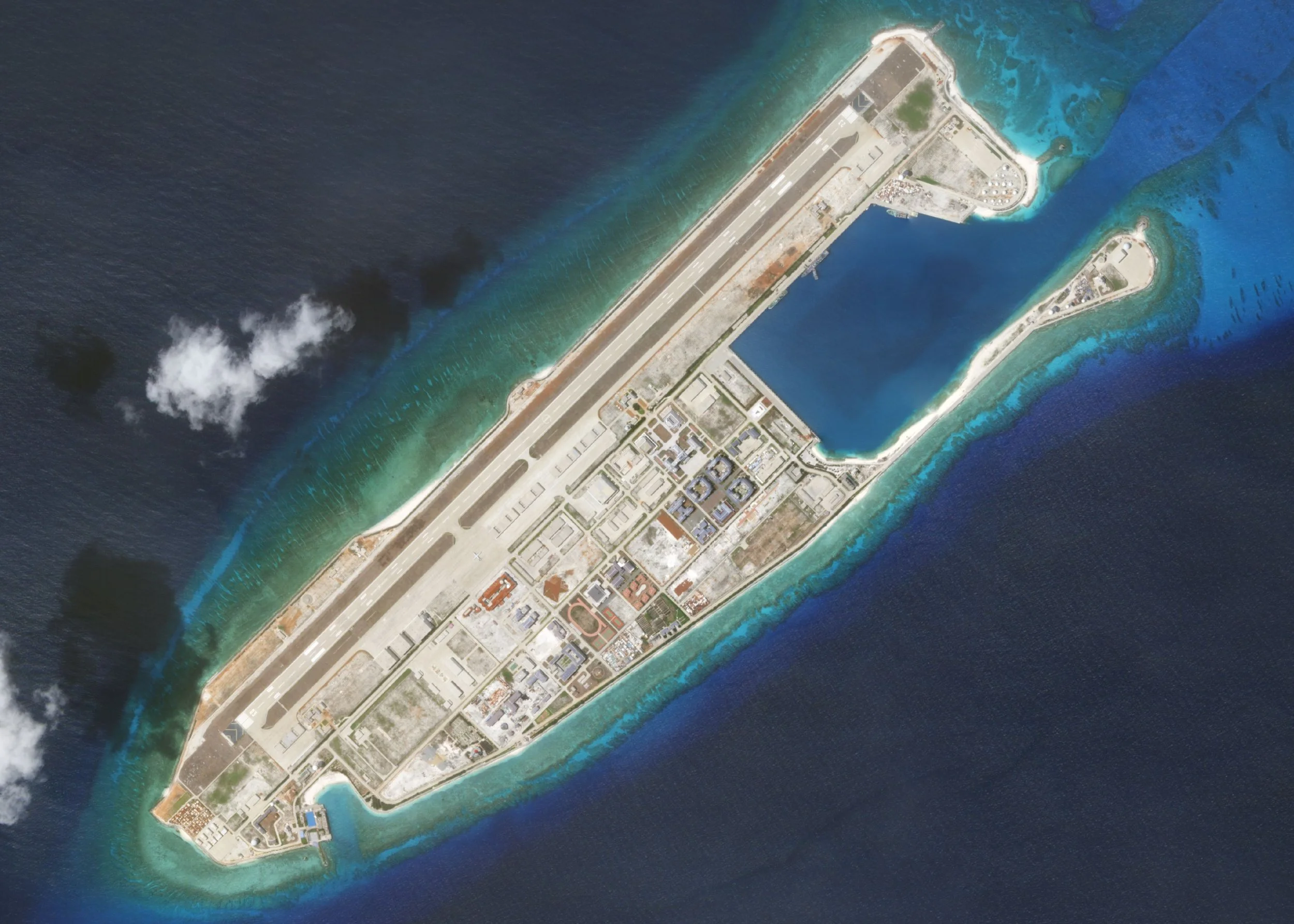
Since the early 2010s, China has undertaken an unprecedented programme of land reclamation in the South China Sea, creating roughly 5,460 acres of artificial islands. The construction of these islands and their supporting infrastructure is best understood as part of a broader strategy to consolidate control in a legally and politically contested environment.
This island-building programme is closely linked to a wider shift in China’s approach to the South China Sea — one that emphasises the ‘domestication’ of the region through increased constabulary activity, stronger authoritative control, and the integration of maritime spaces into China’s broader governance framework. Central to this process has been a reorganisaion of domestic legal instruments to better defend China’s claims and strengthen its capacity to expand its foothold in the South China Sea. The 1992 Law on the Territorial Sea and Contiguous Zone elevated the legal status of China’s disputed territorial claims and authorised the government to take “necessary measures” against foreign vessels engaged in “non-innocent passage” through the territorial seas of claimed features. Building on this foundation, the 1998 PRC Law on the Exclusive Economic Zone and Continental Shelf enshrined China’s claims to the maritime rights assigned by UNCLOS in domestic law, while also reserving unspecified ‘historic rights’ beyond the treaty.
Rather than a system defined solely by universally accepted legal norms, the South China Sea’s regional order is evolving into a ‘practice-based order’, in which rules emerge through sustained behaviour and enforcement rather than through formal agreements and norms. China is not abandoning UNCLOS but reinterpreting and operationalising it selectively. As a result, legal norms are increasingly mediated by power and practice rather than applied in a uniform and authoritative manner.
China’s assertiveness in the South China Sea has also drawn external actors into direct competition over contested waters, particularly the US. In 2018, the USS Decatur — conducting a freedom of navigation operation to challenge China’s excessive claims — nearly collided with the People’s Liberation Army (PLA) Navy destroyer Lanzhou near Gaven and Johnson Reefs.
The construction of artificial islands and consolidation of domestic legal frameworks both serve as key instruments through which China asserts control over disputed areas, functioning as tools of political and legal influence. Yet continued pushback from other claimant states, including non-regional actors, such as the US, has shaped the South China Sea into a contested maritime domain in which control is asserted through conduct at sea rather than legal channels, laying the groundwork for a larger transformation in the maritime order.
Transforming the maritime order
China’s assertive activities in the South China Sea are best understood not only as efforts to strengthen territorial claims, but as part of a broader shift in how the maritime order itself is conceived and practised. While the post-Cold War regional order has largely been grounded in legal frameworks such as the United Nations Convention on the Law of the Sea (UNCLOS), China increasingly seeks to reinterpret UNCLOS’s fundamental balances, demonstrating its ability to shape agendas in international politics.
Island-building reinforces this shift by altering the balance between legality and control. Artificial islands do not automatically generate full maritime entitlements under UNCLOS, but they can significantly enhance a state’s ability to exercise de facto control over surrounding waters. This distinction is crucial: by establishing and occupying these artificial islands, China is able to bypass legal uncertainty and instead anchor its claims in continuous physical presence.
These dynamics have driven regional adaptation, particularly Vietnam’s own island-building efforts. Since 2021, Hanoi has carried out extensive land reclamation across the Spratly Islands, expanding all of its occupied features and constructing new infrastructure and fortified facilities, with approximatly 2,771 acres of reclaimed land. Although smaller in scale, Vietnam’s activities demonstrate the diffusion of island-building as a strategic norm.

A member of CCG personnel caught on camera threatening to injure an AFP soldier with a pickaxe during a humanitarian rotation and resupply mission at BRP Sierra Madre in the Second Thomas Shoal on 17 June 2024. Image credit: Armed Forces of the Philippines/Wikimedia.
The Philippines offers a contrasting response. Although Manila has focused less on its own island-building programme, it has consistently pushed back against China through regular patrols and maritime surveillance. In 2024, a standoff between China and the Philippines near the Second Thomas Shoal injured several Filipino personnel, and in June 2026, the Philippine government officially protested the appearance of a Chinese floating structure at Scarborough Shoal, warning that it could mark the first step towards another artificial island. Yet Manila’s resistance, like Hanoi’s imitation, contests China through presence rather than law.
These responses point to a broader transformation in the maritime order. Rather than a system defined solely by universally accepted legal norms, the South China Sea’s regional order is evolving into a ‘practice-based order’, in which rules emerge through sustained behaviour and enforcement rather than through formal agreements and norms. China is not abandoning UNCLOS but reinterpreting and operationalising it selectively. As a result, legal norms are increasingly mediated by power and practice rather than applied in a uniform and authoritative manner. As rival claimant states imitate or resist China’s approach, they further entrench the emerging order.
Consolidating a practice-based order
The prevalence of island-building programmes and clashes over control in the South China Sea highlights the limitations of a maritime order grounded in legal frameworks but lacking effective enforcement. While the 2016 PCA ruling concluded that Beijing’s nine-dash line claims lacked legal basis under UNCLOS, China’s outright rejection of the decision demonstrates that international law alone cannot compel compliance when major powers question its authority. Legal norms therefore risk being weakened when they are persistently challenged by practices based on power, control, and historical tradition.
To that end, Beijing has persuaded claimant states such as Malaysia, Vietnam, and the Philippines to engage through bilateral consultation mechanisms set up to channel all formal communication on the South China Sea dispute. Beijing has a history of using this approach, which led to the agreements that established the land and maritime borders in the Gulf of Tonkin between China and Vietnam decades ago.
China also promotes the concept of “setting aside disputes and pursuing joint developments” in the South China Sea. Legally speaking, joint development would see both parties apply “provisional arrangements of a practical nature” to disputed maritime areas pending delimitation. However, Beijing conditions this on the principle that “sovereignty belongs to China”, so that any participation in joint development becomes an implicit recognition of China’s sovereignty.
To press claimant states towards this approach, China has consistently interfered with the oil and gas explorations of various South China Sea claimant states within their respective EEZs. Beijing’s coercive measures make independent exploration so costly and dangerous that claimant states are left with little choice but to partner with Beijing on joint development, on its terms.
This has ultimately contributed to greater instability and strategic competition across the region. Other claimant states have responded with legal, diplomatic, and security measures, while external actors have increased their involvement, producing a more contested and militarised environment. Consequently, a practice-based maritime order is born, in which rules are shaped through sustained behaviour rather than universally enforced regulations. While China initiated this transformation through island-building and maritime coercion, its consolidation has depended on the participation of others. Whether through Washington’s competition, Hanoi’s imitation, or Manila’s resistance, each has increasingly engaged Bejing on the basis of presence, capability, and control rather than the legal principles embodied in UNCLOS. Far from limiting China’s challenge to the existing order, such responses have accelerated the shift away from a rules-based framework and towards the maritime order Beijing seeks to construct: one in which effective control supersedes international legal entitlement.
DISCLAIMER: All views expressed are those of the writer and do not necessarily represent those of the 9DASHLINE.com platform.
Author Biography
Gilang Kembara is a Postgraduate Research Student in the School of Global Affairs at Lancaster University, UK. Image Credit: SkySat/Wikimedia.