Nepal's new political generation and the India-China contest for influence
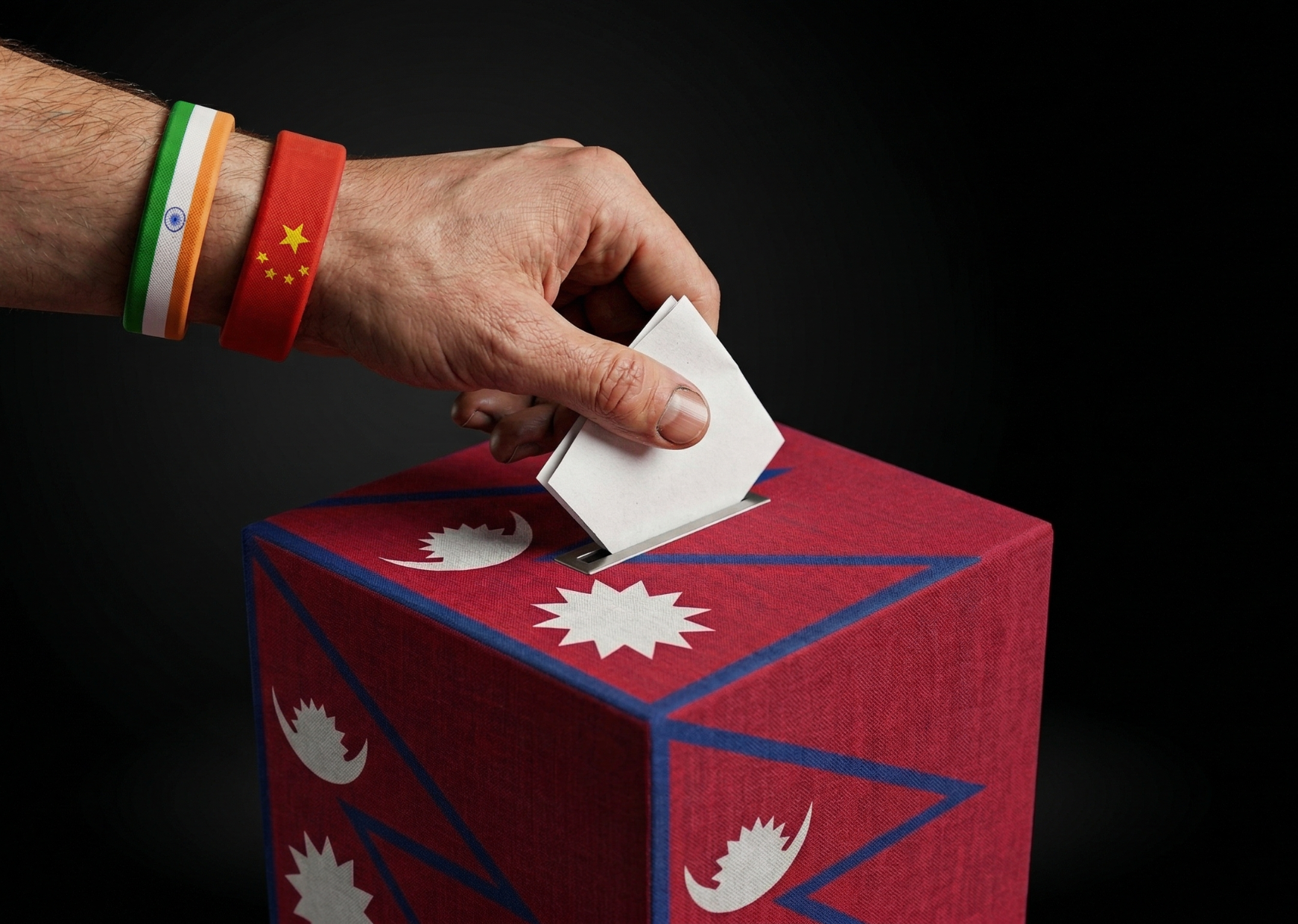
Nepal’s new political generation and the India-China contest for influence
WRITTEN BY OMKAR BHOLE
20 March 2026
Nepal’s 2026 elections have not only produced one of the most dramatic political shifts in the country’s recent history, but also have the potential to reshape how external actors engage in Nepal. The sweeping victory of the Rastriya Swatantra Party (RSP) and the rise of Balendra Shah as the leading prime ministerial candidate signal the arrival of a new political generation shaped by the youth-led protests of 2025. The September 2025 protests — largely led by young voters frustrated with rampant corruption, entrenched political elites, and limited economic opportunities — toppled the previous political order and set the stage for an election that has fundamentally altered Nepal’s political landscape.
For external powers, the implications of these elections extend beyond Kathmandu’s domestic politics. India and China have long pursued influence in Nepal through distinct strategies: India through institutional linkages and deep socio-economic interdependence, and China through infrastructure financing and economic statecraft. These competing strategies were visible leading up to the 2026 elections. While India provided around 650 vehicles and other logistical equipment to support Nepal’s electoral administration, China extended financial aid worth USD 4 million, reportedly conditional on its use only for election purposes.
The emergence of a reformist, Gen Z-backed government now introduces a new political variable. Leadership shaped by protests and popular demands for governance reform is likely to evaluate external partnerships based on development outcomes and greater transparency. The question confronting India and China, therefore, is not whether competition for influence will continue — but whether their existing engagement models are suited to a political system formed by growing youth aspirations, which include improved access to education, decentralisation of power, employment opportunities, and higher governance accountability.
A generational political reset
The scale of RSP’s electoral success, winning 182 seats in a 275-member parliament, reflects widespread dissatisfaction among younger Nepalis with the country’s traditional political order. Despite its democratic transition in 2008, Nepal’s political landscape was long dominated by a few established parties. Persistent coalition instability, elite power-sharing arrangements, and recurring corruption scandals have gradually eroded public trust, particularly among urban youth. Balendra Shah’s political rise is closely tied to this generational shift towards demands for administrative accountability. His campaign emphasised administrative efficiency, anti-corruption measures, digital governance, and urban development — issues that resonate strongly with the younger electorate.
Nepal’s 2026 elections have not fundamentally altered the structural realities of its foreign policy, but they have introduced Gen Z as a new political actor that could reshape how external influence is exercised.
This generational transformation also carries implications for Nepal’s foreign policy. Rather than aligning closely with any single external partner, the new government appears inclined towards pragmatic engagement with multiple actors — including India, China, and Western partners — to prioritise economic outcomes. The RSP leadership’s call to follow a “balanced and independent” foreign policy with an emphasis on “development diplomacy” signals Nepal’s evolving external priorities. As a result, infrastructure development, investment flows, energy cooperation, and employment opportunities are likely to dominate the new government’s external engagement agenda. Meanwhile, the emergence of a strong single-party mandate could reduce the policy volatility that characterised previous coalition governments, narrowing the strategic space for external actors to leverage domestic political instability for strategic advantage.
The proposed Jhapa Industrial Park serves as a notable example. To gain leverage in his own constituency of Jhapa 5, then-Prime Minister KP Sharma Oli signed the Memorandum of Understanding for this project in 2019 with a Chinese company, which was also later included in China’s Belt and Road Initiative (BRI). However, the PM-designate Balendra Shah, who defeated Oli in the Jhapa 5 constituency, removed this project from his election manifesto, indicating a reassessment of its long-term financial benefits for the Nepali population. Similarly, Shah’s past actions as Kathmandu Mayor — such as invoking the “Greater Nepal” map, which includes Indian territories, and opposing an Indian film over cultural misrepresentation — highlight his focus on sovereignty and cultural sensitivities that could play a major role in shaping future India-Nepal relations. Together, these signals suggest that external influence in Kathmandu may depend less on traditional political networks and more on the ability of external actors to contribute to Nepal’s development priorities and youth aspirations.
Limitations for India and China’s strategies
India and China enter this new political era with contrasting strategies for maintaining influence in Nepal. India retains structural advantages that no external power can easily replicate. Geography binds Nepal’s trade routes, transit access, and labour mobility to the Indian economy. India remains Nepal’s largest trading partner, and cross-border ties remain deeply embedded in both societies. Institutional cooperation — such as training and coordination between the election commissions of both countries — has also embedded India within Nepal’s governance structures.
Yet this structural proximity does not automatically translate into political influence. Past bilateral crises, particularly the 2015 blockade episode that followed tensions over Nepal’s new constitution, continue to shape segments of Nepali public opinion among youths. Many Nepalis interpreted India’s response to the constitutional dispute as political pressure, contributing to lingering perceptions of Indian interference. These concerns, coupled with perceptions of its political overreach and delayed project deliveries, have occasionally fuelled anti-India sentiments. In a more politically mobilised Nepal, such perceptions may constrain India’s ability to convert structural advantages into sustained political goodwill.
China’s strategy, by contrast, has relied significantly on economic engagements. Infrastructure financing, development assistance, and investment projects have allowed Beijing to rapidly expand its presence in Nepal over the past decade. Such financial flexibility enables China to engage multiple political actors without tying itself to a single political outcome.
However, China’s growing economic footprint has also faced increasing scrutiny. Concerns about the financial viability of projects, debt sustainability, and project management have surfaced in several high-profile cases, including controversies surrounding the Pokhara International Airport project and cancellation of a Chinese-backed 5G contract. These developments have complicated Beijing’s efforts to translate commercial engagements into long-term political trust.
A reform-oriented government led by the RSP is therefore likely to subject large foreign infrastructure projects to closer scrutiny. This environment could expose the limitations of both countries’ traditional approaches towards Nepal, compelling them to alter their respective Himalayan strategies.
Engaging Nepal’s Gen Z
Perhaps the most consequential long-term shift driving India and China’s influence lies in the growing political influence of Gen Z voters in Nepal, where 56 per cent of the population is under the age of 30. Their influence is evident: around 38 per cent of elected representatives in the 2026 elections are under 40, marking a significant jump from just 11 per cent in the 2022 elections. This highlights that economic opportunities, access to education, digital connectivity, and employment prospects are not peripheral concerns — they are central to young Nepalis’ expectations for both domestic governance and external engagement.
For India, this shift presents renewed challenges for their public diplomacy strategy. Historical ties, cultural affinity, and geographic proximity remain important foundations of the bilateral relationship, but they may not be sufficient to shape lasting perceptions among a generation that prioritises upward mobility and technological advancements. To remain influential, India will need to complement its structural advantages with a more proactive engagement strategy — particularly in areas such as digital innovation, educational partnerships, startup ecosystems, and cross-border employment opportunities. Demonstrating tangible developmental value to Nepal’s younger generation will likely become as crucial as maintaining traditional diplomatic linkages. In this regard, joint initiatives like the High Impact Community Development Programme — which involves 502 completed projects across Nepal to address its grassroots infrastructure gaps — can make a significant positive impact on India’s goodwill and influence.
On the other hand, China’s growing presence in Nepal’s economic and educational landscape has enhanced its appeal among younger Nepalis. Chinese universities and scholarship programmes have attracted increasing numbers of Nepali students, while Chinese infrastructure projects have enhanced Beijing’s visibility as a development partner. Yet, China’s engagement strategy will also have to navigate rising youth aspirations. A politically mobilised youth electorate is likely to enforce stricter scrutiny of transparency standards, with projects perceived as opaque or financially burdensome facing stronger public criticism.
The way ahead
Nepal’s 2026 elections have not fundamentally altered the structural realities of its foreign policy, but they have introduced Gen Z as a new political actor that could reshape how external influence is exercised. The rise of the RSP reflects deeper generational and institutional shifts in Nepal’s political landscape, creating a more fluid environment for regional diplomacy. A government propelled by youth mobilisation and reformist expectations will inevitably place greater emphasis on bureaucratic performance and openness in its engagement with international partners.
For India and China, this evolving landscape requires adapting to a political space where influence will be judged less by historical proximity or financial scale and more by the credibility and effectiveness of their engagement. Cooperation based on visible developmental benefits, respect for governance standards, and resonance with public expectations is likely to carry greater weight in shaping perceptions of partnership.
As Nepal navigates this new political moment, its traditional balancing strategy will likely persist, but in a more calibrated form — one that leverages competition between external actors while safeguarding domestic autonomy. Ultimately, external influence in Kathmandu will hinge on which partner proves more capable of adapting to a Nepal defined by generational change and reformist ambitions.
DISCLAIMER: All views expressed are those of the writer and do not necessarily represent those of the 9DASHLINE.com platform.
Author biography
Omkar Bhole is a Senior Research Associate at Delhi-based Organisation for Research on China and Asia (ORCA). His research focuses on the Chinese economy, domestic politics, India’s neighbourhood policy, and China’s foreign policy in South Asia. Omkar has previously conducted a public opinion survey in Nepal. Image credit: Gemini AI.