Nepal’s Flash Floods: A Devastating Reflection of Weakening International Climate Responsibility
Nepal’s flash floods: a devastating reflection of weakening international climate responsibility
WRITTEN BY LUANA CORREIA
14 October 2026
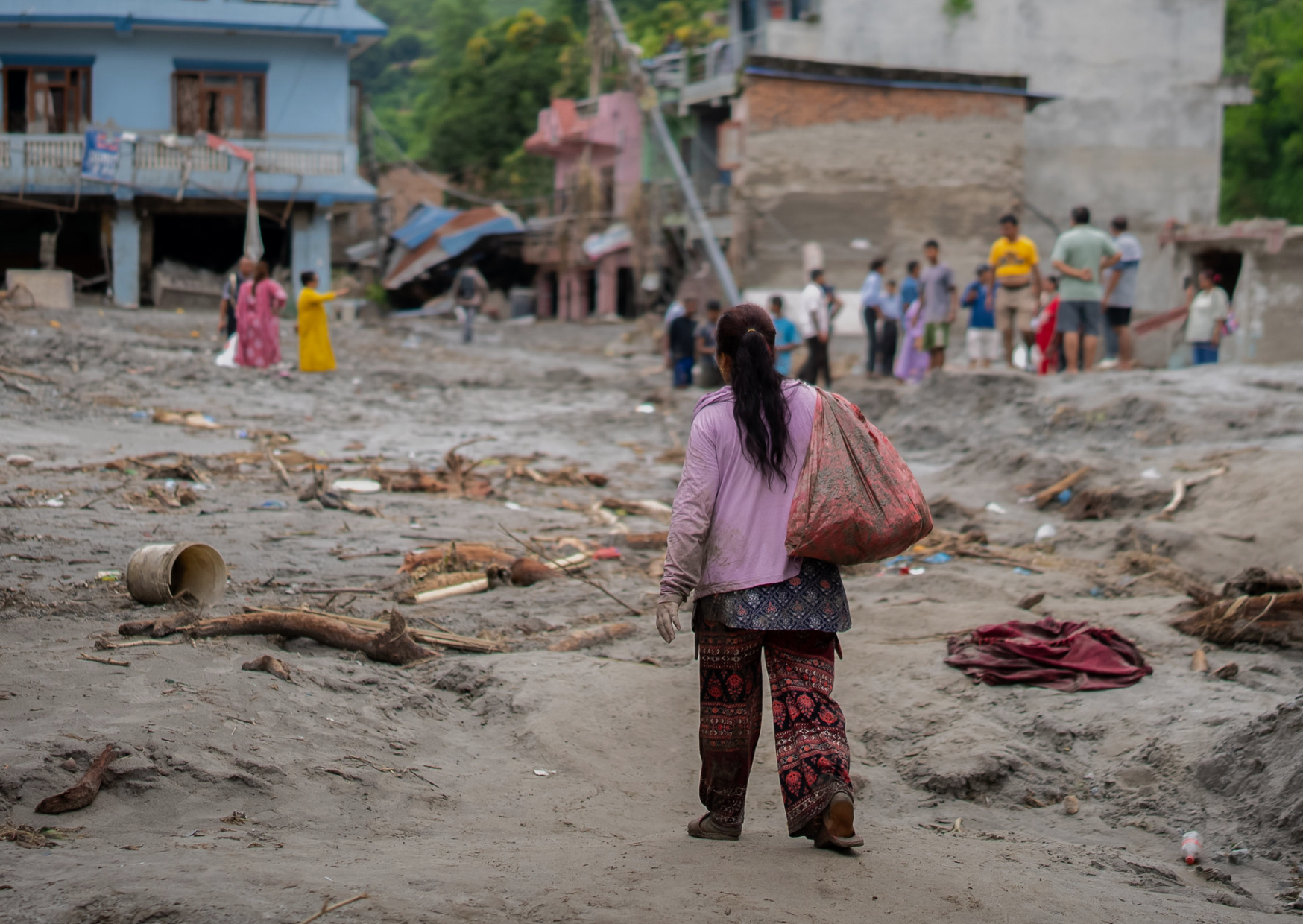
The flash floods that hit Nepal in August 2026 have caused lasting devastation, and an estimated USD 4.71 billion is needed to cover economic losses, repair damage, and reduce vulnerability to further disasters. Initially suspected of being triggered by an earthquake, investigations later found that the floods were caused by debris from a collapsed glacier near the Langtang Lirung peak, which made rivers downstream rise by seven to nine metres within half an hour. The international rescue and relief response was quick: within 72 hours of identifying the need for assistance, rescue teams from India, South Korea, and China were on site and operational. Several other countries, as well as international organisations, including the UN, followed.
The severity of Nepal’s floods was shocking, but they were not the first of their kind in the region. Glaciers in the Hindu Kush Himalaya have been rapidly melting for decades, and a study on the cause of Nepal’s latest glacier collapse underlined climate change as a “destabilising factor”, linking the event to “human influence on the climate”. These findings underpin Nepal’s request for financial assistance to the Loss and Damage Fund, a UN finance mechanism to support communities in dealing with climate-related damage. Kathmandu has highlighted the injustice of paying for the consequences of climate change considering its negligible greenhouse gas (GHG) emissions, stating that major industrial emitters bear responsibility for “justice and compensation”.
However, securing enough recovery funds will be challenging, if not impossible. Bilateral financing is unlikely to be sufficient to cover Nepal’s large recovery bill, and the Loss and Damage Fund has severe limitations. Alternative funding is also improbable, as global climate action has suffered from wealthy nations’ pulling back in recent years. Leaving Nepal to fend for itself would likely mean inaction towards the threatened Himalayas. This would, inevitably, lead to consequences for approximately 2 billion people across South and Southeast Asia.
Warming Himalayas and the role of large emitters
In recent years, Nepal and India have seen multiple disasters caused by glacier collapse, lake outbursts, and heavy rainfall. While geology makes the Himalayas more prone to certain disasters, global warming makes them more likely and severe. In addition to thawing permafrost and destabilising glaciers, warming accelerates snow melt and leads to more precipitation falling as rain — effects that significantly increase the risk of flooding and landslides. Warming in the Himalayas is not a novelty: research published in March 2026 found that glaciers in the Hindu Kush Himalaya have been rapidly melting for decades, with ice loss rates doubling since 2000. A study by World Weather Attribution investigating Nepal’s latest glacier collapse also observed an unusually warm 12-month period preceding the collapse, attributable to human-caused climate change.
While the impacts on the region are imminent and unavoidable, they can be minimised through adequate adaptation and mitigation efforts. This requires wealthier, more capable actors to strengthen their multilateral climate finance commitments and provide impacted nations such as Nepal with strong reconstruction and recovery support.
The role of climate change in Nepal’s floods and its attribution to human influence is Kathmandu’s strongest argument for requesting compensation from international actors. When Nepalese Foreign Minister Shishir Khanal stated that the responsibility for compensation should fall on major global emitters, he named two Himalayan neighbours — China and India. In 2025, China and India were the first and third largest GHG emitters globally, emitting 29.5 per cent and 8.3 per cent of total shares, respectively, compared with Nepal’s meagre 0.08 per cent. It should be in both nations’ interest to limit the impact of climate catastrophes in the Himalayas, a mountain range that supports their economies through tourism, energy, and agriculture. The interconnectedness of Himalayan ecosystems also means that the impacts of a localised climate disaster are likely to spread across borders. India and China certainly have an important role to play in managing regional climate crises. Still, the responsibility to pay for climate impacts extends far beyond Himalayan borders.
India has previously emphasised its relatively low GHG emissions per capita — ranking 132nd globally. China ranks much higher, at 31st, but still sits well below leading oil-rich states, as well as the US, Australia, and Canada, among others. Additionally, after decades of rapid increase, China’s emissions remained broadly stable in 2025, while India’s even decreased slightly. Meanwhile, the US, as second largest GHG emitter in 2025, ranked 18th globally in per capita emissions. More importantly, the US recorded the largest absolute increase among top emitters from the previous year, reflecting a shift away from the trend in which sharply growing emissions had been observed mainly in emerging economies. While it is useful to consider emerging economies in debates over who pays for climate change, it is especially pertinent to focus on wealthier nations whose earlier industrialisation produced historically high emissions.
Nepal’s quest for climate justice
Regardless of which countries bear the most responsibility, the amount of funds needed for Nepal’s reconstruction is too significant to be addressed bilaterally. While full assessments of Nepal’s financial needs following the August floods are still underway, the latest estimate of funds required to compensate for economic losses, repair damaged infrastructure, and implement climate resilience measures stands at USD 4.71 billion. This is equivalent to about 10 per cent of Nepal’s annual GDP, leaving Kathmandu with the option of taking on debt to cover these costs, or turning to the international arena for an alternative. Its decision to pursue the latter has been supported by the bloc of the world’s 44 least developed countries (LDCs), of which Nepal is a member. LDCs have previously been vocal about the injustice of bearing disproportionate climate impacts while contributing the least to climate change, using fora such as the annual United Nations Climate Change Conference (COP) to advocate for compensation and mitigation efforts from wealthy emitters.
Less than a week after the floods, Nepal’s government filed a request for financial assistance from the UN Fund for Responding to Loss and Damage. The fund, established during COP28 in 2023, is meant to assist developing and climate-vulnerable countries in managing loss and damage caused by climate change. Nepal has framed this as not a request for aid or charity but as a call on the countries responsible for climate change to honour their legal and moral obligation to compensate vulnerable nations for climate change-related harm.
To draw international attention to its financing gap and the injustice of leaving Nepal to fend for itself, Nepalese Prime Minister Balendra Shah also dedicated his address to the issue at the UN General Assembly in September. He described the floods as a climate change “warning”, hitting South Asia hardest despite its negligible role in contributing to it. More importantly, he stressed the need for stronger multilateral cooperation through the UN, better representation of climate-vulnerable and LDCs, more accessible climate finance, and equity and justice in the climate fight. Should the Loss and Damage Fund and other UN financing mechanisms support Nepal, the UN would prove its ability to set up functional climate compensation systems and advance global climate justice.
What happens when nobody shows up?
Despite Nepal’s firm position that major industrial emitters and multilateral institutions such as the UN must pay for August’s floods, it is unlikely to receive anything close to the financing it needs for reconstruction. First, the Loss and Damage Fund is severely underfunded. It currently has USD 822 million in pledges, yet the 190 open applications already request a combined USD 2.8 billion. This amount is still far below the estimated annual cost of climate-driven loss and damage compensation — around USD 400 billion. Further, the fund’s limited budget and early stage mean that payouts are currently capped at USD 20 million per disaster. While receiving this amount would be a symbolic win for Nepal, the country would need to seek further financing elsewhere to cover nearly all of its recovery costs.
Yet securing alternative funding will also be challenging, as wealthy states have consistently scaled back their climate efforts in recent years. Since returning to office in 2025, US President Donald Trump has cut national and multilateral climate initiatives, frequently voicing his doubts about global warming and skipping international climate conferences such as COP30. Although the US has stepped back from climate priorities with exceptional intensity, the trend is visible across other wealthy nations. Environment and Climate Change Canada’s 2024-25 Departmental Plan outlined significant, progressively deeper budget cuts for the following years, while earlier this year, the UK halved its contribution to the UN Green Climate Fund, the world’s largest dedicated climate fund. These examples reflect a broader deterioration in global climate action, visible in lacklustre multilateral outcomes such as fragile negotiations and weak commitments at COP30 in 2025.
It would be a mistake to assume that this weakening of climate commitments and finance reflects a lack of global money. Rather, the global climate governance order is destabilising, and many wealthy nations are shifting their priorities towards defence and security. Still, nations and investors continue to subsidise fossil fuels in vast amounts — funds that could be redirected towards climate innovation and green transitions.
Ultimately, Nepal’s floods were a severe demonstration of how climate change may be pushing the Himalayan cryosphere towards tipping points of irreversible retreat — a development that will endanger around 2 billion people across South and Southeast Asia. While the impacts on the region are imminent and unavoidable, they can be minimised through adequate adaptation and mitigation efforts. This requires wealthier, more capable actors to strengthen their multilateral climate finance commitments and provide impacted nations such as Nepal with strong reconstruction and recovery support.
DISCLAIMER: All views expressed are those of the writer and do not necessarily represent those of the 9DASHLINE.com platform.
Author biography
Luana Correia is an assistant editor at 9DASHLINE and has previously worked on communications at the Global Center on Adaptation and at the European Commission’s Directorate-General for Energy. Image credit: Flickr/UN Women Asia and the Pacific.