In Conversation with Dr Eva Seiwert, Senior Analyst, MERICS
27 August 2026
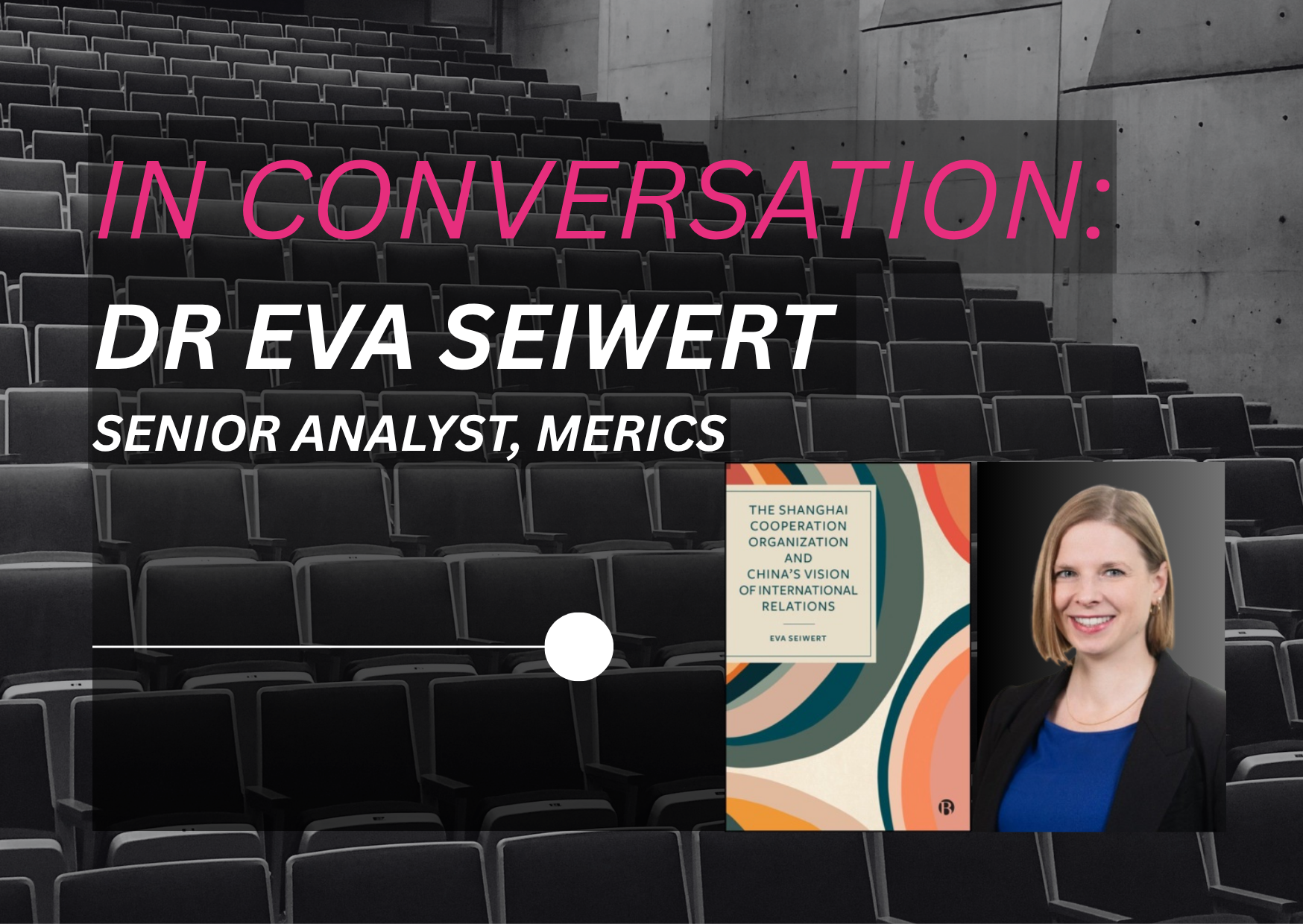
From 31 August to 1 September 2026, heads of state gather for the Shanghai Cooperation Organization (SCO) summit in Bishkek, Kyrgyzstan. With the SCO marking its 25th anniversary, 9DASHLINE had the pleasure of speaking with Dr Eva Seiwert about her latest book: The Shanghai Cooperation Organization and China’s Vision of International Relations.
This book explores China’s evolving ambitions in international relations by looking at its strategic use of the Shanghai Cooperation Organization. Building extensively on Chinese-language documents and interviews, the book uncovers how China has positioned the SCO as a testing ground and platform for its normative ideas for an alternative international order. Additionally, we spoke to Dr Seiwert about the SCO’s role in current geopolitical crises.
9DL: You observe that the SCO promotes the idea that regional problems are best addressed through regional institutions. How do China and other member states define the ‘region’ over which the SCO claims competence?
ES: The SCO’s geography has become genuinely difficult to pin down since three rounds of expansion: India and Pakistan (South Asia) became full members in June 2017, Iran (Western Asia) in July 2023, and Belarus (Europe) in July 2024, going well beyond the initially narrow focus on Central Asia. Because of this, more recent SCO declarations have regularly reaffirmed that Central Asia remains the “core of the SCO”.
Interestingly, no SCO member state promotes the organisation itself as the vehicle for resolving the region’s problems. Even if we think only of Central Asia, the organisation is presented primarily as a platform for regular consultation among members rather than a body tasked with resolving regional problems. Afghanistan is perhaps the clearest illustration: every direct neighbour of Afghanistan except Turkmenistan is affiliated with the SCO (Afghanistan itself became observer state in 2012), Afghan instability sits squarely within the SCO’s “Three Evils” agenda, and nearly every member is directly exposed to any spillover. Still, SCO statements mostly applaud individual member states’ own initiatives on Afghanistan rather than calling for the organisation itself to do more – and member states have similarly rejected the idea that the SCO should take a more active role in regional disputes over water or territory, something a number of my interviewees from the region raised as a frustration. This seems to trace back to the members’ – especially the Central Asian states’ – strong reluctance to cede any sovereignty in exchange for a more empowered, effective SCO.
9DL: The “Three Evils” framework deliberately groups together very different phenomena. What does that tell us about how SCO states conceptualise security threats?
ES: The “Three Evils” (san gu shili) – terrorism, separatism, and extremism – is a distinctly Chinese formulation that groups three phenomena which member states have historically weighted differently. Bundling them together lets the SCO build cooperation around a threat every member could recognise on its own terms, even where the underlying phenomena on the ground differed.
This had a legitimising effect too. Terrorism is a concept that already carries near-universal international legitimacy as something to be fought. By grafting “separatism” and “extremism” onto “terrorism” in the same breath, the SCO effectively borrowed that legitimacy for the other two – broadening what could be justified as counter-terrorism. That dynamic was amplified by 9/11 and the US-led “Global War on Terror”, which gave China and other SCO states additional political cover to frame their own domestic crackdowns as contributions to a globally sanctioned fight against terrorism. The framework thus deliberately blurs the distinction between violent acts and political challenges to state authority, allowing governments considerable discretion in defining what constitutes a security threat.
9DL: China’s insistence on the principle of non-interference is often linked either to the legacy of the ‘Century of Humiliation’ or to a desire to avoid the responsibilities that accompany great-power status. Beyond the official rhetoric, what factors do you think shape this approach to non-interference?
ES: China appears to want to be a different kind of great power than the US has been in the past few decades; reluctant to take on the kind of expansive, exposed leadership role that invites failure and blowback. The logic is fairly straightforward: the more visibly involved you are in resolving something that isn’t fully within your control, the more exposed you are if it goes wrong, and the more visible that failure is to everyone watching. Staying at arm’s length – statements of concern, “constructive” support, quiet coordination – lets China claim credit when things go well without losing face when they don’t. Non-interference functions here as both a genuine normative commitment and a convenient shield, by letting Beijing frame caution as principle rather than risk-aversion.
This also shows up in how cautiously Beijing positions itself as a mediator: it typically gets involved once a deal is largely settled, or works in the background rather than out front. Two examples are the Saudi Arabia-Iran normalisation agreement – announced in Beijing in March 2023, though most of the earlier back-channel negotiations had been facilitated by Iraq and Oman – and the initial April 2026 ceasefire between Iran and the US, where Pakistan was the primary broker but Beijing reportedly provided diplomatic support behind the scenes.
9DL: In Chapter 7, you argue that the SCO advocates a “multi-layered interpretation of non-interference” that accounts for relative geographical and political proximity. Could you elaborate on the types of behaviour this interpretation permits?
ES: This reading comes out of my analysis of six security crises across two chapters: three “regional” crises close to the SCO’s core territory – the Kyrgyzstan revolutions of 2005 and 2010, instability in Afghanistan, and the Iran nuclear issue (Chapter 6) – and three crises “outside the immediate orbit” involving unilateral action by a member state – the Syrian Civil War, the Russo-Georgian War of 2008, and the Russia-Ukraine war since 2014 (Chapter 7).
The SCO’s non-interference norm turns out to have two main layers, depending on who is doing the “interfering”. Regional states – those directly affected by a crisis in their own neighbourhood – are allowed to get involved, but only through non-military means, such as diplomatic pressure or statements. Outside states, by contrast, are not permitted to act unilaterally at all: they may only get involved multilaterally, and only with the consent of the host government and/or the UN. This is a deliberate rebuff of doctrines like R2P, which China and Russia have both long criticised.
The obvious contradiction is Russia’s own conduct: both Russia’s wars against Georgia in 2008 and Ukraine since 2014 have been direct military interventions without the target government’s consent. The SCO has never explicitly criticised Russia for either. I’d argue that all of this costs the organisation credibility and undermines China’s ability to use the SCO as a credible vehicle for its norms – as is generally true whenever a state acts against principles it professes elsewhere (comparable, for instance, to gaps between the EU’s stated values and its record on Gaza, or its vaccine hoarding during the COVID pandemic).
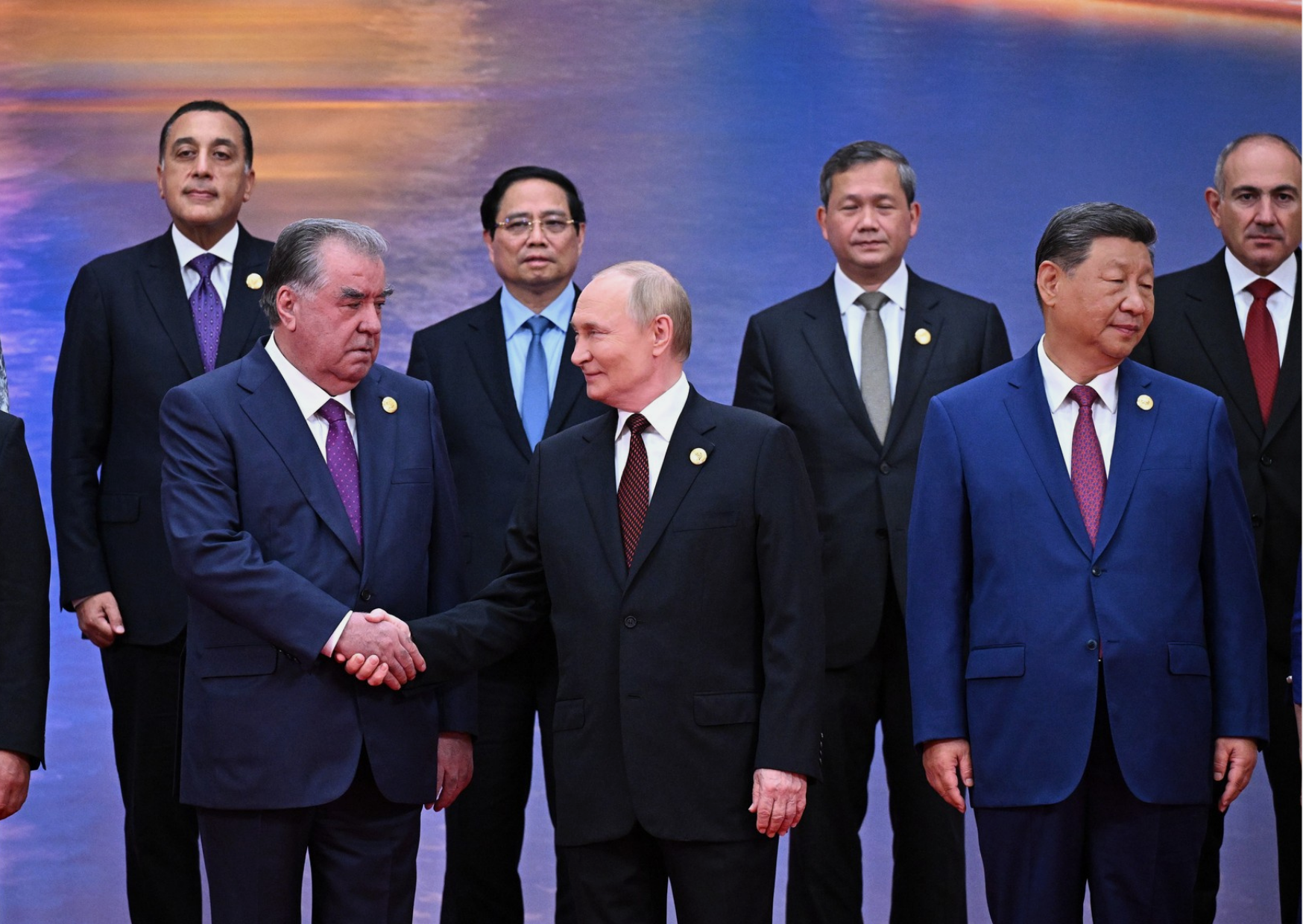
Vladimir Putin shakes hands with Emomali Rahmon, the President of Tajikistan at the 2025 SCO summit. Image credit: kremlin.ru.
9DL: You describe an increasing power divergence favouring China. How has Russia’s war in Ukraine altered the China-Russia balance within the SCO?
ES: Russia’s war on Ukraine has had immense impact on SCO members, especially the Central Asian member states. It has also affected the power balance between China and Russia. As I write in the book, historically, Russia and China have been read as holding roughly equal, shared leadership within the SCO, with China’s influence concentrated in economic leverage and Russia’s in military and normative weight, particularly in Central Asia. However, because of its war on Ukraine, Russia has had significantly less capacity to contest China’s expanding footprint in Central Asia (including into the security domain, where Moscow was traditionally dominant). This is partly because of Russia’s military preoccupation in Ukraine, and partly because sanctions have further increased its economic dependence on China. At the same time, precisely because of Western sanctions etc., the SCO has become more important to Russia than before. Much like BRICS, the SCO has become incredibly valuable to Moscow as a stage for Putin to present himself as anything but isolated globally, being regularly flanked by Xi, Modi, and others. Still, the underlying trend is clearly toward China as the senior partner.
9DL: The phrase “New International Order” has historically been used in many contexts, from post-Cold War debates to Global South diplomacy. What makes the SCO’s version distinctively Chinese or distinctively Sino-Russian?
ES: What makes the SCO’s version of a “new international order” distinctively Sino-Russian isn’t so much the vocabulary: the language of a “new international order” was already circulating in 1992 UN Security Council speeches by Boris Yeltsin and Li Peng, alongside similar statements from other leaders (e.g. from Zimbabwe, Morocco, Japan), so it isn’t unique to China and Russia. What is distinctive, however, is that China and Russia were the first to institutionalize it in writing: their 1997 bilateral “Joint Declaration on a Multipolar World and the Establishment of a New International Order” followed by a 2005 statement are the direct textual ancestors of the language later written into the SCO Charter and every Heads of State declaration since.
Unlike the New International Economic Order of the 1970s, which emerged from a broad coalition of developing states through the UN, or the broader Bandung and Non-Aligned traditions, the SCO's conception of a “new international order” originated in a bilateral Sino-Russian declaration before being multilateralised through the organisation. Just a few weeks ago, at the latest Xi-Putin meeting in Beijing in May, both leaders once again reaffirmed their commitment to building a “more just and multipolar international order” and a “new type of international relations” in a new joint declaration, further reinforcing the continuity of this discourse.
The content also sets it apart. Two decades of SCO documents consistently frame the order around “just”, “democratic”, “equal”, “mutual benefit”, “international law”, and “central role of the UN” – a corrective to “hegemony and power politics”, pursued through existing UN structures rather than against them. Importantly, since the late 2010s, every HoS declaration – and even the most recent bilateral declaration – ties the “new international order” explicitly to China’s own “New Type of International Relations” concept, anchoring what might otherwise read as generic multipolar rhetoric to a specific Chinese diplomatic framework.
9DL: Chapter 8 argues that the SCO’s expanding “circle of friends” creates favourable conditions for Chinese norm promotion. How should we measure the success of that effort? What would meaningful evidence of norm diffusion actually look like?
ES: It’s genuinely hard to isolate norm diffusion that happened specifically because of SCO membership, as opposed to the many other channels, such as bilateral ties, the BRI, UN forums, etc., through which states also absorb Chinese framings. In the book I treat the SCO as one piece of a larger puzzle in China’s foreign policy toolkit rather than a norm-diffusion machine in its own right. What we can observe is that concepts China pushes at the UN, like Xi Jinping’s “community with a shared future”, often get formally endorsed in regional bodies like the SCO first; states already accustomed to (and on the record supporting) that language regionally seem more likely to back it globally too. But establishing that the causality runs specifically through the SCO, rather than through parallel channels, is difficult.
One example of successful diffusion through the SCO actually is one where Russian definitions ended up influencing language in Chinese law. The SCO’s definition of terrorism draws heavily on Russian legal concepts: neither the 2001 nor 2009 SCO definitions were taken from Chinese sources, and at the time, China actually had no clear domestic legal definition of terrorism. China’s first such definition only appeared in its 2015 “Counter-Terrorism Law”, which a PRC official later said was based on both the SCO’s 2001 “Shanghai Convention on Combating Terrorism, Separatism, and Extremism” and a UN declaration. Extremism followed a similar path: China had no precise legal definition of the term in 2001, and only after the SCO adopted its own definition that year did China introduce extremism-related language domestically, e.g. in its 2015 National Security Law and Anti-Terrorism Law.
9DL: Iran’s accession was often presented as evidence of the SCO’s growing appeal as an alternative centre of international order. Yet the recent conflict involving Iran offered a rare opportunity to test the organisation’s commitment to sovereignty, solidarity, and resistance to external pressure. To what extent did the SCO’s response reflect its core norms and capabilities, and to what extent did it expose the organisation’s structural limitations?
ES: The SCO’s response has followed a now familiar pattern. The war this year began with US and Israeli strikes on Iran on 28 February; the SCO issued a statement on 2 March 2026 expressing “serious concern” over developments in the Middle East, extending condolences to Iran, and calling for a resolution based on dialogue and mutual respect, without going further than words. This was not surprising at all, and is broadly in line with what the organisation’s core norms and capabilities would predict: rhetorical solidarity, no practical involvement. In that sense, the Iran crisis reinforced a pattern already visible in Afghanistan, Ukraine, and earlier regional crises: the SCO functions primarily as a diplomatic forum for signalling shared positions rather than as an organisation capable of – or even trying to – coordinate crisis management.
DISCLAIMER: All views expressed are those of Dr Eva Seiwert and do not necessarily represent those of the 9DASHLINE.com platform.
Biography
Dr Eva Seiwert is Senior Analyst at the Mercator Institute for China Studies (MERICS). Her research focuses on China’s foreign policy, with a special interest in China-Russia relations, China's international partnerships, and its behaviour in international organizations. Prior to joining MERICS, Eva was a postdoctoral researcher at Friedrich-Alexander-Universität Erlangen-Nürnberg and managing editor of 9DASHLINE. Her book The Shanghai Cooperation Organization and China’s Vision of International Relations was published with Bristol University Press in May 2025 and is available here.