How ASEAN should respond to Myanmar’s manufactured parliament
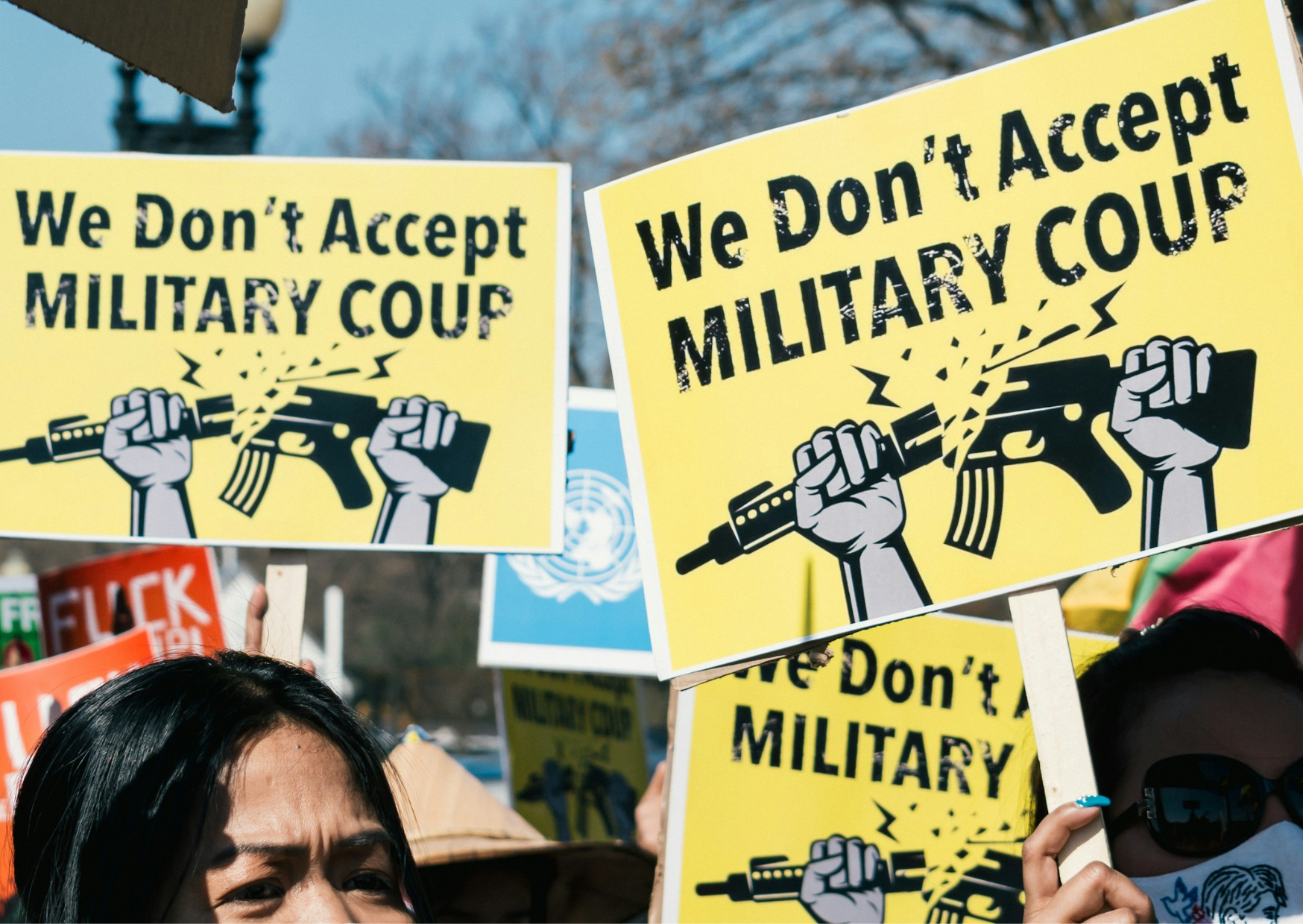
How ASEAN should respond to Myanmar’s manufactuRed parliament
WRITTEN BY LINN THIT HTOO
21 May 2026
Myanmar’s lower house of parliament, the Pyithu Hluttaw, convened for the first time since the country’s 2021 coup on 26 March 2026, with retired Brig Gen Khin Yi elected as speaker. The new parliament — the bicameral Pyidaungsu Hluttaw, referred to below as the Hluttaw — is the product of elections held across December 2025 and January 2026, which the UN, Human Rights Watch, and the Asian Network for Free Elections condemned as a sham. The military-backed Union Solidarity and Development Party (USDP) won 339 seats. Combined with the 25 per cent of seats constitutionally reserved for military appointees, this gives the military — also known as the Tatmadaw — and its proxies an unassailable supermajority.
The new Hluttaw does not represent a transition toward civilian governance. Rather, it is a textbook exercise in electoral authoritarianism: the use of elections to manufacture legitimacy without genuine political contestation. As the regional bloc with the closest ties to Myanmar and the greatest leverage over its political trajectory — as well as a commitment to the principles of democracy, the rule of law, and good governance under its Charter — ASEAN bears a particular responsibility in shaping the international response to the junta. It should therefore reject the new Hluttaw, continue engaging with the National Unity Government (NUG), and pursue a coordinated diplomatic strategy that addresses the structural conditions sustaining military rule.
An engineered parliament
For Myanmar’s junta, these elections serve two purposes: to eliminate viable opposition before votes are cast and to convince foreign and domestic observers that the revolution has failed and military rule is permanent.
A protracted war that the Tatmadaw cannot win, but remains capable of sustaining, is becoming an increasingly poor investment for China.
The Tatmadaw’s grip on parliament began with the 2008 constitution, which was drafted under military supervision. The constitution reserved 25 per cent of parliamentary seats for military appointees, a guarantee that has been in place since the military-managed transition beginning in 2011. Even under National League for Democracy (NLD) civilian governments, these safeguards allowed the Tatmadaw to retain enough seats to block any constitutional amendments that threatened its interests. But the NLD’s landslide victories in 2015 and 2020 created a competing source of domestic political authority and increased international pressure on the military.
To prevent any civilian party from reproducing NLD’s electoral dominance, the junta restructured the electoral system itself. Under the previous first-past-the-post system, the party that won the most votes in a constituency secured its seat in parliament. The new mixed-member proportional system allocates seats partly according to overall vote share, making it significantly harder for any civilian party to convert a popular majority into a parliamentary supermajority capable of overcoming the USDP and its coalition of smaller proxy parties. In a political landscape where major opposition parties have already been dissolved, the system ensures that any future opposition cannot win in the way the NLD did.
The junta’s institutional redesign extends beyond elections. On 3 February 2026, weeks before the Hluttaw convened, Myanmar’s coup leader Senior General Min Aung Hlaing rushed through a law establishing the new Union Consultative Council. The five-member Council, appointed by the president, is intended to oversee national security, the rule of law, foreign affairs, peace, and legislation. The Council’s effective purpose is to allow Min Aung Hlaing to control the military while simultaneously assuming the presidency.
These institutional changes were not made from a position of strength, but amid mounting military setbacks. By the end of 2024, resistance forces controlled 42 per cent of Myanmar’s territory while the junta retained only 21 per cent. Between 2023 and 2024, the military suffered significant losses including in the northern Shan State and the Mandalay region, threatening the military’s Defence Services Academy in Pyin Oo Lwin. Despite intensified counter-offensives throughout 2025, the military only managed to recapture nine township centres ahead of the first phase of voting on 28 December. Sixty-five townships were unable to hold elections at all. Even in the regions designated by the junta’s Union Election Commission as stable, nearly one in five townships experienced documented conflict-related incidents in the four months preceding the elections.
Myanmar’s new Hluttaw also sends important signals to both foreign and domestic audiences. For the international community, it provides a pretext for normalisation, allowing governments that favour engagement over confrontation to point to a functioning parliament and elected president as evidence of democratic progress, however hollow. For the domestic population, it indicates that the cost of continued opposition outweighs any realistic prospect of change.
The China factor
Beijing is not a passive observer, but rather one of the most decisive external factors shaping the conditions that made these elections possible and the broader trajectory of the conflict. China has long been the Tatmadaw’s most important external patron, supplying weapons, providing diplomatic cover at the UN Security Council, and maintaining economic ties that successive Western sanctions have failed to sever.
Following the significant gains made by the resistance forces during Operation 1027, China moved to prevent the opposition from consolidating its advances and ending the civil war on terms unfavourable to its interests. Beijing shut border crossings between Yunnan province and territories held by the Myanmar National Democratic Alliance Army (MNDAA) and Ta’ang National Liberation Army (TNLA), cutting off the supply of internet, fuel, and electricity. Beijing also brokered coercive ceasefires that required ethnic armed organisations to withdraw from towns they had captured. Beijing allegedly placed MNDAA commander Peng Daxun under house arrest after he travelled to Yunnan for talks, reportedly to pressure resistance leadership into accepting terms that preserved the military’s position.
China’s primary concerns are the stability of Belt and Road Initiative (BRI) economic corridors running through Myanmar — including the Kyaukphyu deep-sea port and oil and gas pipelines connecting Yunnan to the Indian Ocean — and ensuring stability along its southern border. For Beijing, supporting the Tatmadaw is a means to achieve those interests rather than an end in itself. This creates a genuine, if narrow, opening for alternative diplomacy.
The ongoing civil war has repeatedly disrupted the Mandalay-Muse highway, a critical corridor for overland trade. Conflict in border areas has led to refugee flows into Yunnan and sustains the scam compound networks in Shan State where trafficked workers are forced to run online fraud operations that have victimised thousands of Chinese nationals. A protracted war that the Tatmadaw cannot win, but remains capable of sustaining, is becoming an increasingly poor investment for China. Beijing backed the junta expecting stability on its doorstep. Instead, it inherited a costly conflict with no end in sight.
ASEAN at a crossroads
ASEAN bears a responsibility in responding to developments in Myanmar, as its credibility as a rules-based organisation is directly undermined by the junta’s manufactured transition. Since the 2021 coup, ASEAN has maintained a formal position of non-recognition toward the junta, barring its leaders from summits and declining to endorse the electoral process. The bloc’s 2021 Five Point Consensus called for an immediate end to violence, constructive dialogue, and humanitarian access — commitments the junta has systematically ignored.
ASEAN’s silence, or acceptance of incremental normalisation, would become an endorsement. A more active response should include the following two elements.
First, ASEAN and the broader international community should affirm the Committee Representing Pyidaungsu Hluttaw (CRPH) and the NUG as Myanmar’s legitimate representative institutions. This would deny the new Hluttaw international legitimacy, signal continued support for the resistance, and protect Myanmar’s seat at the UN from the junta.
Second, ASEAN should help the NUG develop functional channels of dialogue with Beijing by framing engagement in terms of stability, economic partnership, and border security rather than liberal democracy. The goal should be to make the case that an NUG-led federal settlement offers a more durable guarantee of Chinese interests than a junta governing a country in permanent civil war. With Beijing as the Tatmadaw’s strategic lifeline, neither Western sanctions, ASEAN condemnation, nor NUG institutional development alone is likely to produce a political resolution.
The international community, and ASEAN in particular, must resist normalisation of military rule. Engagement with the junta is likely to be rationalised as pragmatic — the only realistic option given China's backing of the military. However, that rationalisation must be rejected. A Myanmar locked in managed stalemate under a militarised pseudo-parliament will remain a source of regional instability, continuing to generate refugee flows, narco-economies, arms trafficking, and humanitarian crises for decades.
Resistance to the junta does not offer guarantees. But it remains the only path that does not end with the international community actively ratifying the destruction of Myanmar’s democracy. It is also the only path that takes seriously the aspirations of the millions of people who have resisted, at extraordinary cost, to ensure that the 16 March 2026 elections are not the final word.
DISCLAIMER: All views expressed are those of the writers and do not necessarily represent those of the 9DASHLINE.com platform.
Author Biography
Linn Thit Htoo is a student of International Relations and Global Affairs at Mahidol University International College in Thailand. Originally from Myanmar, Linn writes on Southeast Asian politics, authoritarianism, and feminist and queer theory. Image credit: Gayatri Malhotra/Unsplash.