India’s AI summit contradictions could undermine its credibility as an alternative to the US-China digital models
India’s AI summit contradictions
could undermine its credibility as an alternative to the US-China digital models
WRITTEN BY KUSHANG MISHRA
19 May 2026
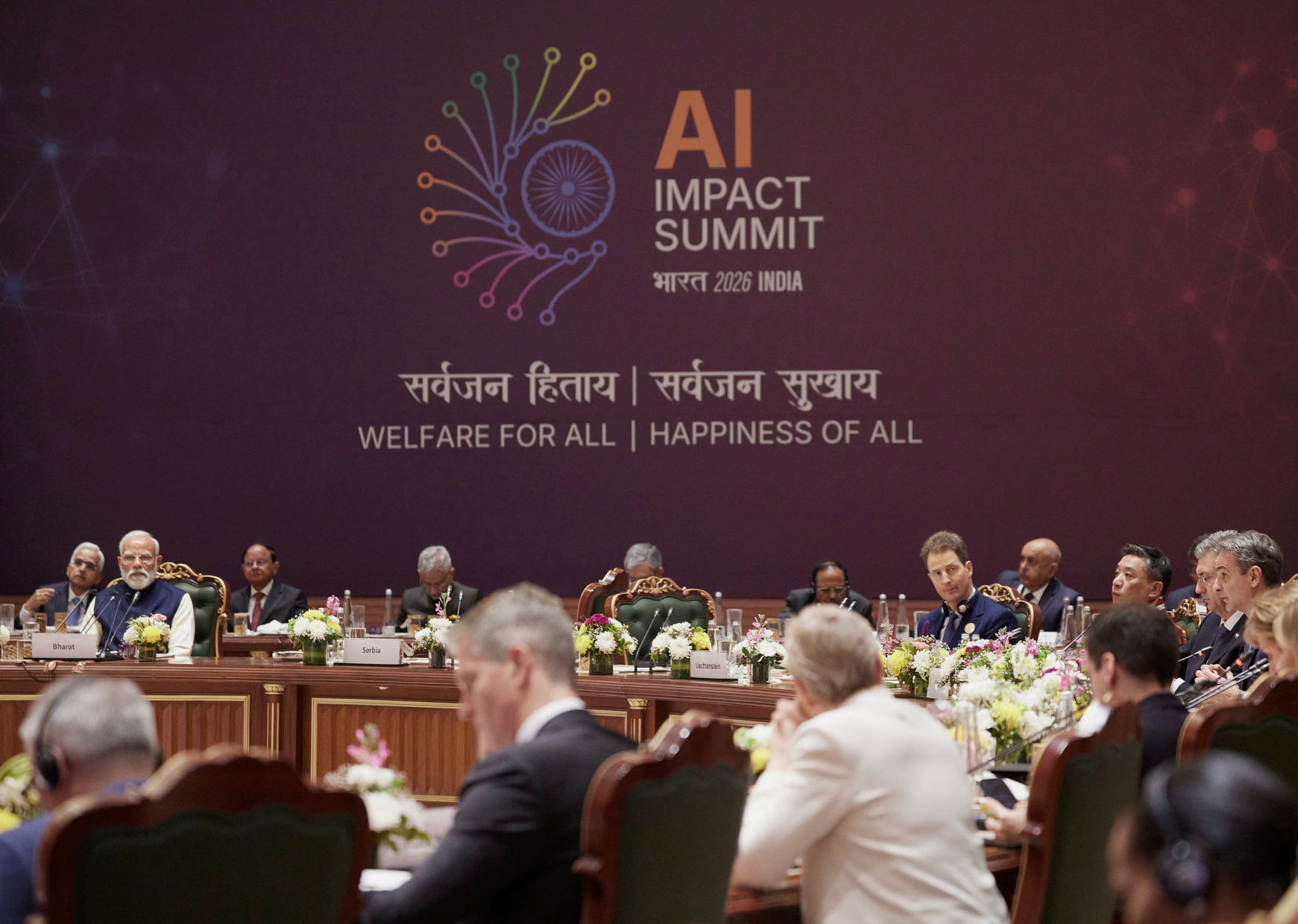
At the AI Impact Summit held in Delhi from 16 to 21 February 2026 — the first AI summit hosted in the Global South — Prime Minister Narendra Modi aimed to position India as a leader in AI: “The entire world wholeheartedly praised India's potential at the historic AI Summit held in Delhi”. The summit brought together representatives from more than 100 countries, including 20 heads of state and government, and over 500 global AI business leaders, including the CEOs of Google and OpenAI.
The AI Impact Summit exposed the contradictions in India’s efforts to position its data and AI policy as an alternative to American- and Chinese-led data-based models — revealing both the promises and the lost opportunities of India’s emergence as a leader in AI governance. These contradictions are evident in good-intentioned, yet non-binding declarations; in rhetoric over substance on digital sovereignty and democracy; and in its push for digital “public” infrastructure that relies too heavily on the private sector. These lost opportunities could undermine India’s role as an alternative to Western- or Chinese-led AI leadership. Such an alternative is needed to make the AI supply chain, which relies on underpaid labour and natural resources from the Global South, truly fair for the majority of the world.
Questioning India’s commitment to digital sovereignty for the Global South
A major outcome of the summit was the endorsement of the New Delhi Declaration by 88 countries and international organisations, which calls for democratising AI resources to drive economic growth and social good, and for creating a secure and trusted AI. However, the declaration remains non-binding and does not establish any enforcement mechanisms. It has also been criticised for relying on a voluntary, industry-led reform that further legitimises Big Tech's self-regulatory model. Furthermore, its multi-stakeholder model lacks a concrete hierarchy of responsibilities to ensure proper enforcement.
Instead of using this platform to champion a fairer system as an emerging leader of the Global South, the Indian government appeared content to secure a seat at the global power table and seek investments from the very Big Tech companies it has itself criticised in the past.
Alongside this, the summit produced the New Delhi Frontier AI Commitments, a set of voluntary agreements endorsed by Big Tech companies, calling for increased transparency around AI use and inclusion of underrepresented languages and cultural contexts from the Global South in AI systems. However, critics have argued they do not go far enough on child safety and national security risks.
The summit was also an opportunity for India to demonstrate South-South AI collaboration that could help address unequal access to computing infrastructure — such as cloud platforms, proprietary models, and highly specialised technical talent — that favours the Global North. India has long talked about the need for data sovereignty (and nationalism), even releasing a working paper on generative AI and copyright that calls on AI companies to pay royalties whenever they use copyrighted material from India to train their models.
At the summit, India signed a joint agreement with Brazil — a country very similar to India in terms of population size and in its aspirations to transform AI supply chains in favour of the Global South. However, the two countries have very different approaches to AI governance: Brazil demands rights-based regulations and clearer obligations for Big Tech companies, while India aligns more closely with the US, seeing the same companies as “essential infrastructure”. In fact, after years of asserting data sovereignty, India’s focus at the summit remained on attracting Big Tech investment — perhaps unsurprising given the global cultural and political influence these tech behemoths exert over governments worldwide (except China).
Another major blow to India’s rhetoric of data sovereignty — and a sign of its growing closeness with the US — came with its signing of the US-led Pax Silica declaration on the sidelines of the summit, intended to counter China’s dominance over critical minerals needed to build Information and Communication Technology (ICT) systems. In contrast, the US did not shy away from data sovereignty rhetoric. The head of the US delegation at the summit, Michael Kratsios, explicitly rejected the idea of global AI governance, stating that “prioritising AI for your people means pursuing a sovereign AI capability for your country now”. Nonetheless, given the isolationist behaviour under the Trump administration, India’s alignment with the US at the summit seems like a lost opportunity to build a Global South alliance that could push back against it.
Promoting digital public infrastructure as the “third way”
The summit also gave India an opportunity to focus on “impact” — on-the-ground issues — with Prime Minister Modi pushing for developing AI as a common good. This ambition is illustrated by India’s recently launched Bharat-VISTAAR (Virtually Integrated System to Access Agricultural Resources), a multilingual AI tool that integrates “farmer identity, crop practices, and institutional knowledge” to better inform farmers’ decision-making. The Indian government has repeatedly promoted such digital public infrastructure (DPI), with the state playing a crucial role in building an open, interoperable platform architecture with the help of private actors. This strategy is emerging as a “third way”, in contrast with the US’ market-centric, minimal-regulation approach and China’s state-centric, “authoritarian” approach. It is part of India's broader positioning of itself as the ”AI use case capital of the world” in sectors including health, agriculture, education, and financial inclusion for development in the post-colonial countries.
However, despite claiming to be a distinct approach from the under-regulation of the US model, DPI has been criticised for giving private actors an outsized role in creating “public infrastructure”. Jacqueline Hicks has termed this “digital ID capitalism”, in which post-colonial states justify not regulating the domestic private sector and instead create an infrastructure for it. Hicks points to Aadhaar, India’s digital ID system containing individual demographic and biometric details, which the state built and later opened to private actors to authenticate individuals and provide services such as direct payments, e-signatures, and opening bank accounts. The justification is that domestic companies need support to compete with Western Big Tech, which already has an unfair advantage stemming from its colonial past. Yet, Aadhaar has also been criticised for making essential public services, including food subsidies, inaccessible to those without an Aadhaar ID.
The irony is that, for all the talk of restricting Western Big Tech in the name of decolonisation, these same companies continue to dominate such infrastructure — whether it is India’s much-touted payments interface, the Unified Payments Interface (UPI), led by Google and Walmart, or the cloud infrastructure on which these systems run.
One of the key focuses of the summit — the “democratisation of AI” — tells a similar story. Under the theme “Sarvajana Hitaya, Sarvajana Sukhaya” (welfare for all, happiness for all), the summit invited people from all walks of life, from students and teachers to small business owners — not just the usual crowd of technocrats and CEOs. Yet, an analysis of the summit by the Internet Freedom Foundation found this did not translate into more discussion of rights, privacy, and equality, reducing “democratisation” to mere posturing. Despite its rhetoric of openness and diversity, the summit was criticised for not providing civil society with equivalent high-level platforms to the closed government tracks and invitation-only CEO sessions. Actual power remained concentrated in familiar circles.
Overcoming contradictions to make the AI system fairer for the Global South
Some of these contradictions are understandable in context. India’s pragmatic pursuit of strategic autonomy requires it to stay multi-aligned with different partners — not just the Global South — to advance its economic and strategic interests. However, this was the first time a Global South country hosted such a summit on a global stage. Instead of using this platform to champion a fairer system as an emerging leader of the Global South, the Indian government appeared content to secure a seat at the global power table and seek investments from the very Big Tech companies it has itself criticised in the past.
This has consequences that go beyond India. AI adoption in the Global North is twice as fast as in the majority world, even as the latter bears the cost of extracting the natural resources upon which these systems are built. And it is their underpaid and over-exploited labour that powers these systems. By failing to assert itself on the question of data sovereignty, promoting a system of “public infrastructure” that relies on the Big Tech companies it criticises, and merely using democratisation as a buzzword, the Indian government’s data policy leaves much to be desired. To truly emerge as a credible leader of the Global South, India would need to shed these contradictions and build stronger alliances within the Global South to reshape the global AI supply chains on fairer terms.
DISCLAIMER: All views expressed are those of the writers and do not necessarily represent that of the 9DASHLINE.com platform.
Author biography
Kushang Mishra is a PhD student of Sociology at the Faculty of Arts and Education, University of Auckland. Through his PhD, he wants to explore the impact of AI/ML-driven digitalisation on Agriculture in India. Image credit: ΝΕΑ ΔΗΜΟΚΡΑΤΙΑ/Flickr (cropped).