Cheng's China gambit — can Xi meeting alter the KMT’s fortunes?
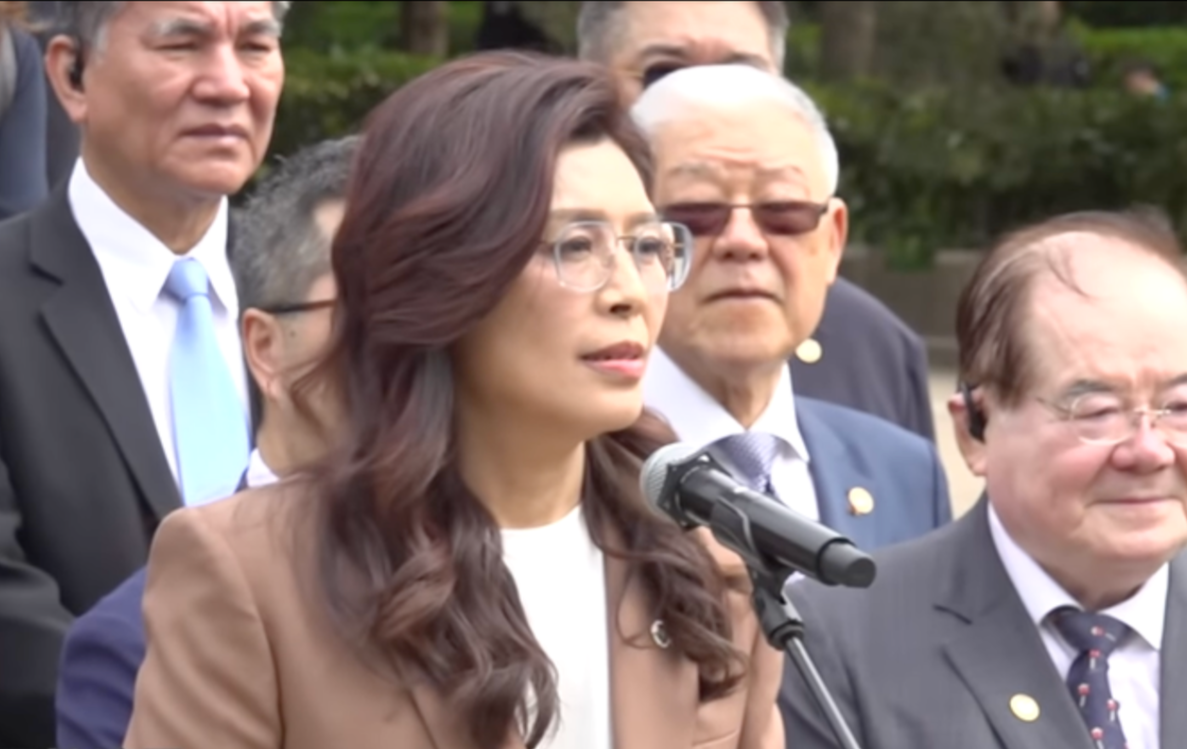
Cheng's China gambit — can Xi meeting alter the KMT’s fortunes?
WRITTEN BY DANIEL MCINTYRE
10 April 2026
Taiwan’s Kuomintang (KMT) Chairwoman Cheng Li-wun has embarked on a historic visit to China from 7 to 12 April 2026 — including a meeting with Xi Jinping on 10 April — the culmination of months of secret diplomacy since she was unexpectedly elected chair in October 2025. The meeting is the first between sitting leaders of the KMT and the Chinese Communist Party (CCP) in nearly a decade.
The move is undoubtedly a bold one, risking tying her party’s fortune to the proposition that Taiwan’s security is better served through closer engagement with Beijing, without any guarantee that such engagement will moderate Beijing’s behaviour. Cheng has framed her visit as a “peace mission” aimed at stabilising cross-strait relations. Yet she embarks amid significant unease within her own party over her policy direction, and broader public scepticism about whether the KMT can be trusted to safeguard Taiwan’s interests. With important local elections looming in November 2026 and her party languishing in the polls, she has little room for error.
An unconventional leader
Cheng is, in many respects, an unconventional KMT leader. She entered last year’s KMT chair election very much as a dark horse. Unlike her campaign rivals, such as Hau Lung-bin — former Taipei mayor and the son of a former premier and military general — she does not come from the party’s traditional elite, often dominated by political families who evacuated to Taiwan after the fall of the Nationalist government in 1949.
She cut her political teeth in pro-democracy and Taiwan independence street activism in the 1990s. While she later joined the KMT in 2005 and served two terms as a legislator, most recently from 2020 to 2024, she has since journeyed to the party’s more hardline wing, favouring closer ties with Beijing over the US, and expressing scepticism that increased defence spending will ultimately improve Taiwan’s security.
The immediate results of her trip may yield modest concessions, perhaps on tourism or the lifting of restrictions on Taiwanese imports. But without a sustained reduction in military pressure and an end to large-scale exercises, these would be quickly eclipsed.
Unlike her predecessors, Cheng does not have an established factional base, whose networks are often crucial for asserting authority within the highly factionalised party. She distinguished herself during the campaign through her direct, often uninhibited rhetoric, especially on emotive questions such as cross-strait relations and identity. This included pledges to make Taiwanese “proud” to call themselves Chinese, setting her apart from the usual hedging used by conventional KMT politicians. Such messaging resonated with the KMT’s base — whose views generally diverge sharply from those of median voters — but unsettled party moderates.
Cheng’s unconventionality was highlighted within weeks of her taking office. In an interview with foreign media, she said it was “too harsh” to call Putin a dictator — a discourse more commonly observed among pro-China communities online. She also attended a commemoration for Wu Shi, an alleged communist spy executed by the Nationalist government in 1950.
Internal party discontent
This behaviour has attracted dissatisfaction across her party. Moderates view her pro-China reputation as an electoral liability. With local elections looming, many believe she is too focused on cross-strait policy — an area where the party is weakest — rather than on livelihood issues, where it traditionally performs more strongly. Meanwhile, elements of the old guard fear she represents a strand of thinking that allows hatred towards the ruling Democratic Progressive Party (DPP) to overshadow the threat posed by the CCP to the Republic of China.
Cheng’s leadership has also failed to deliver the surge in support the party faithful had hoped for, weakening her authority. Support for the KMT has edged down to around 20 per cent since she took office, while the DPP has remained buoyant at around 35 per cent. Recent polling has also shown that just 23.9 per cent of respondents trust her, a decline of 4.8 percentage points from January, while 54.5 per cent say they do not.
She has also faced criticism from the party’s pro-US wing over her handling of defence spending. This has centred on the KMT legislative caucus’s repeated obstruction of the government’s USD 40 billion special defence budget — an eight-year programme aimed at strengthening deterrence through enhanced asymmetric capabilities.
The dispute comes at a critical moment for Taiwan’s security, amid growing US pressure on allies to increase defence spending, and a sustained rise in the People’s Liberation Army’s (PLA) military activity. The KMT eventually put forward its own scaled-down alternative of around USD 12 billion, drawing unusually direct criticism from US lawmakers over its actions.
With two-thirds of the public backing the government’s proposal, influential figures in the party — including former chairman Eric Chu and Taichung Mayor Lu Shiow-yen, widely seen as the KMT’s strongest presidential contender — have signalled support for a budget closer to the government’s. They are concerned that the impasse not only damages the party’s image with voters but also risks undermining Taiwan’s security by straining relations with the United States.
Placing political fate in Beijing’s hands
Cheng has framed her visit to China and prospective meeting with Xi as a mission for peace, aimed at bringing in a “warm spring” to bilateral ties, stabilising cross-strait relations, and laying the groundwork for expanded exchanges. She is betting that deeper engagement between the KMT and CCP — such as the jointly held think tank forum in February 2026 — alongside broader cultural and economic exchanges, can ease tensions across the strait, reassure Beijing, and ultimately lead to a reduction in military pressure.
This is a bold gamble. In recent years, the DPP’s electoral strength — and the KMT’s corresponding weakness — has been significantly shaped by Beijing’s hostile rhetoric and military pressure. This has reinforced the view that China poses an existential threat to Taiwan’s way of life. Cheng is, in effect, seeking to alter that dynamic. By encouraging Beijing to moderate its behaviour, she hopes to reshape the terms of debate — from seeing China as a threat to be kept at arm’s length, to a source of stability and prosperity amid an increasingly turbulent world. Such a shift would, in turn, help level the electoral playing field for the KMT.
Yet there is no guarantee that Beijing will moderate its behaviour in response. In the short term, the meeting enables it to bolster a friendly but embattled leader while stabilising cross-strait relations at a time of significant international volatility. But moderation is unlikely to be enduring. In recent years, Beijing has shown a clear preference for maintaining the initiative in cross-strait affairs through military, legal, and economic pressure. With the DPP holding the presidency — and therefore control over foreign and defence policy alongside an interest in consolidating Taiwan’s autonomous identity — it will be difficult for Cheng’s peace overtures to break the cycle of hostility and escalation.
Against this backdrop, Cheng is ultimately staking her leadership — and the party’s fortunes — on forces beyond much of her control: the hope that Beijing will uphold its side of the tacit bargain and moderate its behaviour. The immediate results of her trip may yield modest concessions, perhaps on tourism or the lifting of restrictions on Taiwanese imports. But without a sustained reduction in military pressure and an end to large-scale exercises, these would be quickly eclipsed. Such an outcome would reinforce perceptions that the KMT serves merely as a conduit for Chinese influence, driving away the moderate voters Cheng needs to reverse the party’s electoral fortunes.
DISCLAIMER: All views expressed are those of the writers and do not necessarily represent those of the 9DASHLINE.com platform.
Author biography
Daniel McIntyre is an Associate Editor at 9DASHLINE and a former copy editor at the Taipei Times. He will begin a PhD on Taiwan’s grand strategy at SOAS University of London in September. Image credit: Wikimedia/China News Agency.