Strategic Autonomy under pressure: Cambodia’s multi-geared hedging in a post-multilateral world

Strategic Autonomy Under Pressure: Cambodia’s Multi-Geared Hedging in a Post-Multilateral World
WRITTEN BY CHANDARITH NEAK AND CHHAY LIM
8 May 2026
Three years into Hun Manet's premiership, Cambodia confronts the most turbulent strategic landscape since the end of the Cold War. Great-power competition is intensifying, global supply chains are fragmenting, and the world is entering a post-multilateral era in which rules-based institutions are increasingly bypassed in favour of bilateral and transactional arrangements. Along the western border, Cambodia and Thai forces clashed for weeks in late 2025. To the north, China closely watches Cambodia’s every move. To the east, Vietnam eyes that same relationship with deep caution. Across the Pacific, Washington's trade policies squeeze the export economy on which millions of Cambodian livelihoods depend.
In such a climate, international analysis of Cambodia tends to revolve around one question: whose proxy is it? This framing, born of other states' strategic anxieties, fundamentally misreads a country determined to be the author of its own foreign policy. Two anxieties dominate this misreading: Vietnam’s unease as Cambodia grows closer to China, and China's wariness when Cambodia engages the US and its allies. A third pressure — the growing unpredictability of US trade policy — now compounds both. The proxy question reveals little about Cambodia’s intentions; instead, it reveals how great powers project their own anxieties onto small states.
Cambodia’s hedging policy has not only endured but evolved into a proactive strategy to avoid forced alignment: the choice between accepting Chinese dominance or pivoting towards Washington, and between deepening ties with Hanoi or distancing from Beijing. This approach may be understood as ‘multi-geared hedging’, in which Cambodia is not re-aligning but diversifying its sovereignty portfolio. Unlike conventional hedging, which seeks equidistance between rival powers, multi-geared hedging involves the simultaneous cultivation of overlapping dependencies across economic, infrastructural, diplomatic, and security domains — ensuring that no single partner acquires decisive leverage over Cambodia's strategic choices.
By engaging with initiatives like US President Trump’s Board of Peace, Cambodia secures a diplomatic hedge that provides political legitimacy in Washington. This engagement does not come at China's expense. Rather, it enables Cambodia to manage its deep dependence on Chinese infrastructure while expanding Western trade ties and middle-power cooperation. The recent recalibration of Cambodia's China policy signals strategic maturity: a small state recognising that, to remain ironclad with one partner, it must remain engaged with all. Yet hedging against great powers is only half the challenge; the other half sits right next door.
Vietnam: geography as the ultimate hedge
While hedging helps Cambodia manage relations with great powers, geography presents a more enduring constraint. The concept of ‘permanent neighbours’ (Láng giềng vĩnh cửu) captures this reality: Vietnam will always be next door. Regardless of who governs either country or how political ideologies shift, Cambodia's foreign policy must manage cooperation and friction simultaneously. For relations to succeed, periods of confrontation must give way to an equal partnership in which interdependence raises the cost of conflict for both sides.
The February 2026 Joint Statement between Cambodia and Vietnam set a public tone of “strategic cohesion”, pledging USD 20 billion in trade and connectivity projects, including the Phnom Penh-Bavet and Ho Chi Minh-Moc Bai expressways. These are not merely diplomatic gestures; they are infrastructures of interdependence. However, relations between the ‘permanent neighbours’ are not without friction. By creating direct access from Phnom Penh to the Gulf of Thailand, reducing reliance on Vietnamese ports, and backed by Chinese funding, the Funan Techo Canal has emerged as a contested “tactical gear” in the bilateral relationship.
The difficult truth is that no combination of alternatives fully replaces access to the US market or the scale of Chinese infrastructure finance. Diversification reduces vulnerability; it does not eliminate it.
Vietnam’s concerns must be understood in historical context. During the colonial and postcolonial periods, Cambodia operated within Hanoi's strategic orbit, reflected in the anh-em (elder-younger brother) framing. This hierarchy was particularly explicit in the 1980s when Vietnamese forces were present in Cambodia. Although this era has passed, anxieties regarding losing influence remain, with the Funan Techo Canal at the centre of these concerns. For Cambodia, the canal represents greater logistical autonomy through direct access to international shipping lanes. For Vietnam, however, the canal challenges the maritime order it has long sought to maintain along the shared coastline and signals China’s expanding influence in Southeast Asia — a subregion where Vietnam has traditionally been the dominant force.
These anxieties take concrete form in a geographic chokepoint: vessels exiting the Funan Techo Canal must pass through shallow coastal waters near Vietnam’s Phu Quoc Island before reaching major international shipping lanes. Because this corridor is too shallow for vessels above 3,000 Deadweight Tonnage (DWT), Cambodia would need substantial seabed dredging to make the canal commercially viable at scale — and that dredging requirement is precisely where geography becomes legal leverage. Vietnam’s ongoing siltation and salinity monitoring near its Phu Quoc causeway provides a scientific basis to argue that any such dredging near the Phu Quoc Marine Protected Area constitutes "significant harm" under the transboundary provisions of the 1995 Mekong Agreement. While Cambodia maintains that these obligations apply strictly to the Mekong River mainstream, Vietnam's interpretation expands this scope to the maritime environment — creating what amounts to a "dredging trap": to deepen access, Cambodia risks triggering a formal legal challenge it may not be able to win.
This dynamic creates a high-stakes institutional hedge, in which the mere threat of a legal challenge through the Mekong River Commission may deter international stakeholders. For global cargo insurers, the prospect of 3,000 DWT vessels navigating a contested or narrow channel introduces significant risk, often discouraging coverage for large-scale maritime operations. Such institutional friction weighs heavily on Chinese build-operate-transfer investors, specifically the China Road and Bridge Corporation, which requires consistent high-volume traffic to ensure return on its 40 to 50 year investment in the canal. If the maritime entry remains restricted to smaller vessels, the fundamental economic feasibility of the USD 1.7 billion project collapses, turning a tactical maritime bottleneck into a strategic financial barrier.
These tensions, however, do not define the entire relationship. Cambodia is a sovereign state pursuing a recalibrated China policy driven by development needs: Chinese investment builds roads, ports, and power grids at a scale and speed unmatched by other partners. According to the Council for the Development of Cambodia, Chinese investment approvals accounted for roughly 54 per cent of total foreign investment in 2025, totalling USD 5.42 billion. This reflects economic pragmatism rather than alignment against Vietnam.
At the same time, the February 2026 visit of Vietnam’s Communist Party General Secretary To Lam to Phnom Penh — his first foreign trip after assuming the party’s leadership — suggests mutual recognition that the bilateral relationship must evolve toward a partnership grounded in sovereign equality rather than hierarchy. Cambodia and Vietnam share a long border, deep people-to-people ties, and overlapping interests in regional stability. The task is to ensure that the 'permanent neighbour’ remains a source of mutual prosperity rather than a driver of the security dilemma. By physically and economically interlocking with Vietnam while simultaneously building the Funan Techo Canal to secure logistical autonomy, Cambodia is hedging against the very “big brother” dynamics.
The direction for Cambodia is clear: complete the canal to secure logistical autonomy while strengthening partnerships with middle powers such as Australia, Japan, and South Korea — a strategy that requires paying the diplomatic tax of transparency with its neighbours. This reflects a broader logic of 21st century sovereignty, which is less about isolation than about distributing risk across a web of relationships complex enough that no single disruption can prove fatal. In this sense, Cambodia does not become indispensable; it becomes harder to coerce.
China: the logic of diversification
While Vietnam's unease reflects historical patterns rooted in geography, China's wariness stems from a different concern: that Cambodia's engagement with Washington and its allies signals a strategic shift. When Phnom Penh engages in initiatives involving the US or expands exchanges with Japan and Australia, Beijing may interpret these moves through a competitive lens rather than in light of Cambodia’s actual developmental needs.
This reading misunderstands Cambodia's approach. The depth of its relationship with China is evident: Chinese investment accounts for 54 per cent of FDI, alongside transformative infrastructure projects, regular “Golden Dragon” joint military exercises, and development assistance in sectors no other partner has prioritised. These are not relationships a small state discards lightly — yet Cambodia cannot allow this depth to become a strategic constraint.
Cambodia's increasingly diversified foreign policy is not a pivot away from China but a practical necessity of economic survival. The US remains Cambodia's largest export market, absorbing more than a third of total shipments. Japan has been a consistent development partner for decades. The EU, Australia, and South Korea are all important sources of investment, technical cooperation, and market access. Cambodia's total trade expanded by 17.6 per cent year-on-year in early 2026, with China remaining the largest partner even as the US, Japan, and the EU all increased their shares.
This is not balancing in the classical sense but multi-geared hedging: diversification as strategy, born of necessity. In the China relationship, multi-geared hedging therefore operates as a reassurance mechanism: Cambodia signals loyalty through economic depth while simultaneously building the diplomatic and commercial diversification that prevents that depth from becoming a chokehold.
The United States: the market hedge
For Cambodia’s export-dependent economy, access to American consumers is a structural necessity. More than a third of Cambodian exports go to the US, predominantly garments and footwear that employ over 900,000 workers, most of them women from rural provinces. This relationship is neither easily replaced nor easily dispensable.
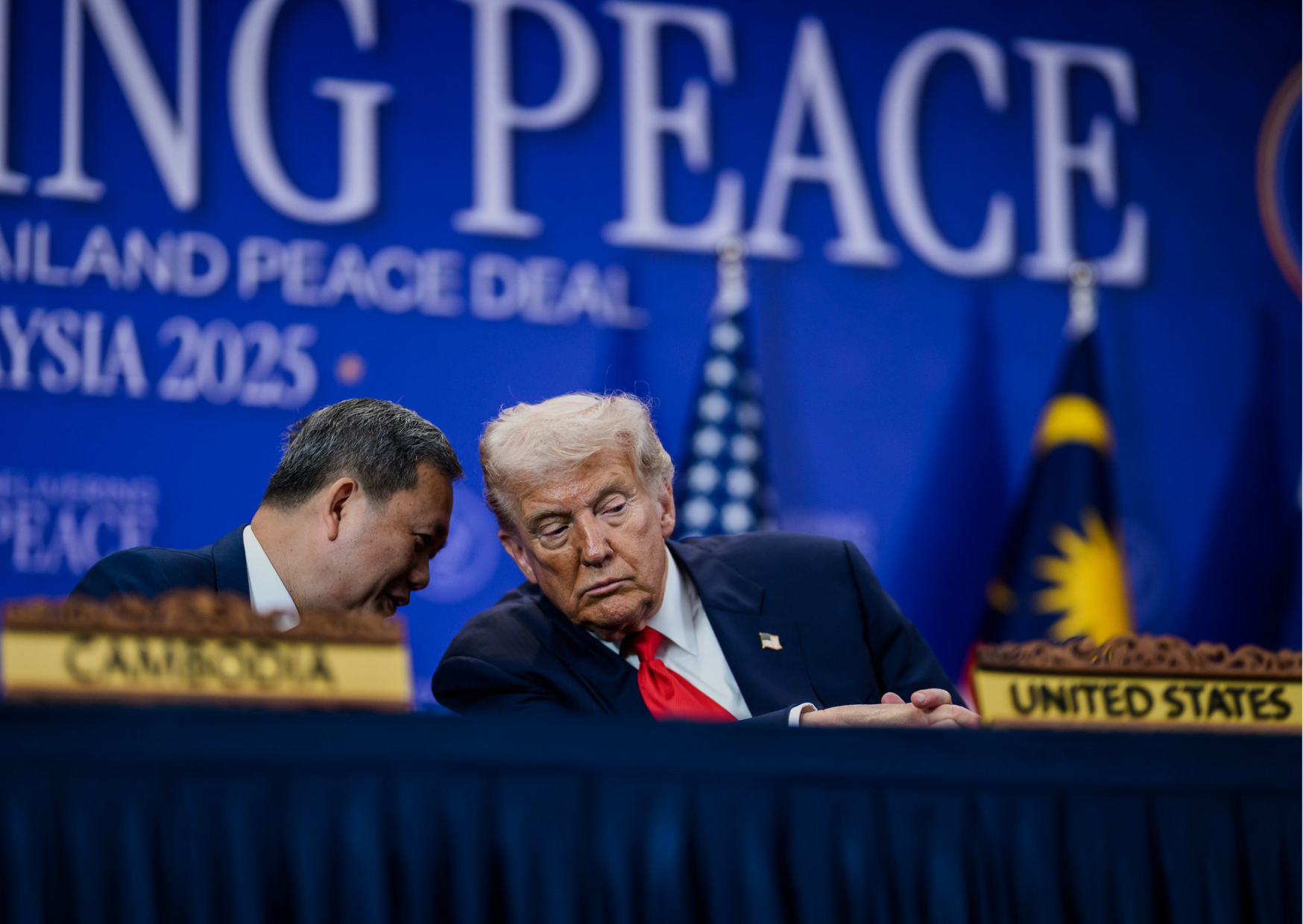
Cambodian Prime Minister Hun Manet speaks with President Donald Trump. Image credit: Flickr/The White House.
Yet this market hedge is also the most unpredictable. The Trump administration first introduced reciprocal tariffs of up to 49 per cent in April 2025, later reduced to 19 per cent by October the same year. On 11 March 2026, Washington launched a new Section 301 investigation targeting 16 economies — including Cambodia — over concerns about "structural industrial overcapacity". The investigation focuses on indicators such as persistent trade surpluses, government subsidies, and state-owned enterprise practices — factors largely beyond Cambodia's control but with direct consequences for its export-dependent economy. Barely weeks after the US Supreme Court struck down the administration's previous tariff regime, and only months before the 150-day interim tariff window expires in July, the pattern is clear: when one source of trade pressure recedes, another quickly emerges.
This unpredictability reflects a new American Monroe Doctrine: a hemisphere-first approach signalled in the Trump administration’s National Security Strategy 2025, which treats economic relationships as tools of strategic competition rather than mutual benefit. Engaging with the US balances dependence on China, but it also exposes Cambodia to the volatility of American domestic politics. The market hedge provides diversification, but not stability.
This signifies a gradual shift away from a predictable multilateral trading system toward a more transactional, interest-driven global order. Prime Minister Hun Manet has acknowledged this challenge directly. Speaking at the Cambodia-ASEAN Business Summit in early March, he warned that "unilateral tariff measures" and "rising political tensions" threaten regional stability, and called for strengthening regional resilience through deeper economic integration and diversified partnerships.
For Cambodia, the US relationship functions as a specific gear in its hedging strategy — one that provides market access and Western legitimacy, but whose volatility demands that other gears remain engaged. Dependence on the American market is not a strategic choice so much as a structural condition; the hedging lies in ensuring it is never the only one.
The path forward: hard choices, not magic formulas
A third pressure now compounds the anxieties of Vietnam and China: the growing unpredictability of American trade policy. For Cambodia, this confirms what should have been obvious all along: reliance on any single market or patron carries risks. Recognising this may be obvious, but solving it is not.
ASEAN, Regional Comprehensive Economic Partnership (RCEP), Comprehensive and Progressive Transpacific Partnership, are often presented as alternatives to Western markets, yet their capacity to support strategic autonomy remains limited. ASEAN moves at the speed of its slowest member, RCEP liberalises trade but does not insulate participants from US pressure.
The difficult truth is that no combination of alternatives fully replaces access to the US market or the scale of Chinese infrastructure finance. Diversification reduces vulnerability; it does not eliminate it. The goal, then, is modest: ensure that no single relationship is so essential that losing it would break the country. Cambodia's multi-geared hedging is best understood as a strategy in motion rather than an achieved equilibrium: its dependencies on Chinese finance and American markets are real and will not dissolve quickly, but the strategic intent is to ensure they remain manageable rather than decisive.
Whether Cambodia can manage this balance remains uncertain. The Hun Manet government faces external pressures more intense than anything Phnom Penh has dealt with in decades. Its partners would do well to start seeing Cambodia for what it is: a small state with its own interests, its own history, and no good options — only hard choices. Cambodia is not a passive surface onto which great powers project their strategic anxieties. It is a small state navigating constrained choices, and its multi-geared hedging is the clearest evidence of that agency.
DISCLAIMER: All views expressed are those of the writers and do not necessarily represent those of the 9DASHLINE.com platform.
Author biographies
Dr. Chandarith Neak is an Associate Professor and Director of Institute for International Studies and Public Policy of Royal University of Phnom Penh.
Chhay Lim is a designated deputy director and a lecturer at the Center for Southeast Asian Studies of Institute for International Studies and Public Policy of Royal University of Phnom Penh. He is also a Visting Scholar at the Sigur Center for Asian Studies of the George Washington University.
Image Credits: Google Gemini and Flickr/The White House.