In Forum FOIP: AUKUS in a Free and Open Indo-Pacific
In Forum
FOIP: AUKUS in a Free and Open Indo-Pacific
16 October 2026
A decade has passed since then-Prime Minister Shinzo Abe launched the Free and Open Indo-Pacific (FOIP) strategic vision in 2016, which has since been widely adopted across the Indo-Pacific and beyond. Rising Chinese assertiveness in the South China Sea and East China Sea, alongside its expanding economic reach through the Belt and Road Initiative, drove efforts to preserve maritime security and the rule of law in the region.
In 2026, Prime Minister Sanae Takaichi’s updated version of FOIP shifts the framework’s focus toward economic security. This recalibration comes at a moment when the United States has turned toward a more transactional foreign policy, deepening the very regional uncertainties FOIP was intended to manage.
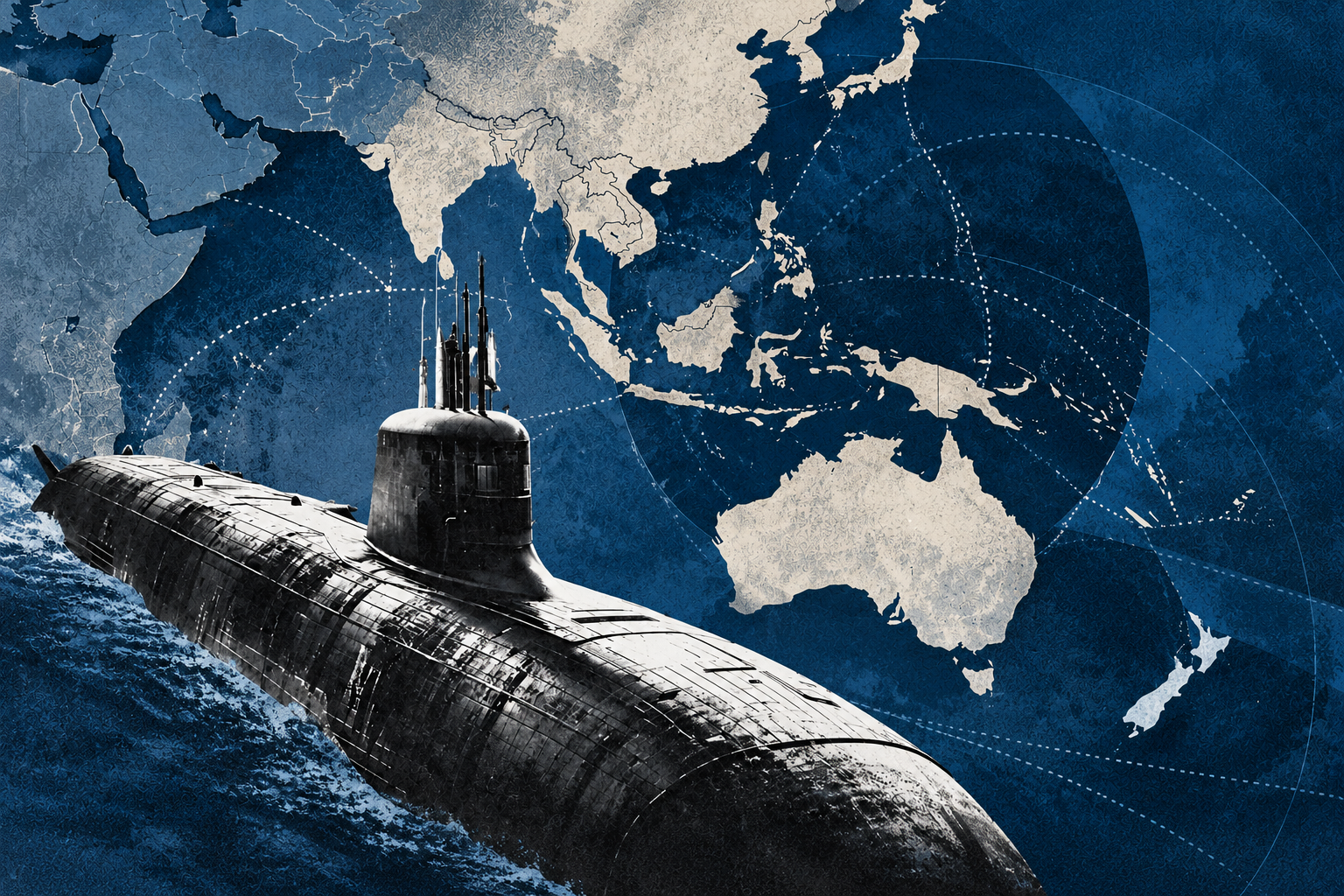
Regional actors have engaged with FOIP on their own terms, interpreting the vision through an overlapping web of institutional responses that have shaped its trajectory and exposed its underlying tensions. AUKUS — the trilateral security partnership between Australia, the United Kingdom, and the United States — represents FOIP’s most explicitly hard-security expression, built around the acquisition of nuclear-powered submarines. Its military buildup stands in tension with Pacific Island states advancing their own vision of regional security, centred on climate resilience and sovereignty. The Blue Pacific Ocean of Peace Declaration, adopted by Pacific Islands Forum leaders in September 2025, explicitly rejects great-power rivalry and nuclear militarisation — and its coexistence with AUKUS exposes a fundamental tension within FOIP.
Reflecting on FOIP’s first decade — and looking ahead to the next — we invite a number of leading experts to consider how AUKUS has shaped, and stands to shape, its future amid competing visions of regional security. Does AUKUS undercut the very “free and open” principles FOIP claims to uphold in the Pacific? How are Pacific Island states defining regional security on their own terms, and what do these contending frameworks reveal about the limits of FOIP?
TWO VISIONS OF ‘FREE AND OPEN’
Sione Tekiteki, Senior Lecturer at the Auckland University of Technology, Law School, New Zealand, and former regional diplomat.
A decade into FOIP, we are seeing two different, and potentially competing, articulations of what “free and open” looks like in the context of Pacific security.
The AUKUS trilateral security pact between Australia, the UK, and the US, including the acquisition of nuclear-powered attack submarines as part of AUKUS Pillar 1, translates one interpretation into practice: prioritising the defence of the prevailing regional order through advanced military capability and deterrence. By contrast, Pacific Islands Forum (PIF) leaders have set out a much broader conception of what needs defending by placing climate, human, environmental, and resource security alongside traditional security concerns, as reflected in the 2018 Boe Declaration.
The Ocean of Peace Declaration is the Pacific’s more specific expression of peace and security. It affirms a nuclear-free Pacific, recognises climate change as a primary security threat, and emphasises adherence to international law and the UN Charter. While sharing some of FOIP’s vocabulary — references to sovereignty and international law — the Ocean of Peace asserts a distinctly Pacific claim to define the remit of regional security and resists growing geopolitical tensions as its organising logic.
The question, therefore, is not necessarily whether Pacific states reject the international order FOIP seeks to defend. It is whether FOIP can accommodate the Pacific’s own conception of security and its ambition to set the rules at home, rather than requiring the region to operate within an externally defined strategic order.
There is, however, another dimension to this. The Ocean of Peace could itself become the framework through which deterrence is legitimised, as expanding bilateral security arrangements including the recently signed Fiji–Australia Vuvale Union and deeper regional security integration increasingly invoke it as their source of legitimacy. A Pacific framework intended to manage and constrain geopolitical competition could therefore become the vehicle through which that competition — and FOIP — is accommodated.
DETERRENCE IN THE VOCABULARY OF RULES
Dr Emma Salisbury, Senior Fellow in the National Security Program at the Foreign Policy Research Institute, United States.
AUKUS does not undercut FOIP’s ‘free and open’ principles so much as expose that they were always doing double duty. From the outset, FOIP bundled together a rules-based order argument — freedom of navigation, UNCLOS, resistance to coercion — with a great-power balancing argument about containing Chinese military reach. As a hard-security architecture built around submarine interoperability, AUKUS is unambiguously the latter dressed in the vocabulary of the former. That was always going to sit awkwardly next to the Pacific Islands’ declarations that define security as climate resilience and sovereignty, not deterrence.
From London’s vantage point, this tension is manageable rather than fatal, but only if the UK is honest about what AUKUS is for. The programme gives Britain a stake in Indo-Pacific deterrence disproportionate to its regional footprint, something that Whitehall has leaned into to varying degrees over the last decade as the UK grapples with its post-Brexit future on the world stage. Pacific Island states are not wrong to read AUKUS as militarisation adjacent to their waters, whatever assurances accompany it, but they should remember that China is the driving force behind this militarisation.
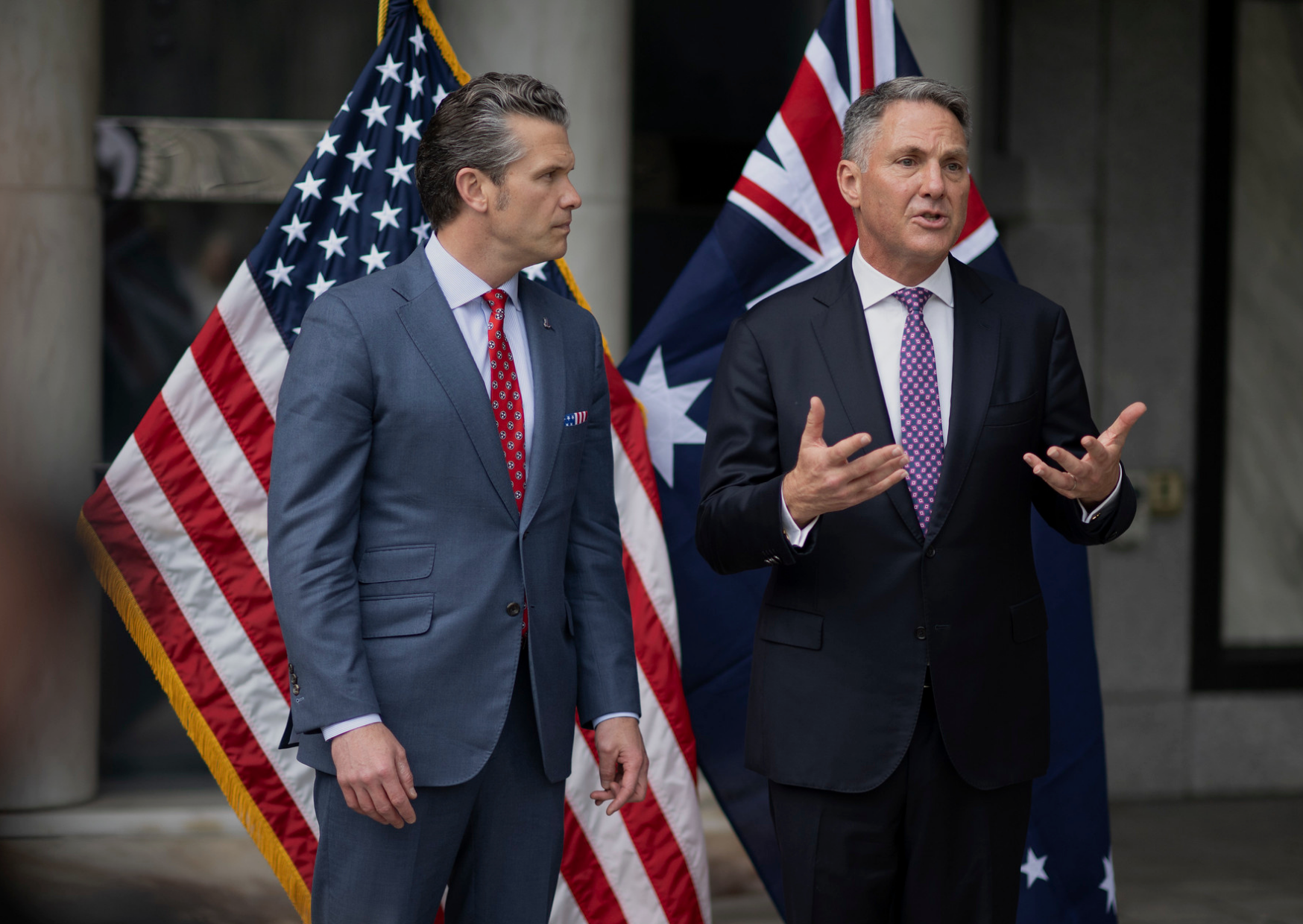
Secretary of War Pete Hegseth meets with Australian Deputy Prime Minister and Minister of Defense Richard Marles. Image credit: Flickr/US Secretary of War.
Meanwhile, a more transactional Washington is reviewing, trimming, and re-litigating its own commitments. That makes AUKUS harder to read as a signal of durable US resolve, even as the Pentagon has formally endorsed it after a five-month long review last year. More positively, however, Japan’s economic-security pivot of FOIP under Takaichi is an honest acknowledgment that its rule-of-law language was never going to reconcile hard-security build-up with Pacific sovereignty claims on its own terms.
A DANGEROUS PRECEDENT FOR PROLIFERATION
Dr Alan J. Kuperman, Associate Professor of Public Affairs, Lyndon B. Johnson School of Public Affairs, University of Texas at Austin, United States.
AUKUS, as currently being implemented, increases risks of nuclear-weapons proliferation in the Indo-Pacific, endangering all three of FOIP’s original goals: peace, stability, and freedom of navigation. That is because the proposed fuel in all the nuclear-powered submarines that Australia would receive is weapons-grade, highly enriched uranium (HEU). Indeed, Australia would receive an amount of such uranium sufficient for dozens of nuclear weapons if diverted, and it would retain this dangerous material forever under the AUKUS agreement.
Nuclear-powered submarines do not actually require weapons-grade uranium and instead can run on non-weapons-usable, low-enriched uranium, as utilised by France and China in their nuclear submarines. Australia would be the first country without nuclear weapons to obtain nuclear submarines, so its use of weapons-grade uranium could also set a dangerous precedent, contrary to the Ocean of Peace Declaration.
At the UN’s Non-Proliferation Treaty review conference in 2022, Indonesia warned that “HEU in the operational status of nuclear naval propulsion” in Australia would endanger “the global non-proliferation regime”. Even US allies — the Netherlands, Norway, and South Korea — implicitly admonished the AUKUS countries, declaring jointly that “efforts to reduce stocks of HEU and to minimise and eventually eliminate the use of HEU are a form of permanent threat reduction”.
Such criticism reflects genuine anxiety that Australia possessing large quantities of HEU could foster the spread of nuclear weapons, endangering past accomplishments including the 1985 Treaty of Rarotonga. A regional nuclear arms race would undoubtedly leave the Indo-Pacific less free and open, threatening both peace and prosperity.
CAN AUKUS OPERATE IN AN ‘OCEAN OF PEACE’?
Joanne Wallis, Professor of International Security and Director of the Stretton Institute for Public Policy, Adelaide University, Australia.
AUKUS exemplifies the challenge Australia faces in its foreign and strategic policy: its interests in the broader Indo-Pacific are not necessarily compatible with those in the Pacific Islands region. The centrepiece of AUKUS is Australia’s acquisition of nuclear-powered submarines, which Canberra sees as critical to its “strategy of denial” to deter conflict and prevent coercion in the context of worsening strategic competition between China and the United States. But so is remaining the “security partner of choice” for Pacific Island countries situated across Australia’s most important sea and air lanes of communication.
This tension is rooted in Pacific Island countries’ longstanding commitment to the South Pacific Nuclear Free Zone, established under the 1985 Treaty of Rarotonga — reflecting the damaging legacy of nuclear testing in the region. Although Australia argues that the AUKUS submarines comply with the treaty, several former Pacific leaders have expressed disappointment that Australia relies on a technical reading of the treaty rather than respecting its anti-nuclear spirit.
AUKUS may also clash with the Pacific’s aspiration to be an “Ocean of Peace”, which Pacific Islands Forum leaders formalised in a 2025 declaration seeking to preserve the region “from acts that undermine peace”. Australia can argue that AUKUS advances that agenda by extending deterrence across the region, but regional sceptics warn that the submarines instead risk “bringing war much closer to home”.
While some degree of incompatibility between Australia’s broader strategic interests and Pacific priorities is inevitable and probably irresolvable, Australia could do more to demonstrate how AUKUS can advance the latter. Most importantly, Australia needs to better convince Pacific Island countries that deterrence is critical to maintaining a free and open Indo-Pacific and a rules-based order that safeguards both their security and prosperity. It could also build trust through greater transparency about submarines operations and nuclear waste disposal, while making progress on the advanced technologies and interoperability envisaged under Pillar II. These could deliver tangible security benefits for the Pacific, such as greater cooperation on maritime surveillance and efforts to combat transnational crime.
DISCLAIMER: All views expressed are those of the writers and do not necessarily represent that of the 9DASHLINE.com platform.
Main image credit: OpenAI.