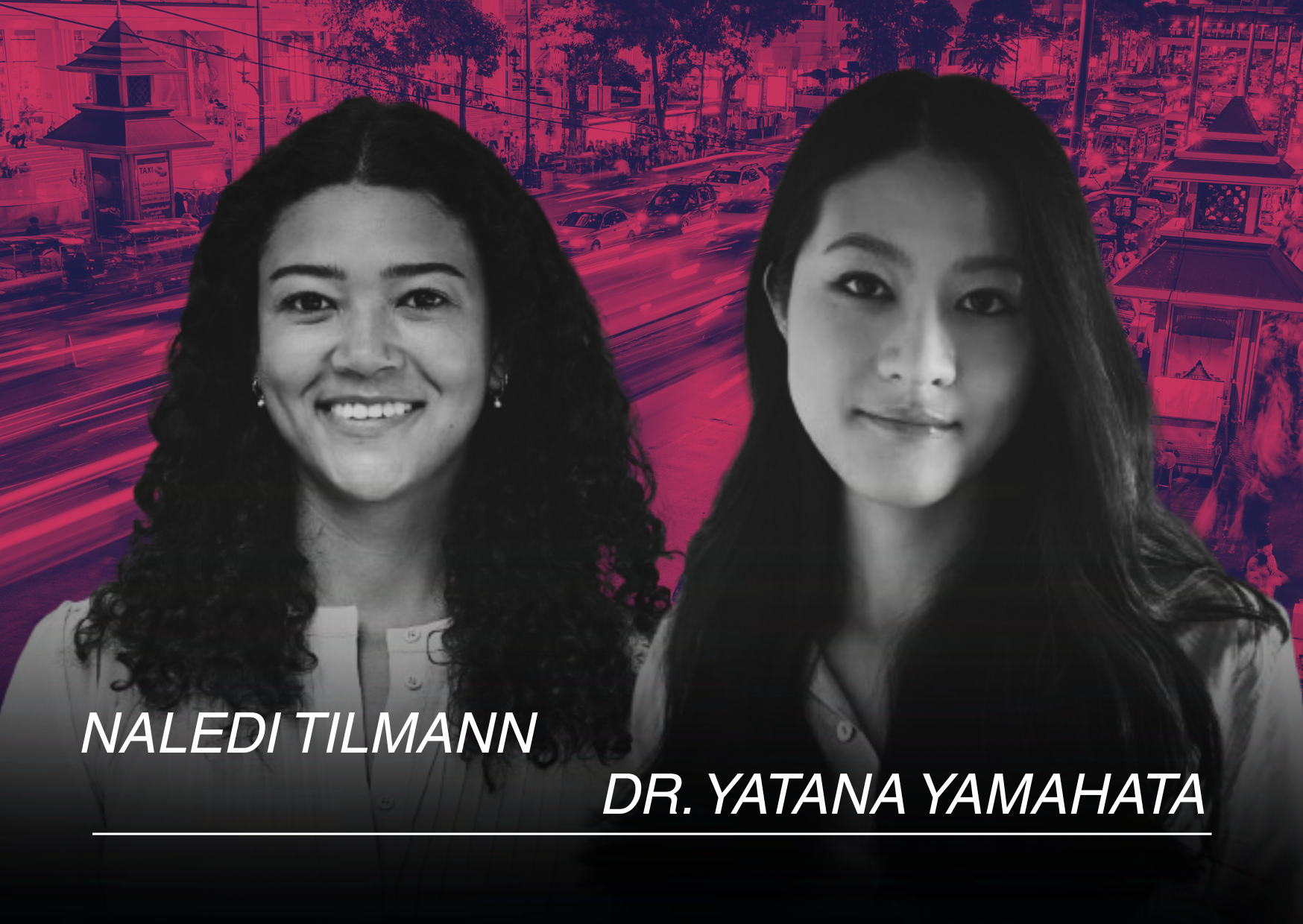
In Brief: Naledi Tilmann and Dr. Yatana Yamahata
16 January 2026
NEW MANAGING EDITOR AND EDITOR-IN-CHIEF
As the Indo-Pacific grapples with a new era of 'hybrid insecurity', the editorial direction of our platform has never been more vital.
In her capacity as Executive Director of Research and Insight, Dr Manali Kumar recently sat down with the new leadership team of our blog — Dr Yatana Yamahata, Editor-in-Chief, and Naledi Tilmann, Managing Editor — to discuss how they plan to sharpen our lens on the region’s most complex drivers.
Moving quickly beyond the ‘noise’ of great power rivalry, they explored their vision for an inclusive 9DASHLINE: one that prioritises the agency of smaller states, spotlights youth-led activism, and examines the growing influence of non-state actors. Follow the highlights of this conversation below to meet our new colleagues and explore key regional flashpoints — from Myanmar’s resistance to the “Asian Century” to others that will define our coverage in the months ahead.
MK: You both bring distinct expertise to the table outside of your editorial roles. What has been your professional journey up to this point, and what motivated you to take on the leadership mantle at 9DASHLINE?
YY: My research so far has focused on how Myanmar and other Asian states navigate the legacies and persistence of authoritarianism, conflict, and mass atrocities. Too often, states and societies in the Indo-Pacific are treated mainly as case studies for theoretical debates or as objects of policy relevance, rather than as sites where issues are created, contested, and resolved in ways that shape theory and policy. 9DASHLINE’s commitment to centering the Indo-Pacific as a space for analysis in its own right strongly resonated with me, and motivated me to take on the role of Editor-in-Chief to help build a more inclusive platform that reflects the region’s diverse perspectives and experiences.
I also have experience editing across different publication platforms, peer reviewing journal articles, and writing book reviews. These roles have trained me to identify original contributions, sharpen arguments, and refine structure so that authors’ ideas are communicated clearly. I find it really rewarding to see how thoughtful editorial work can broaden engagement with complex issues, and I think 9DASHLINE is very successful in making the Indo-Pacific accessible beyond academic and policy circles. I hope to continue this work at the high editorial standard established by the team, while contributing to more accessible knowledge production and dissemination on the Indo-Pacific.
NT: I’ve worked in research and communications roles across international organisations, think tanks, academia, and the private sector, with an academic background in international relations and European foreign and security policy. As a news junkie with a love for writing, I’ve always been drawn to work that helps us make sense of today’s increasingly complex geopolitical landscape — be that through analytical op-eds, policy briefs, or forums for dialogue and cooperation.
My editorial experience spans several student and youth-led publications, as well as a think tank focused on counter-terrorism and counter-extremism issues. As I step into the role of Managing Editor at 9DASHLINE, I am motivated by the exciting challenge of spotlighting such a dynamic region with objectivity and sharp analysis. I’m committed to supporting the platform’s growth and ensuring we continue delivering the timely and relevant insights that our readers rely on.
MK: The Indo-Pacific is a massive and often noisy conceptual space. When you look at the region right now, what do you see as the defining 'under-reported' story or trend?
NT: I think there’s generally a strong focus on great power rivalry in discussions on the Indo-Pacific, but the role of smaller states is often obscured within this framing. Smaller and medium powers — such as Vietnam, South Korea, and the Philippines — are playing an increasingly active role in reshaping the regional order and security dynamics in the Indo-Pacific. Old alliances and dependencies are shifting across the region as states are diversifying their partnerships, supply chains, and looking for greater defence autonomy, especially in the context of ongoing US retrenchment. I’m looking forward to seeing contributors go beyond the traditional lens to explore how smaller and middle powers are adapting to the rapidly changing nature of the Indo-Pacific.
YY: Related to that, discussions about the Indo-Pacific also tend to be framed through state-centric understandings, whether in terms of rivalries between states (e.g. the United States and China), or partnerships among states (e.g. the Quadrilateral Security Dialogue), or organisations of states (e.g. ASEAN). Unfortunately, the growing role of non-state actors is often overlooked. With corporations investing in infrastructure projects and insurgent groups exercising territorial control, it is important to understand how these non-state actors are increasingly connected across borders, such as through youth-led digital activism that has helped spread anti-authoritarian movements. We’re eager to see contributors unpack these dynamics in the Indo-Pacific.
NT: Right. I’m particularly excited to see our contributors engage with ‘the youth’ — we’ve been seeing growing political engagement among young people across the Indo-Pacific, and this is aligned with a global upswing in youth movements. Young people are mobilising to challenge corrupt and authoritarian governments across dozens of countries.
YY: I see this very clearly in Myanmar too, where young people have been a vital force in resisting military authoritarianism. As someone of Burmese origin, I’m particularly drawn to work that examines civilian resistance against the military junta in Myanmar and the extent and limits of international support. I’m also born and raised in Japan, so I’m keen to see contributions that discuss press freedom, gender equality, immigration, and other sociopolitical issues in Japanese society.
MK: I’m so happy to see you both bring fresh energy to 9DASHLINE. How do you see the blog evolving under your leadership? Are there new themes or specific goals you are aiming to tackle in the coming year?
YY: Our main goal is to reinforce 9DASHLINE’s role as a hub for expert analysis on the Indo-Pacific by continuing to ensure our coverage represents the full breadth of the region’s diversity. While great-power competition will remain an important analytical framework, we are excited to deepen the blog’s commitment to centering the agency of states and territories often treated as peripheral. We want to further examine how these actors both shape — and are shaped by — major powers, and how these interactions are reshaping the regional order.
To support this, we encourage contributions that focus on under-represented states and territories, and will continue to amplify voices from students, scholars, and practitioners based in these locations. We look forward to scaling the blog’s coverage to be even more geographically comprehensive, grounded in local expertise and diverse sociopolitical issues that affect the Indo-Pacific beyond great-power competition.
NT: Building on this foundation, we also aim to continue exploring new formats for delivering original and accessible content — such as longer form reports or more interactive mediums that promote dialogue. 9DASHLINE has always strived to remain reliable and relevant by adapting to a rapidly changing world; We see experimenting with new formats and engaging more deeply with our audience as a natural extension of that mission.
MK: To peel back the curtain a bit: What is one book, podcast, or piece of writing on the Indo-Pacific that has significantly shaped your thinking recently?
YY: I recently read a great article looking at how the Pacific Islands continue to be shaped by legacies of colonialism, economic dependencies, and escalating militarisation. It really pushed me to reflect on the contradictions underpinning the vision of a “Free and Open Indo-Pacific”. Some territories continue to operate within political and economic frameworks imposed by ongoing US and French governance, while Indigenous communities in Australia and New Zealand are still living within structures constructed by settler colonialism. For me, this raises critical but necessary questions about how leading actors and partners in the Indo-Pacific sometimes fall short of the very principles they claim to uphold. I think it’s important to keep asking who the Indo-Pacific is free and open for, and whose conceptualisations of peace and security are being prioritised.
NT: That sounds fascinating. I just finished reading Parag Khanna’s “The Future is Asian: Global Order in the Twenty-first Century” — a highly informed, historical and contemporary analysis of the rising influence of Asian countries on the global economy and power structures. Khanna argues that this shift — driven by increased connectivity, innovation, and economic expansion across the region — will define our current century as the “Asian Century”. He also expects a multipolar global order to emerge and for European and American dominance to decline. It was a compelling read and shaped my thinking in terms of emphasising the need to shift away from more traditional framings of global politics, such as the great power rivalry lens I mentioned earlier. Only history will show whether we are truly in the “Asian Century”, but in the meantime, exploring these shifting power dynamics and the ongoing transformation of the Indo-Pacific region drives our work at 9DASHLINE.
MK: Finally, if you had to summarise your mission for 9DASHLINE in a single sentence for a new reader visiting the site today, what would it be?
YY: As a platform bridging the Indo-Pacific and Europe, we would especially like to invite contributions exploring their evolving dynamics and consequences for both traditional and non-traditional security. We also welcome analyses on prominent issues such as climate change, supply chain resilience, and ageing populations, as well as emerging or evolving issues, including rising disinformation and misinformation, identity politics, new technologies, and their impacts on societies and economies across the Indo-Pacific.
NT: This year, we are particularly interested in moving beyond conventional geopolitical analyses to explore socio-political movements challenging authoritarianism, corruption, and colonial legacies. We are especially keen to highlight how youth actors are using leaderless, digital, and everyday forms of organising to redefine political engagement across the region.
END —