Ukraine’s real lesson for Taiwan’s communications resilience

Ukraine’s real lesson for Taiwan’s communications resilience
WRITTEN BY YOU-HAO LAI AND REN-WEI CHANG
16 July 2026
When policymakers ask how Taiwan would maintain communications under grey-zone pressure or military threat from China, the English-language conversation invariably runs in two directions: down to the seabed and up to the sky. One expert’s recent testimony before the US-China Economic and Security Review Commission focused entirely on submarine cable hardening and satellite backup. The US Congress has introduced legislation tying undersea cable security to Taiwan’s national defence. Think tanks have framed Taiwan’s satellite ambitions as “Starlink 2.0” recommended the US provide Low Earth Orbit (LEO) satellite access, and cast satellite communications as “a Plan B” for cable-cutting.
These concerns take lessons from Ukraine’s wartime experience, and rightly so: both cable protection and satellite backup are indispensable to Taiwan’s communications resilience. However, cables and satellites are both ways of reaching the outside world. The conversation has yet to turn inward to Taiwan’s ground network and whether the island can keep essential services running at home when those external links are lost. As an island, more easily cut off from the world, Taiwan’s stakes are higher.
How Ukraine stayed online
To keep critical government records from being destroyed or seized, Ukraine moved its systems onto cloud servers abroad. This was made possible by the Ukrainian parliament’s 2022 adoption of Law No. 7152 authorising the use of foreign servers for public functions under martial law. More than 10 petabytes of data were subsequently migrated from 42 government agencies and other institutions. This model depended on abundant overland connectivity. Ukraine had 18 separate physical routes crossing into neighbouring countries, meaning foreign-hosted services remained reachable even as infrastructure in the war zone was destroyed.
But overland cables were only part of the picture. Ukraine entered the war with an internet architecture that Chatham House described as “unusually complex and decentralised”. Its networks exchanged traffic locally through twenty internet exchange points (IXPs), and its top three internet service providers (ISPs) held only about 33 per cent of market share. The diversity of ISPs and the absence of strict state controls enabled Ukraine to avoid a nationwide internet shutdown despite sustained Russian attacks on telecommunications infrastructure. During the war’s early stages, this allowed domestic traffic to flow between local networks and enabled operators to maintain partial internet functionality in several cities even when connections to the wider internet were severed.
Multinational cloud providers should be included to show that their Taiwan-based nodes can function when cut off from the overseas systems that normally control them. This requirement should be built into government procurement and critical infrastructure audits.
Satellite connectivity complemented a resilient terrestrial internet in Ukraine, but it was not a substitute for one. Starlink undeniably played a vital role for frontline military units and communities whose ground infrastructure had been destroyed. But according to Cloudfare, Starlink carried no more than 0.3 per cent of Ukraine’s internet traffic — and Chatham House warns against overestimating Starlink’s contribution to overall national resilience, noting the risk of concentrating critical connectivity in a single commercial provider. By 2026, Ukraine had restricted Starlink access to officially registered terminals.
Taiwan’s communications challenges
Ukraine’s survival rested on two pillars that had little to do with the seabed or the sky: overland routes that kept it connected to the outside world and a decentralised domestic network that kept traffic moving at home. Taiwan has neither.
Taiwan’s links to the world run almost entirely undersea. As of February 2026, Taiwan had 15 international and 10 domestic undersea cables with no overland alternatives. Near-shore cables are vulnerable to earthquakes and anchor damage from passing vessels, often suspected to be grey-zone disruption. After two cables serving the Matsu Islands were severed in 2023, residents endured 50 days of limited internet access. While Taiwan has since expanded microwave and satellite backup, the Matsu episode shows that backup capacity can preserve priority communications but cannot reproduce normal digital life. If submarine cables are cut or severely congested, off-island services may become unreachable. Taiwan will need to sustain itself on what its domestic network can provide.
Taiwan is not without advantages. The island’s compact territory makes core network links easier to repair than in a continental war zone. But the contrast between Taiwan’s domestic network and Ukraine’s is stark. Taiwan’s top three ISPs account for about 80 per cent of market share, as opposed to 33 per cent in Ukraine. Internet Society Pulse lists only seven active IXPs compared to Ukraine’s 20. Five of those are in Taipei, while Ukraine’s exchange points are spread across multiple cities.
The risk is not hypothetical: a 2013 data-centre fire at a single Taipei interconnection facility disrupted the majority of Taiwan’s international internet traffic for over 12 hours. Concentration is not necessarily a failure. In a crisis, however, it reduces the number of independent paths and local fallbacks available when normal routing assumptions break.
The most critical concern, then, is the operability of everyday services. A 2026 test of 1,859 commonly used websites in Taiwan found that 47 per cent depended directly on overseas infrastructure, while another 42.3 per cent relied on multinational cloud nodes located on the island. Yet the actual operability of these on-island nodes in a cable-cut scenario remains highly uncertain, since the systems that verify logins, manage requests, and hold underlying data may still depend on systems abroad. Only 10.7 per cent showed no overseas dependency; in other words, nearly nine in ten commonly used services were either high-risk or high-uncertainty.
This is not an argument against global cloud providers; their Taiwan-based nodes may be vital to resilience. But the relevant test is not whether a service has a node in Taiwan. It is whether the full user journey, from login to payment to notification, can complete locally under stress.
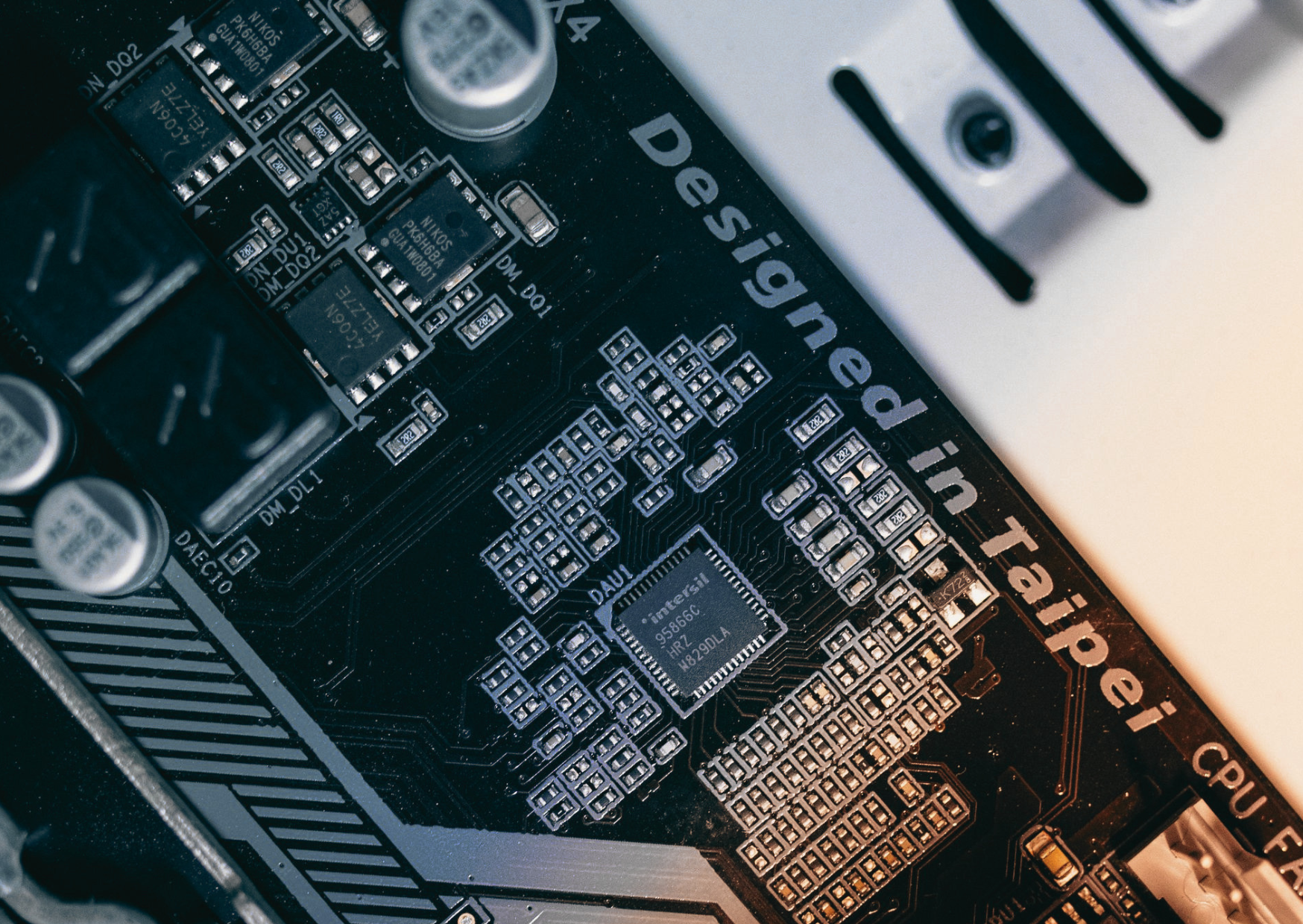
Motherboard and circuits designed in Taipei. Image credit: Pexels/Jonathan Borba.
LINE shows the stakes of resiliency. With 22 million monthly active users and over 93 per cent market penetration, LINE is more than a messaging app in Taiwan. It is how legislators reach constituents, how local governments push emergency alerts, and how families stay connected. Yet LINE depends on servers in Japan. In a Ministry of Digital Affairs discussion, then-Minister Audrey Tang warned that even a video call between two users inside Taiwan may require a metadata handshake through foreign servers before the call can begin. In a submarine cable outage, the call simply would not connect.
This dynamic complicates the use of satellite as backup in the event of a cable outage. If domestic coordination tools require foreign metadata paths, Taiwan would be forced to spend scarce satellite bandwidth initiating domestic conversations. The alternative is what Tang called “local resilience”: domestic communications should remain domestic so that satellite capacity can be reserved for what only satellites can do — maintaining Taiwan’s essential connections to the outside world.
Putting domestic operability on the agenda
Domestic operability remains largely absent from the English-language policy conversation, which still asks whether Taiwan can protect its cables, deploy more satellites, or replicate government functions abroad. Yet this is a design choice Taiwan must make in advance, not one it can discover under pressure — Taiwan’s policymakers are already moving in this direction. The government has built a public-service internet exchange point, tested disaster roaming with major telecom providers, and articulated a “diverse and heterogeneous” communications resilience strategy covering land, sea, and sky — a framework Taiwan’s current leadership continues to advance.
To build on these efforts, Taiwan should adopt three measures. First, it should conduct a national cable-cut operability review for critical and commonly used services. The review should go beyond hosting location and test whether full user workflows can complete locally while mapping dependencies on foreign backend systems.
Second, it should require critical services to conduct regular “local mode” exercises, demonstrating that they can provide defined minimum functions when international networks are unreachable. Multinational cloud providers should be included to show that their Taiwan-based nodes can function when cut off from the overseas systems that normally control them. This requirement should be built into government procurement and critical infrastructure audits.
Third, it should treat domestic IXP resilience as national-security infrastructure. IXPs are where domestic traffic stays domestic. In Ukraine, this kind of local traffic exchange helped maintain partial connectivity in besieged cities when upstream links were disrupted. If domestic traffic routinely transits overseas in peacetime, rerouting it locally under crisis will be far costlier than building local exchange capacity in advance.
If Ukraine’s experience has a lesson to teach, it is that communications resilience is a system. Protecting undersea cables and building satellite backup are essential parts of that system. So is ensuring domestic digital infrastructure can sustain the daily life of twenty-three million people when international connectivity is lost. Doing so requires policymakers to look not only to the sea and sky, but to the systems and infrastructure on the ground.
DISCLAIMER: All views expressed are those of the writer and do not necessarily represent those of the 9DASHLINE.com platform.
Author biographies
You-Hao Lai is Deputy Director of the Democratic Governance Program at the Research Institute for Democracy, Society, and Emerging Technology (DSET), a Taiwanese think tank, where his research spans cybersecurity, data governance, platform regulation, and foreign information manipulation and interference (FIMI) in the Indo-Pacific. He is an S.J.D. candidate at the George Washington University Law School and holds an LL.M. from Harvard Law School.
Ren-Wei Chang is an Adjunct Research Fellow at DSET. He is currently a Ph.D. student at the Institute of Sociology, National Tsing Hua University. His research focuses on the development of digital resilience and cybersecurity policy in the context of geopolitical conflict, and he has designed tabletop exercises on this theme for government agencies and international partners. Image credit: Pexels/H&CO.