Keeping the door open: Rethinking Washington’s approach to North Korea and denuclearisation
keeping the door open: rethinking washington’s approach to
north korea and denuclearisation
WRITTEN BY HANS HORAN
22 April 2026
In late February 2026, during a speech at North Korea’s Ninth Party Congress, Supreme Leader Kim Jong-un declared that denuclearisation “can never happen” and that the country’s nuclear capabilities were “irreversible and permanent”. Kim went on to say that “If the United States drops the absurd obsession with denuclearising us [North Korea] and accepts reality, and wants genuine peaceful coexistence, there is no reason for us not to sit down with the United States”.
Kim’s comments have led many North Korea experts to assume that Pyongyang is willing to re-engage Washington in dialogue, but with a key caveat: denuclearisation is not to be discussed. While denuclearisation was excluded from both US President Donald Trump’s latest National Security Strategy and the National Defence Strategy, in contrast with previous years, Pyongyang is fully aware that Washington and, more importantly, Trump’s policy of “complete denuclearisation” of North Korea has likely not changed.
This puts US policymakers and the White House in a tricky situation. On the one hand, they want to re-engage North Korea (DPRK); on the other, they are acutely aware that their main negotiation point has become a non-starter.
In this regard, it is correct to assume that US-DPRK dialogue is no longer possible in the current negotiating environment with denuclearisation as a prerequisite. However, if the Trump administration wishes to resume diplomacy with North Korea on its terms, it will need to fundamentally reassess the factors that previously made denuclearisation negotiations with Washington attractive. This requires examining what has changed since then, and how diplomatic dialogue might be sustained while waiting for the situation to shift in its favour.
US-DPRK dialogue: historical context vs today
First, it is important to understand that Pyongyang has historically sought diplomatic dialogue with the US during periods of significant socio-economic stress. In the wake of the Cold War, Pyongyang became increasingly economically and ideologically isolated as the Communist Bloc collapsed and China opened to international markets. This resulted in the collapse of the DPRK’s socialist command economy and the famine of the 1990s, commonly known as the “Arduous March”.
While such dialogue should not be entered into naively, persistent and earnest engagement would allow Washington to proceed cautiously and slowly transform its relationship with the regime in a sustainable fashion that benefits both parties.
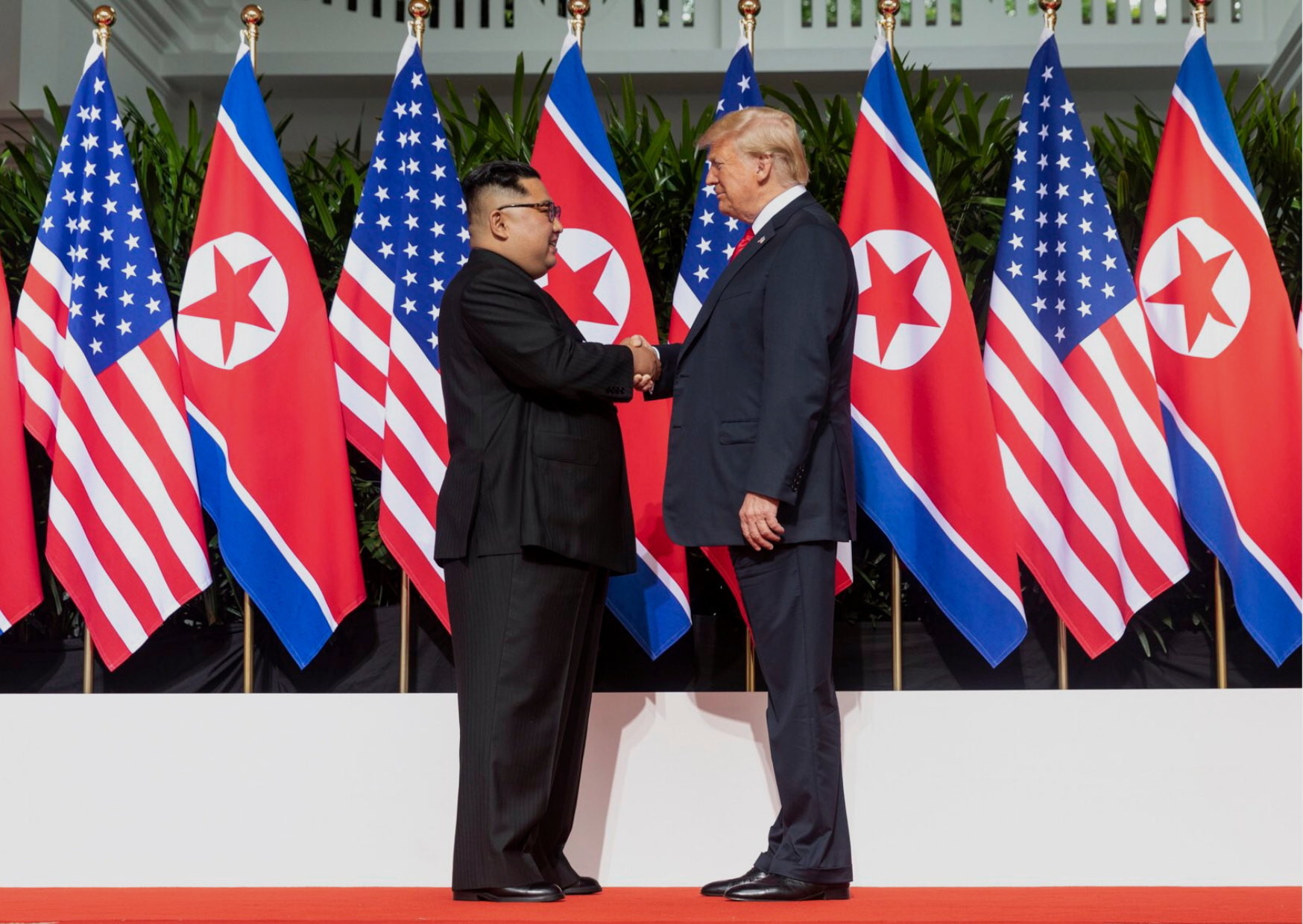
Following the end of the Cold War and the loss of its support structures, alongside growing pressure arising from its developing nuclear programme, Pyongyang began seeking regular diplomatic dialogue with Washington. In the preceding years, the DPRK's tendency to remain open to diplomatic dialogue and signing agreements with the US was due to these continued socio-economic and security pressures. For example, North Korea signed the 1994 Agreed Framework with then-US President Bill Clinton’s administration after Washington reportedly “deliberated striking North Korea’s fledgling nuclear facility”. More recent examples include Pyongyang’s signing of the short-lived 2012 "Leap Day" deal with the Obama administration after the fall of the Gaddafi regime, as well as the flurry of US-DPRK summits that followed Trump’s “fire and fury” rhetoric toward Kim Jong-un.
Evidently, Pyongyang’s structural weaknesses (economic or otherwise) made it more willing to engage with Washington to lessen the potential repercussions from the White House. Joel Wit, senior fellow at the Stimson Center, notes in his book, Fallout: The Inside Story of America’s Failure to Disarm North Korea, that Pyongyang appeared at times to have genuinely wanted to negotiate a denuclearisation deal with the US, in exchange for economic and political concessions, such as the phased lifting of UN sanctions.
Wit also notes that North Korea showed a willingness to compromise at times and was frustrated by Washington’s stance that Pyongyang needed to fully denuclearise before it would receive any sanctions relief. For example, during the 2019 Hanoi summit, then-DPRK negotiator Choe Son-hui noted that they only wanted the sanctions lifted that “hurt the livelihood of their people” and that they would be willing to accept “snap back sanctions” that could be reimposed if Pyongyang did not fulfil its end of the deal. In the same vein, Choe noted that “Chairman Kim doesn’t understand your [Washington’s] method of calculation”, underscoring Pyongyang’s confusion as to why Washington would not lift the sanctions they requested.
However, more hawkish US policymakers and North Korea watchers dismissed such concessions, claiming that the DPRK was merely using negotiations and agreements as stop-gaps to buy time to further develop its nuclear deterrent. Nevertheless, Pyongyang’s warming relations with Beijing and Moscow have since weakened Washington’s leverage to prompt Pyongyang to resume denuclearisation dialogue. Warming Sino-DPRK relations have supported Pyongyang economically. Most notably, trade between the two parties nearly returned to pre-pandemic levels in 2025, with DPRK exports to China reaching USD 257.4 million in December 2025.
Moreover, the DPRK’s growing trade and military cooperation with Russia in the wake of its 2022 invasion of Ukraine has provided Pyongyang with a strategic economic and military boon. According to the South Korean Institute for National Security Strategy, Pyongyang generated between USD 7.67 billion and 14.4 billion from troop deployments and arms exports supporting Russia’s war in Ukraine.
While it is hard to quantify the full impact that North Korea’s aid to Russia has had on its war in Ukraine, the UN Security Council estimated that it has had a “significant contribution”. Such deepening cooperation likely provides Kim with the necessary support to reject Washington’s overtures to restart negotiations on the US’ terms.
Russia and North Korea: a relationship waiting for divergence?
While these partnerships have given Pyongyang the strength to rebuff Washington’s denuclearisation dialogue attempts, the DPRK’s newfound ability to do so rests on the laurels of its relationship with Russia. This presents significant strategic uncertainty about the longevity of the Russo-DPRK relationship, as it can currently be categorised as a marriage of convenience built upon mutual desperation and opportunity rather than deep, long-term strategic alignment. Indeed, Russia is provided with cheap arms, soldiers, and labour to aid its war efforts in Ukraine, while Pyongyang gets much-needed capital, technology exchanges, a security guarantee, and the ability to acquire battlefield experience that the Korean People’s Army (KPA) lacks.
Therefore, while Russo-DPRK relations are at their highest level in years, there remains a strong likelihood that this alliance could cool once the Russo-Ukraine war ends. Daniel R. DePeris, fellow at Defence Priorities, observes, “when the war does end, and it will eventually end, the commonalities now binding Moscow and Pyongyang could give way to divergences”. This divergence is reinforced by uncertainty over whether Moscow would be willing or able to commit the same level of support to Pyongyang in the event of its own escalation, given the likely resource constraints and troop fatigue in a post-Ukraine scenario.
The perils of strategic ambiguity and importance of continued engagement
Washington’s North Korea policy is currently missing a thorough, well-formulated plan vis-à-vis this expected divergence. Former National Security Council chief of staff Fred Fleitz said in early April 2026 that he “believes there’s a good chance of a Trump-Kim summit this fall”. However, there is now considerable uncertainty surrounding Trump’s policy stance towards North Korea. While a summit would be a step in the right direction, the current strategic policy ambiguity between the two parties poses a serious risk of miscalculation regarding each other’s intentions.
This is why Trump and his team should not walk into any potential summit assuming that they will (a) start off on the same footing they had at the end of his first presidency, or (b) sign a deal immediately or push the denuclearisation envelope after only a few meetings. Indeed, so long as the Russo-DPRK alliance remains firmly aligned with its congruent strategic objectives, there is a low likelihood that Pyongyang will acquiesce to Washington's more hawkish demands.
Therefore, it is more in Washington’s strategic interest to maintain proactive, frequent dialogue with Pyongyang on areas such as increased US-DPRK-ROK economic cooperation, both to lessen Moscow and Beijing’s influence over Pyongyang and to ensure it can capitalise on opportunities should cracks appear in the Pyongyang-Moscow alignment. This likely means that talks of denuclearisation will need to be temporarily shelved until this moment appears (which could be years away), as any attempts to broach the topic earlier could result in a breakdown of communications similar to that which followed the failed 2019 Hanoi summit.
The most challenging aspect of this policy shift will likely be that both sides need to be willing to show good-faith signs and overlook potential lapses, within reasonable limits, to allow conversations to continue into the future. Indeed, Joel Wit noted in his book that many of the US-DPRK deals ultimately failed because of a mismatch of expectations between Washington’s desire for immediate concessions, North Korea’s desire for a phased arms reduction and consecutive economic boon, and the inherent mistrust between the two countries due to continued hostile policies towards each other.
As David C. Kang of the University of Southern California asks in Nuclear North Korea, co-authored with Victor Cha of the Center for Strategic and International Studies, “why are we afraid of dealing with the North?”. If there is no intention of starting a war in Northeast Asia, greater willingness to engage Pyongyang is needed to sustain negotiations and conclude a mutually beneficial deal while strengthening security guarantees in the Indo-Pacific.
While such dialogue should not be entered into naively, persistent and earnest engagement would allow Washington to proceed cautiously and slowly transform its relationship with the regime in a sustainable fashion that benefits both parties. This dialogue could even entail a partial recognition of Pyongyang as a “nuclear-enabled state”. Such a move would trade a potential escalation in tensions for a “cold peace”, enabling the US and its allies to capitalise on (and potentially even proactively influence) weakened Sino-Russo-DPRK ties to bring Pyongyang back to the negotiation table and lower the threat of nuclear escalation in the Indo-Pacific region.
DISCLAIMER: All views expressed are those of the writers and do not necessarily represent those of the 9DASHLINE.com platform.
Author biography
Hans Horan is a strategic analyst at the Hague Centre for Strategic Studies, specialising in the Indo-Pacific, cyber threat intelligence, and security and defence affairs. Prior to joining HCSS, Hans worked for over seven years in the intelligence and security industry for both private and public sector organisations across the globe, where he served as their lead cyber intelligence and principal Asia-Pacific analyst. Hans advised a number of both private and public sector clients during this time on how to navigate growing geopolitical tensions and minimise the impact on their business operations.
Hans regularly publishes with renowned international current affairs magazines and news outlets, such as The Diplomat and NK News, and think tanks, such as Stimson Center’s 38 North Department, on defence and security trends. Outside of HCSS, Hans is also a non-resident fellow at the European Centre for North Korean Studies. Image credit: Shealah Craighead/Wikimedia Commons.