Grey-zone drones: Lessons for Europe from the Indo-Pacific
Grey-zone drones: lessons For Europe from the Indo-Pacific
WRITTEN BY THIJS STEGEMAN
2 April 2026
In the autumn of 2025, suspected Russian drones appeared above NATO countries, raising alarm across Europe. The most audacious incident involved more than a dozen Shahed-style unmanned aerial vehicles (UAVs) crossing into Polish territory, several of which NATO fighter jets intercepted. Elsewhere, unauthorised drone activity forced two Danish airports to temporarily shut down. Similar incidents involving unidentified UAVs were reported near sensitive military and infrastructure sites in the Baltic states, Germany, France, Belgium, and Italy. Although definitive attribution is difficult, the timing and clustering of these incidents suggest a deliberate effort to use drones as a grey-zone tool of interference: a reminder that Russia’s interference is not limited to Ukraine.
This pattern closely resembles China’s drone-enabled grey-zone activities since 2022, targeting Taiwan and disputed areas in the East and South China Seas. These unmanned intrusions likely probe military responses, complicate political decision-making, and signal displeasure with military or political developments. The timing and similarities between the campaigns indicate, at a minimum, mutual inspiration — and potentially institutional cross-learning — between the Russian and Chinese militaries. Europe, in turn, can draw lessons from how Indo-Pacific states have responded.
Taiwan’s outlying islands
Taiwan has been the main target of China’s grey-zone harassment, as the Chinese Communist Party (CCP) regards the island as part of China and applies political and military pressure to compel acquiescence. Since then-US Speaker of the House Nancy Pelosi’s visit in August 2022, the CCP has incorporated drones into these tactics. Initially, civilian UAVs appeared over Taiwan’s outlying islands, but combat drones soon followed, culminating in a flight over Taiwanese-controlled Pratas (Tungsha) Island in the South China Sea in early 2026.
Europe must communicate clear thresholds and move forward with its own integrated drone defence, or risk allowing Russia’s grey-zone drone activity to become the new normal.
Around the time of Pelosi’s visit and the subsequent People’s Liberation Army (PLA) Navy exercises near Taiwan, multiple civilian drones flew sorties over Kinmen Island, which lies just two kilometres off the mainland coast. Definitive attribution was difficult, as some flights appeared to be civilian-operated. The CCP nonetheless seized on these incidents to argue that Taiwan was unable to protect its own airspace and to reinforce its claim that Taiwan is part of China.
The incidents triggered tensions between Taiwan and China. Taiwanese soldiers were recorded throwing rocks at a drone, drawing ridicule from mainland commentators and backlash in Taiwan. Meanwhile, a Chinese vlogger filmed himself dropping food on the beach of Kinmen. After the first footage was made public, then-President Tsai Ying-Wen “ordered the Ministry of National Defence to take necessary and strong countermeasures”. On 1 September 2022, Taiwanese soldiers shot down a drone above Kinmen for the first time. Two days later, Xiamen instituted a 10-day ban on drones and tightened controls on civilian drones. Since then, drone reports above Kinmen have largely ceased. In 2024, a single civilian-operated drone dropped leaflets above the outlying island, but no further incidents were recorded.
Since 2022, Taiwan has prioritised drone defence on its vulnerable outlying islands, equipping soldiers with anti-drone jammer guns and procuring 26 domestically developed anti-drone countermeasure systems in 2025 for deployment on the outlying islands and near strategic airports and ports. While these initial steps seemed successful, the PLA has since increased its use of military-grade UAVs. In April 2023, a TB-001 “Twin-Tailed Scorpion” combat drone circled Taiwan’s main island, and in January 2026, a Chinese reconnaissance drone flew over Pratas Island.
The East China Sea
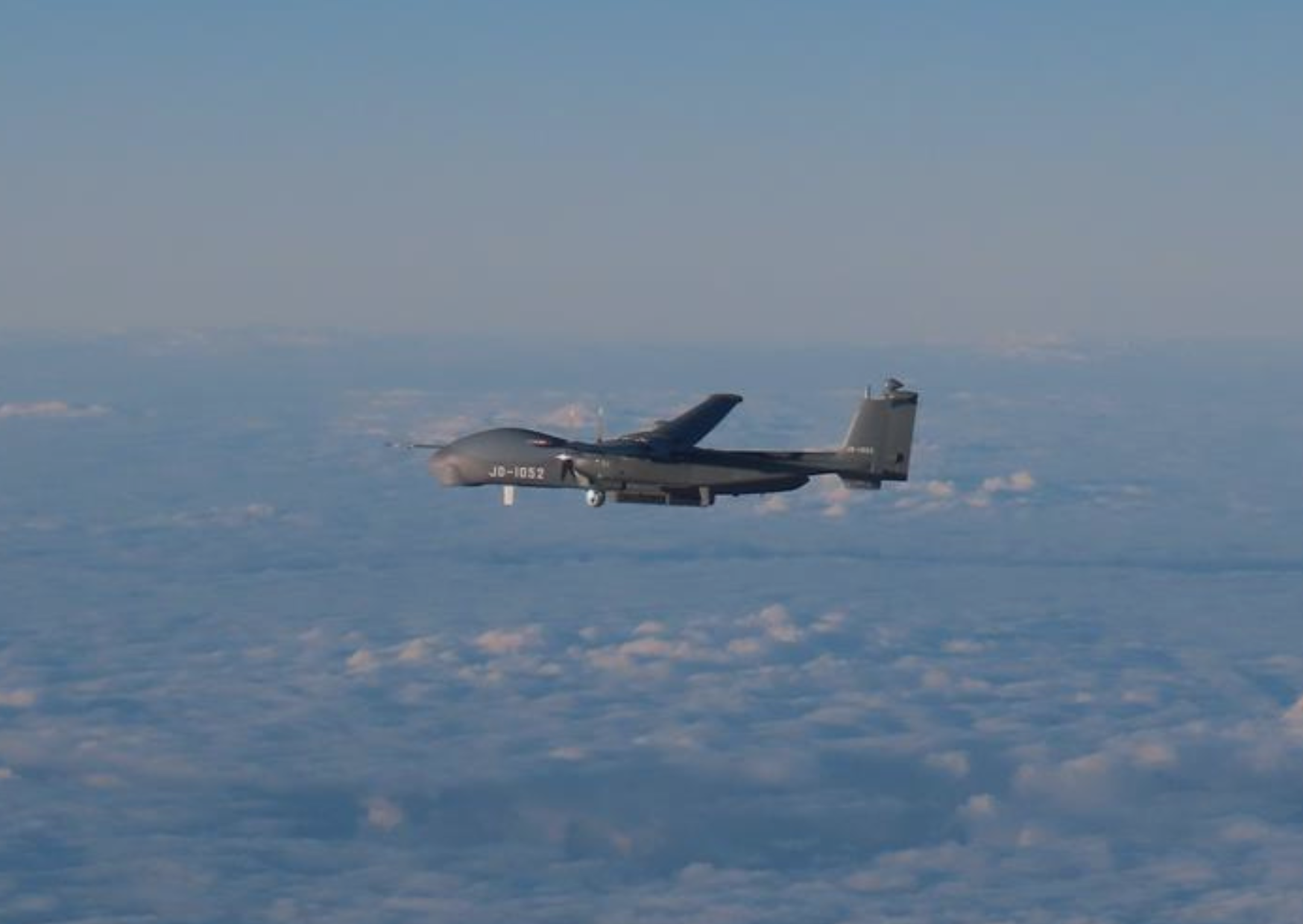
Japan has faced a similar surge in Chinese military UAVs probing its defences around islands in the East China Sea, including the disputed Senkaku/Diaoyu Islands and others close to Taiwan, with most sightings near Okinawa and the Miyako Strait. Although none of the drone intrusions crossed into Japanese territorial airspace, they were likely intended to test and strain Japan’s military readiness.
Between March 2024 and April 2025, the Japan Self-Defense Forces scrambled fighter jets 23 times to intercept presumed Chinese drones within its air defence identification zone (ADIZ). The 2024 figure was the highest on record and equalled the total number of scrambles in all previous years combined. Japan’s Ministry of Defence (MOD) had already warned of China’s increased UAV deployment in its 2023 Defence White Paper.
In response, Japan’s military leadership reinterpreted the Self-Defence Forces Law to make it easier to shoot down UAVs. In February 2023, the MOD stated that “weapons may be used even in cases that do not fall under legitimate self-defense or emergency evacuation,” as is the case for hostile manned aircraft. This became government policy in June 2025.
At the same time, Japan strengthened its own capabilities. It accelerated the procurement of long-range drones for airspace patrol and detection of foreign UAVs, while investing in low-cost hard-kill countermeasures. In March 2026, Japan announced the SHIELD defense system, which will include Ukrainian drone interceptors and maritime drones. A military official explained that “if we just keep the conventional way of combat, we’ll be left behind”.
The South China Sea
In the disputed waters of the South China Sea, including areas within Philippine territorial waters, fishermen have recovered multiple Chinese unmanned underwater vehicles (UUVs). Though unarmed, these devices were equipped with oceanographic sensors to map the ocean floor, potentially supporting submarine navigation and other military purposes. Since 2022, the Philippine Coast Guard has recovered at least six Chinese-origin UUVs. While the Coast Guard listed these incidents and their locations in 2025, they had not previously been publicised. Most retrieved UUVs are confirmed to be, or closely resemble, the PLA-adopted “Sea Wing” glider, which, when deployed in larger numbers, could support submarine detection and tracking. In another instance, a Wing Loong-2 surveillance drone was spotted changing its transponder signal to appear as a Belarusian cargo plane while flying above the South China Sea.
China has also deployed drones near Vietnam. In August 2024, as Vietnam prepared for joint coast guard drills with the Philippines, the PLA Wing Loong-10 — a high-altitude, long-range drone — flew two sorties along Vietnam’s eastern coast just outside its territorial waters. During its first sortie, it did not switch off its transponder, indicating that it was intended to be noticed. Unlike Japan and Taiwan, Vietnam did not scramble fighter jets or publicly condemn the operation.
While Vietnam chose to maintain a low profile, the Philippine Navy and Coast Guard have increased cooperation with international partners in response. The US and Japan have both supplied the Philippines with advanced radar installations to improve its maritime domain awareness (MDA) capabilities. At the Philippines’ request, the US has also temporarily stationed an MQ-9A Reaper drone squadron to provide round-the-clock overwatch of the South China Sea. Although the Philippines lack the resources of Taiwan and Japan to deter drone intrusions, it has effectively leveraged its partnerships with the US and Japan to complement its own capabilities.
Lessons for Europe
As Russia’s war in Ukraine enters its fifth year, Europe must adapt to Russia’s growing use of grey-zone activities. That does not mean that Europe has remained static. Following the drone incidents at a Danish airport, French commandos boarded a tanker suspected of serving as a “mothership” for the drones, and NATO launched Operation Eastern Sentry, deploying additional fighter jets to reinforce its eastern flank. The European Commission also proposed a “drone wall” to strengthen air defence across the EU, although the initiative later became mired in political disputes.
Despite these measures, NATO’s policy response to Russian drone activity has remained largely implicit. Engagement decisions are taken at the national level, resulting in an opaque patchwork of thresholds. NATO aircraft shot down several drones over Poland, but an incident over Romania was handled in a different way. While the alliance condemned the intrusions, it stopped short of drawing clear red lines. This ambiguity creates exactly the uncertainty in which grey-zone activities thrive.
The experience of Indo-Pacific states suggests a different approach, centred on the three pillars of deterrence: communication, capability, and credibility. Taiwan communicated early and effectively how it would respond to future drone intrusions around its outlying islands, publicly outlining an escalation ladder: “warning, flare, shoot down”. By clearly signalling both attribution and consequences, Taiwan reduced the ambiguity that grey-zone tactics seek to exploit.
Japan not only publicly communicated how it would handle intrusions, but it also improved detection and interception capabilities. It accelerated the procurement of surveillance drones and signed a partnership with Ukraine to help develop interceptor and maritime drones for its SHIELD defence system. While the EU's “drone wall” has stalled, Japan is moving ahead.
The Philippines overcame its credibility gap by collaborating more closely with the US and Japan. It incorporated these capabilities to improve maritime domain awareness and hosted the US MQ-9 drone deployment for persistent surveillance. By embedding allied capabilities, Manila signalled that it is backed by international support.
Together, these cases illustrate a consistent strategy: communicate clear consequences, build the capability to enforce them, and ensure those commitments are credible. Europe must communicate clear thresholds and move forward with its own integrated drone defence, or risk allowing Russia’s grey-zone drone activity to become the new normal.
DISCLAIMER: All views expressed are those of the writers and do not necessarily represent those of the 9DASHLINE.com platform.
Author biography
Thijs Stegeman is a PhD candidate at NDHU in Taiwan, focused on China’s regional foreign policy and cross-strait relations. Image credit: Wikimedia Commons/Japan Ministry of Defense.